
Messier 44, also known as the Beehive Cluster or Praesepe, is an open cluster of stars in the constellation Cancer.
Civilizations have watched the Beehive climb high on late winter nights for thousands of years. From Ptolemy describing M44 as a “nebulous mass in the breast of cancer” to Chinese astronomers calling it a “cloud of pollen,” the Beehive has held the attention of skywatchers over the ages.1 From darker skies, it’s visible as a hazy patch. From suburban skies, the cluster makes an excellent target for binoculars or any telescope.
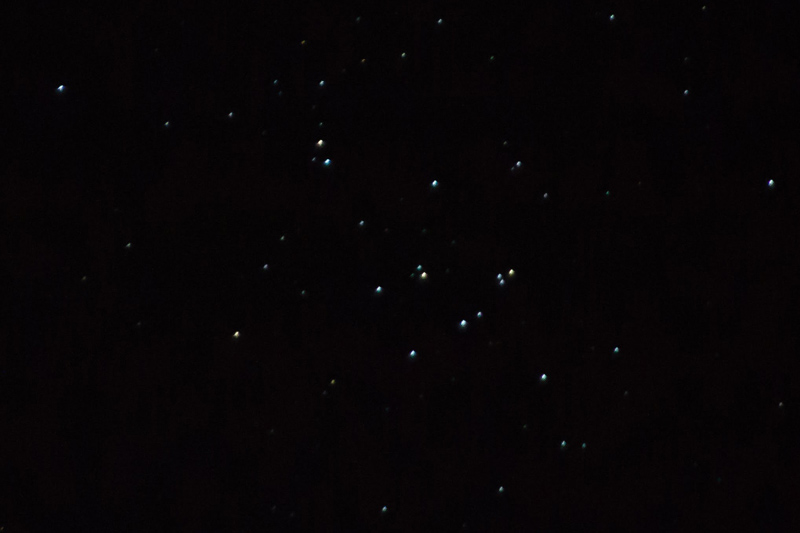
One of the most striking features of Messier 44 is its sheer size and beauty. It is easily visible to the naked eye as a faint, fuzzy patch of light from darker locations. With a small telescope or binoculars, its individual stars become visible, and the cluster takes on a spectacular appearance. It is an ideal target for astrophotographers, which can capture its beauty in stunning detail. The stars of Messier 44 are primarily yellow and orange in color, with a smattering of blue-white stars sprinkled throughout. The cluster is also surrounded by a faint haze of gas and dust, which gives it a soft bluish glow.
As you spy M44 with your binoculars or telescope, just think: you are looking at one of the nearest open clusters to Earth, with a distance of around 520-610 light-years.
My Observations of M44
| Date | March 21, 2023 |
| Time | 10:45 p.m. |
| Location | Seattle, WA |
| Magnification | 169x |
| Scope | Meade 8″ SCT |
| Eyepiece | 12mm |
| Seeing | Average |
| Transparency | Average |
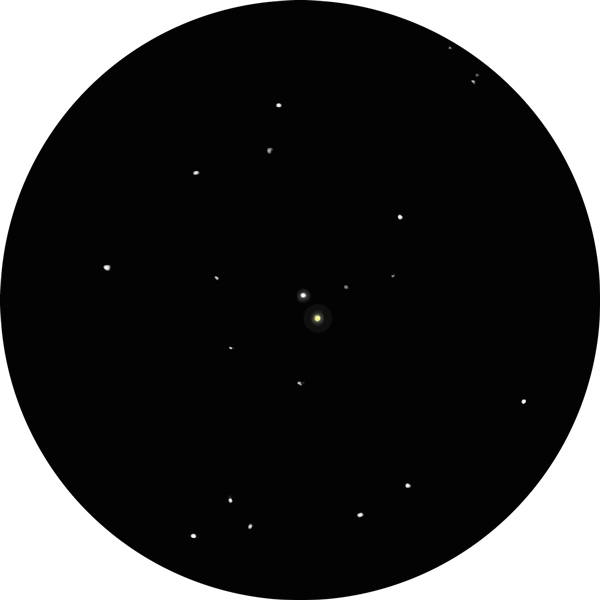
As with my observation back in 2021, I end my night observing M44. A chilly breeze from the north is prompting me to close up shop. I need to start my evening sometime with the Beehive and take ample time to let its beauty seep in. Looking at it tonight, I’m enjoying its mix of various colored stars, along with the brilliant orangish star in the center of my eyepiece. I decided to “zoom in” and use a 12mm for tonight, and I love the contrast of the center orange star with several of the surrounding dots of blue and white. Goodnight, Praesepe. Thank you for letting me visit.

| Date | February 9, 2021 |
| Time | 8:45 p.m. |
| Location | Seattle, WA |
| Magnification | 85x |
| Scope | Meade 8″ SCT |
| Eyepiece | 24mm |
| Seeing | Average |
| Transparency | Average |
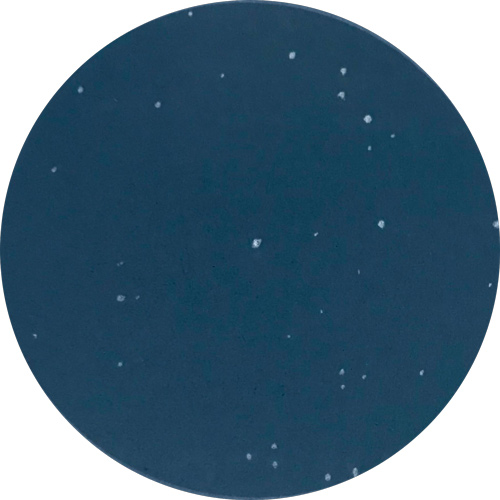
Tonight, I’ve been fighting against random puffs of clouds appearing and miraculously disappearing. A rare major snowstorm is approaching the Seattle area, and it has been many weeks since I’ve had a clear night with little to no moon. I was ready to pack up the scope when I decided to turn it toward M44, knowing that out of any object in my mixed hazy sky, this cluster would break through. I don’t own a lower eyepiece than 24mm at this time, so I’m not able to view the entire cluster. However, this “closer” view brings up the brightest stars (in pairs and trios) beautifully.
Key Stats
| Constellation | Cancer |
| Best Viewing | Late Winter / Spring |
| Visual Magnitude | +3.1 |
| Absolute Magnitude | -3.27 |
| Distance from Earth | 600 ly |
| Diameter | 12.4 ly |
| Apparent Size | 70 arcmin |
| My Viewing Grade | A |
| Designations | M44, NGC 2632, Cr 189, Praesepe |
Historical Observations
Aratos (260 B.C.)
Watch, too, the Manger. Like a faint mist in the North, it plays the guide beneath Cancer. Around it are borne two faintly gleaming stars, not far apart nor very near but distant to the view a cubit.s length, one on the North, while the other looks towards the South. They are called the Asses [in the constellation Cancer], and between them is the Manger. On a sudden, when all the sky is clear, the Manger wholly disappears, while the stars that go on either side seem nearer drawn to one another: not slight then is the storm with which the fields are deluged. If the Manger darken and both stars remain unaltered, they herald rain. But if the Ass to the North of the Manger shine feebly through a faint mist, while the Southern Ass is gleaming bright, expect wind from the South: but if in turn the Southern Ass is cloudy and the Northern bright, watch for the North wind.2
March 4, 1769, observation by Charles Messier
At simple view [with the naked eye], one sees in Cancer a considerable nebulosity: this is nothing but a cluster of many stars which one distinguishes very well with the help of telescopes, & these stars are mixed up at simple view [to the unaided eye] because of their great proximity.2
Sources
Photo of M44 by Stuart Heggie and licensed under the Creative Commons Attribution-Share Alike 4.0 International license.
1 “Beehive Cluster.” Wikipedia, Wikimedia Foundation, March 11. 2023, en.wikipedia.org/wiki/Beehive_Cluster. Accessed March 23 2023.
2 Guy McArthur, Hartmut Frommert. “Messier 44.” Messier Object 44, http://www.messier.seds.org/m/m044.html.
Sketches by Wayne McGraw
 The Garden Astronomer
3 thoughts on “Messier 44 (NGC 2632): A Swarm of Bees in Cancer”