
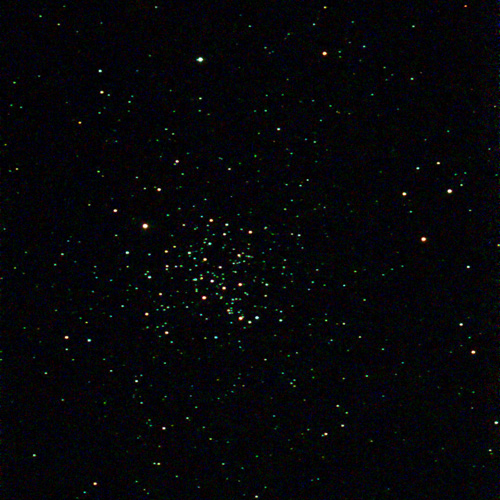
Messier 67, also known as the King Cobra cluster or NGC 2682, is an open star cluster in the constellation of cancer. It’s best viewed in late winter and early spring. It is one of the oldest known star clusters and contains more than 500 stars!
At about 2,600 light-years away from Earth and with a diameter of about 20 light-years, the cluster is relatively nearby and easy to observe, making it a popular target for amateur astronomers. One can see it with binoculars, though a telescope brings out individual stars better. What’s more, the cluster shines down from 1,500 light-years above the plane of the galaxy. So the next time you’re viewing it, just think: you are staring at an object “floating” above the arms of the galaxy.
M67 is also interesting to astronomers because it is a relatively unevolved cluster, meaning that its stars have not undergone significant chemical evolution and can provide important insights into the early stages of stellar evolution.1
Historically speaking, the astronomer Johann Gottfried Koehler discovered M67 in 1779 and added to Charles Messier’s catalog in 1780.
My Observations
| Date | March 21, 2023 |
| Time | 10:15 p.m. |
| Location | Seattle, WA |
| Magnification | 169x |
| Scope | Meade 8″ SCT |
| Eyepiece | 12mm |
| Seeing | Average |
| Transparency | Average |
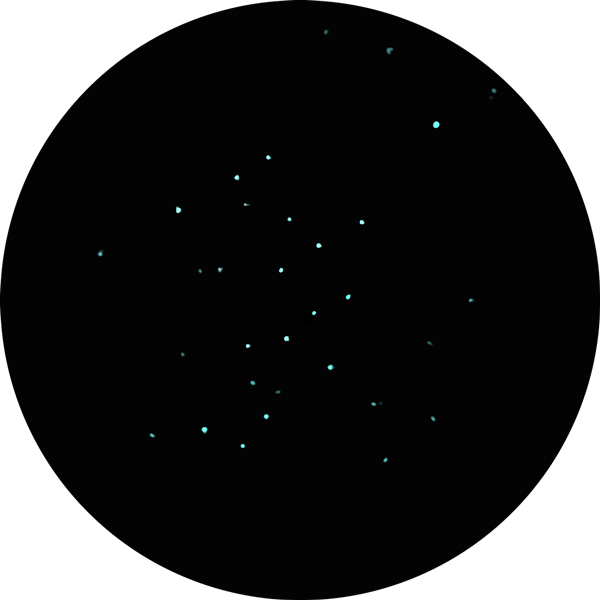
Tonight was a nice break in a week of cloudy skies, and now with Daylight Savings Time, my time under the stars is starting later. Patches of clouds sailed in around sunset so I thought I wouldn’ve even go out tonight, but I pushed myself to go after 9, and I’m glad I did. I first observed M67 with the 20mm eyepiece, and it fits well and snug. There are several bright stars, seemingly in clumps, spread throughout the cluster. While most of the faint stars look white to me, there are some blue ones.
Even under subpar seeing condition, I’m happy to report M67 is a good target from suburban skies—both in my 8-inch Meade and binoculars. I agree with John Herschel (description below) who wrote 203 years ago that this is a supurb, rich cluster with edges that fade off. I did land up sketching with the 12mm eyepiece (to get the core), though I should sketch at 20mm next time.
Key Stats
| Constellation | Cancer |
| Best Viewing | Late Winter |
| Visual Magnitude | +6.9 |
| Absolute Magnitude | -2.6 |
| Distance from Earth | 2,600 ly |
| Diameter | 20 ly |
| Apparent Size | 25 arcmin |
| My Viewing Grade | A- |
Historical Observations
April 6, 1780 observation by Charles Messier
“Cluster of small stars with nebulosity, below the southern claw of Cancer. The position determined from the star Alpha [Cancri].”2
March 20, 1820 observation by John Herschel
“Superb cluster, very rich and brilliant; fills field; stars from 9th to 15th magnitude; straggling edges and not very compressed in the middle.”2
Sources and Notes
Banner photo Jim Mazur and licensed under the Creative Commons Attribution-Share Alike 4.0 International license. Source info: https://commons.wikimedia.org/wiki/File:M67_Mazur.jpg
1“Messier 67.” Wikipedia, Wikimedia Foundation, 23 Feb. 2023, en.wikipedia.org/wiki/Messier_67. Accessed 22 Mar. 2023.
2Guy McArthur, Hartmut Frommert. Messier 67, http://www.messier.seds.org/Mdes/dm067.html.
 The Garden Astronomer
