
Struve 1520 is a double star in Ursa Major, best viewed on spring nights.
The brightest star of the pair is +6.5 magnitude, while the secondary star is fainter at 8.0 magnitude and lies 12.4 arcseconds away, so urban astronomers will need at least small scope to see this double. The primary star is a yellow main sequence star classified as a spectral type of G0V.
While this double is unremarkable, I ran into some mystery regarding the secondary star color. Reports on various websites and books state the fainter star is yellow, while others a light blue. After looking at the pair myself, I’m leaning toward a pale red!
My Observations
| Date | March 21, 2023 |
| Time | 10:05 P.M. |
| Location | Seattle, WA |
| Magnification | 169x |
| Scope | Meade 8″ SCT |
| Eyepiece | 12mm |
| Seeing | Average |
| Transparency | Average |
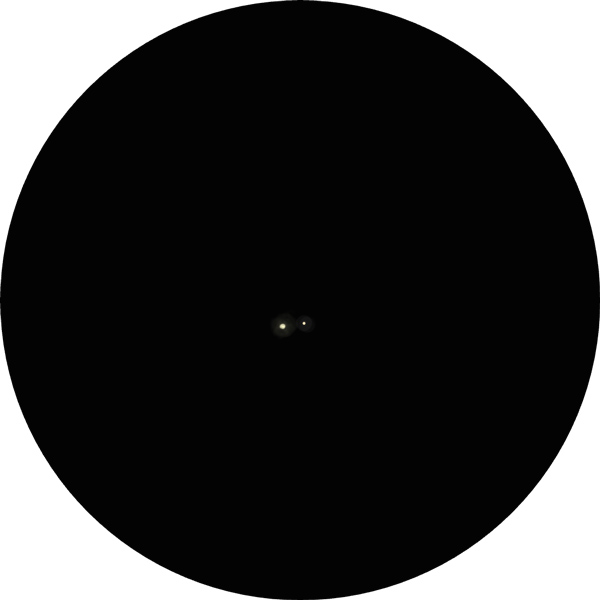
Tonight I feel a little scattered as the temperature on this late winter day drops. I’ve been trying to find some “easier” double around Ursa Major. I landed on Strive 1520. This is a nice, fairly close, yet easily separable pair. What’s interesting is that my book says it’s a pair of yellow stars, but I see the fainter secondary as a light red star. This will need further investigation.
Key Stats
| Constellation | Ursa Major |
| Best Viewing | Spring |
| Visual Magnitude | +6.5, +8.0 |
| Separation | 12.4″ | 537 AU |
| Position Angle | 344° |
| Spectral Class | Primary=G0 |
| Absolute Visual Magnitude | +4.84 |
| Distance from Earth | 141 ly |
| Milky Way Location | Orion Spur |
| My Viewing Grade | B |
| Designations | STF 1108, HIP 36691, BD +23 1744 |
Sources and Notes
Banner illustration was created by the European Southern Observatory (ESO) and is under the Creative Commons Attribution 4.0 International License. Per ESO agreement: Here is the original image on the ESO website.
Sketch by Wayne McGraw
 The Garden Astronomer