
A trip to Lowell Observatory in Flagstaff, Arizona, is a must for any astronomy-loving person. Lowell’s visitor program, along with its open-deck observatory, is second to none. Founded in 1894 by astronomer Percival Lowell, the observatory today is a non-profit astronomical research institution dedicated to connecting people to the universe, through education, exploration, and discovery.
One of the most significant contributions of the observatory was the discovery of Pluto in 1930 by Clyde Tombaugh. Percival Lowell had predicted the existence of a ninth planet based on anomalies in the orbits of Uranus and Neptune, and Tombaugh was hired to search for it. After a long search, he discovered Pluto, which was later reclassified as a dwarf planet. He noticed Pluto as the moving “star” comparing photographic plates. Pluto was in the area near Delta Geminorum (Wasat).
Also, I’d be remiss for not mentioning Robert Burnham Jr. here. Burnham wrote his classic Celestial Handbook in his free time while working at Lowell. Amateur astronomers, including myself, have loved Burnham’s three-volume set, composed with a rich mix of personal, lyrical, and scientific observations. Sadly, Burnham was eventually let go from Lowell Observatory as his research program closed. He spent most of his remaining years in California, where he lived a lonely existence until his death at age 61.1 I recommend reading Guy Ottewell’s article “In Memoriam” for more on Burnham’s life.
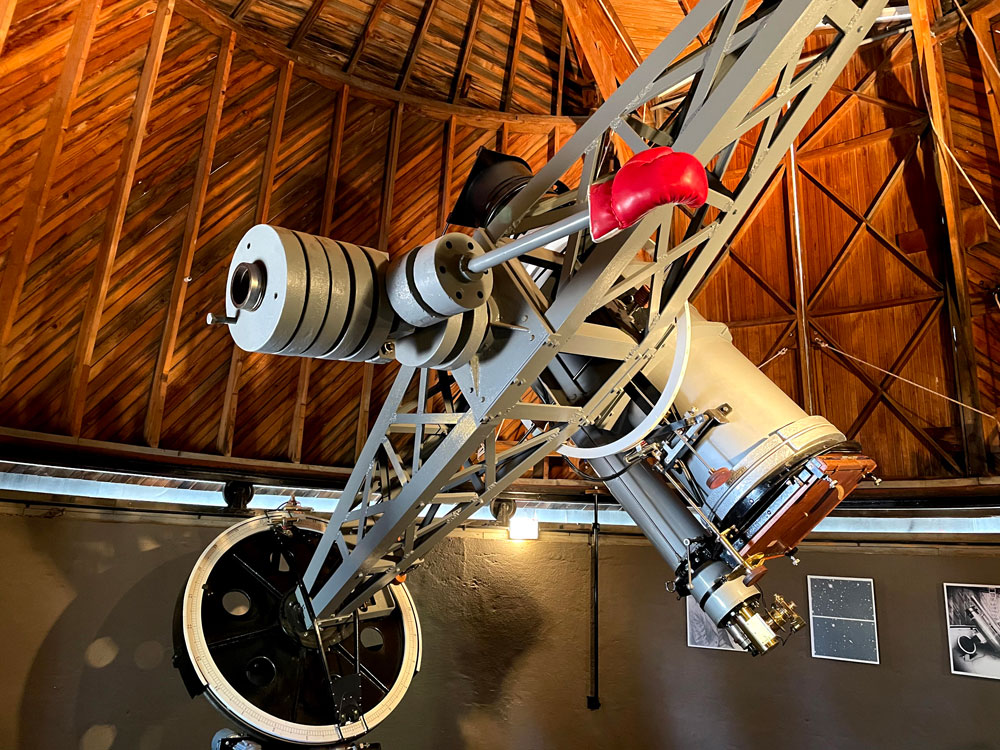
I put together this video about Lowell, which features the telescope used to discover Pluto. Of note, Robert Burnham used this same scope for much of his work when he was at Lowell.
PHOTO 1: Tombaugh’s journal entry about the photographic plates that contained the photo of Pluto.
Note the date of January 21, 1930. The plate was exposed on this date, but Tombaugh didn’t discover Pluto until a few weeks later on February 18th. As mentioned in the video above, he was comparing plates when he saw the movement of Pluto. Also, note the main star referenced below: “Delta Geminorum,” the star also known as Wasat. It’s located in the constellation Gemini. You can read my entry for the historic star here.
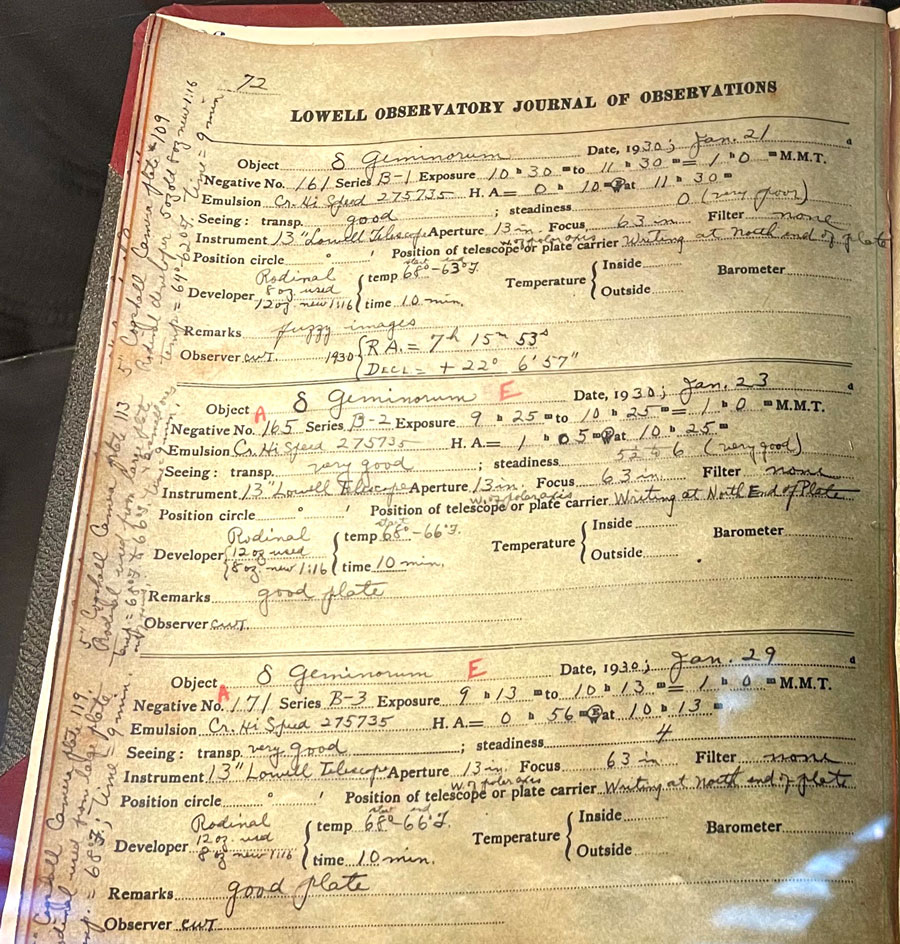
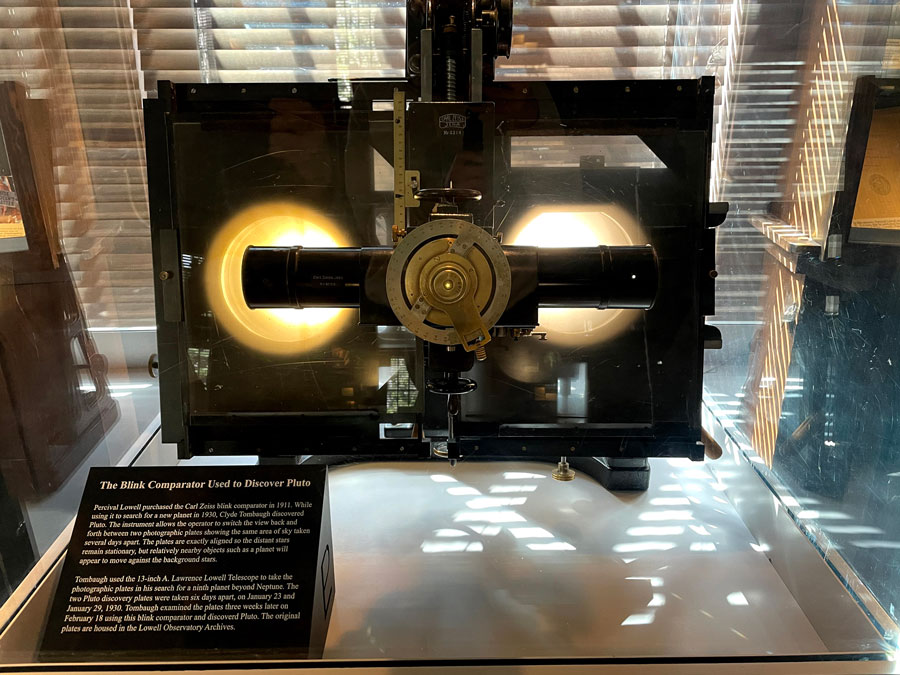
PHOTO 2: The Blink Comparator
Tombaugh used this machine to compare photographic plates of the starry region in Gemini. By comparing the plates, he noticed how one very small point of light moved, which turned out to be Pluto. Watch the video above to see how it worked.
Sources:
- Video and photos by Wayne McGraw.
- 1Ottewell, Guy. “In Memoriam Robert Burnham.” Universal Workshop, 12 Feb. 2017, https://www.universalworkshop.com/2014/12/01/in-memoriam-robert-burnham-2/.
 The Garden Astronomer
3 thoughts on “Lowell Observatory”