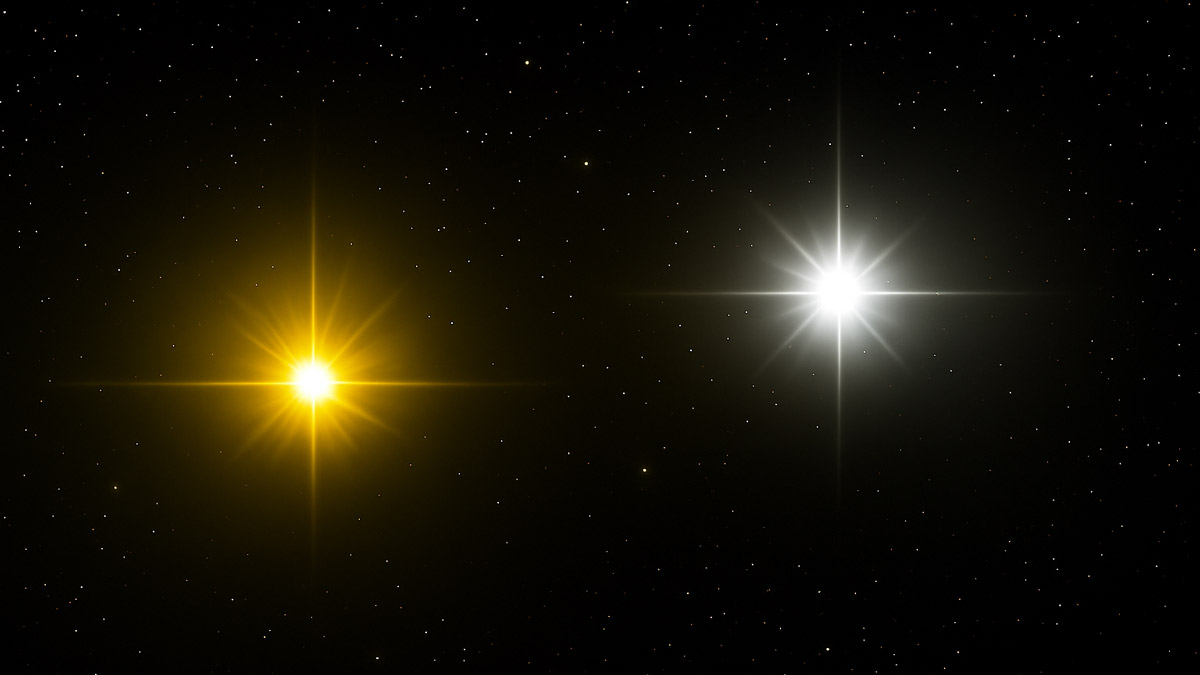
88 Leonis, also cataloged as Struve 1547, is a binary star in the constellation Leo. Amateur astronomers in the northern hemisphere can track down the double star in springtime.
Unlike the nearby tight binary of 49 Leonis, 88 Leonis is a fairly wide binary. With most reasonably-sized telescopes, backyard astronomers should comfortably manage to split the two stars. The primary star shines at +6.3 magnitude, making it easy to see through a scope in the suburbs. The secondary star, however, is much dimmer at a +9.1 magnitude.
The space between the two stars in the sky is 15.46 arcseconds, and the distance separating the pair is 385 astronomical units. The primary star is yellow-white in color and classified as an F-type star. In comparison, the secondary star is classified as a G-type star, the same as our Sun. The stars are relatively close to us at “only” 76 light-years away from our solar system.1
Historically speaking, William Herschel first recorded 88 Leonis on the night of February 9, 1782.2
My Observations
| Date | April 19, 2023 |
| Time | 9:38 p.m. |
| Location | Seattle, WA |
| Magnification | 169x |
| Scope | Meade 8″ SCT |
| Eyepiece | 12mm |
| Seeing | Average |
| Transparency | Below Average |
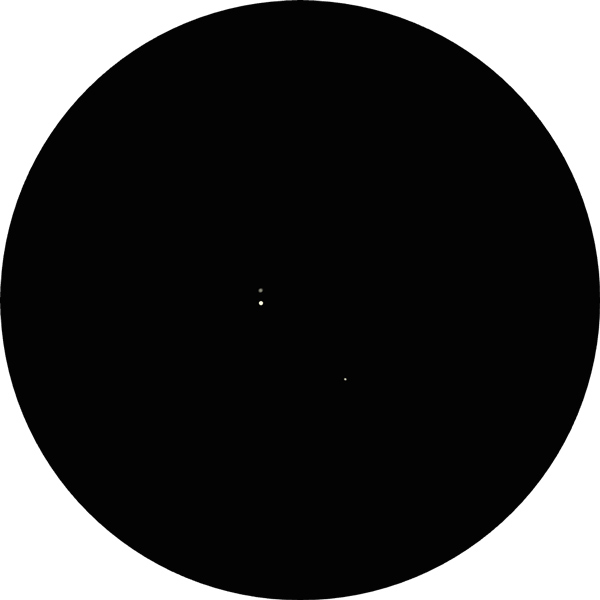
After spending a brief amount of time at the scope, I’ve noticed several patches of clouds in the western direction, visible through the trees. Despite the challenging task of splitting 49 Leonis during my sketching session, I’m glad to report that my scope is perfectly aligned and can locate the targets with ease. However, this upcoming cloudy weather is disappointing, considering this is my first stargazing trip in a month.
Looking through the 12mm eyepiece, I see a pair of stars lying vertically, with the dimmer secondary star right above the primary. I’ve read various reports on the colors of these two stars. Some mention the primary as copper, orange, or light yellow. I see the bright primary as white with perhaps a tinge of yellow mixed in. On the other hand, the companion star is too dim to really tell. Part of me thinks it looks pale blue or lilac, but it may just look that way because it’s so dim.
On a different topic, I don’t see many extra stars in the field of view, except for a bright star positioned below and left of the binary. From my research, I don’t believe this third star is related.
Key Stats
| Constellation | Leo |
| Best Viewing | Spring |
| Visual Magnitude | +6.3 | +9.1 |
| Absolute Visual Magnitude | +4.42 |
| Distance from Earth | 76 ly |
| Separation | 15.3″ | 385 AU |
| Position Angle | 332° |
| Orbital Period | 3453 years |
| Milky Way Location | Orion Spur |
| My Viewing Grade | B |
| Designations | Struve STF 1547, SAO 99648, HR 4437, HIP 56242, HD 100180 |
Sources and Notes
Banner adapted from an illustration created by Pablo Budassi. The illustration is licensed under the Creative Commons Attribution-Share Alike 4.0 International license. Full details here.
1 Wikimedia Foundation. (2022, March 27). 88 leonis. Wikipedia. Retrieved April 23, 2023, from https://en.wikipedia.org/wiki/88_Leonis
2 MacEvoy, B. (2011). William Herschel’s double star catalog. Retrieved April 23, 2023, from http://www.handprint.com/ASTRO/Herschel_All.html
Sketch by Wayne McGraw
 The Garden Astronomer