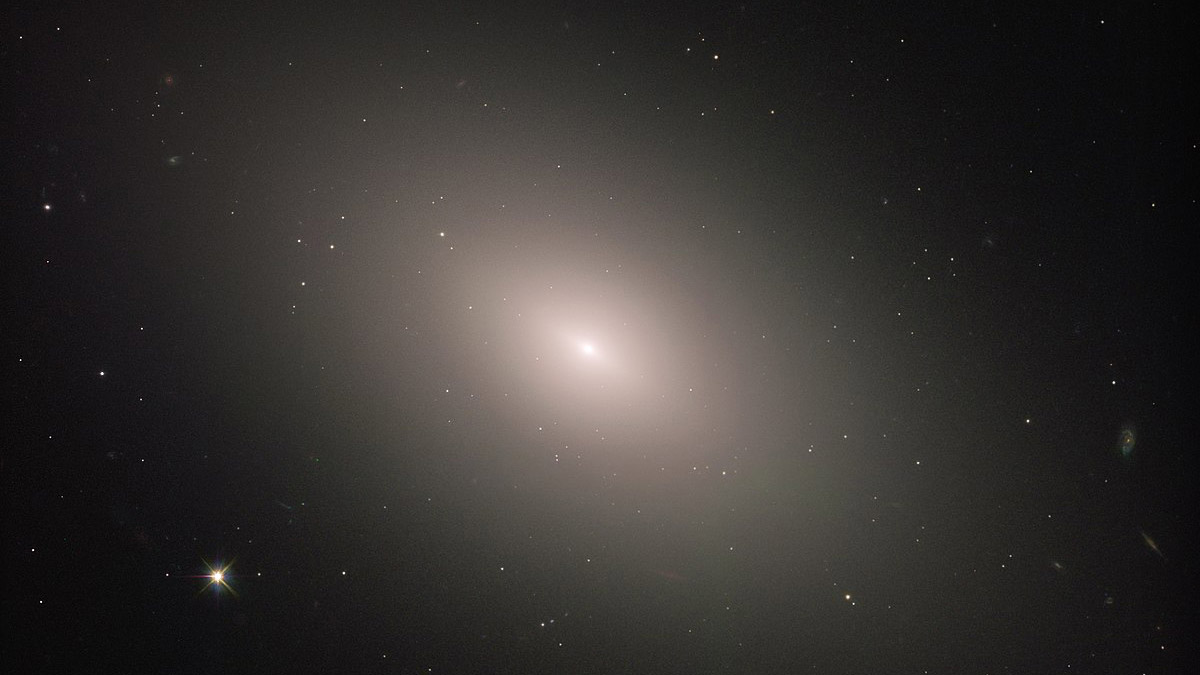
Messier 59 (M59) is an elliptical galaxy in the Virgo constellation. As with many of the wonderful galaxies in Virgo, M59 is a popular target for amateur astronomers in springtime.
At a dim magnitude of +9.6, M59 is not as bright as other galaxies in this region. In my case, my 8-inch scope only picked up a faint fuzzy patch; I noticed it after using averted vision (observation below). Many backyard astronomers, especially those suburban ones, share similar observations. Still, it’s good to know this hazy point in the sky is within reach with a decent-sized scope.
According to NASA, M59 lies nearly 60 million light-years away and is one of the larger elliptical galaxies in Virgo. One of M59’s unique factors is the high number of globular clusters lying in its midst. I just wish I could see these 2,200 globulars—what a site it would be!1
Historically speaking, the German astronomer Johann Gottfried Koehler first set eyes on M59’s faint light on the same night he was observing Comet Bode. That was April 11, 1779! A few days later, Messier followed suit and recorded M58, M59, and M60 in his famous catalog of astronomical objects.2
My Observations
| Date | April 19, 2023 |
| Time | 9:45 p.m. |
| Location | Seattle, WA |
| Magnification | 169x |
| Scope | Meade 8″ SCT |
| Eyepiece | 12mm |
| Seeing | Average |
| Transparency | Below Average |
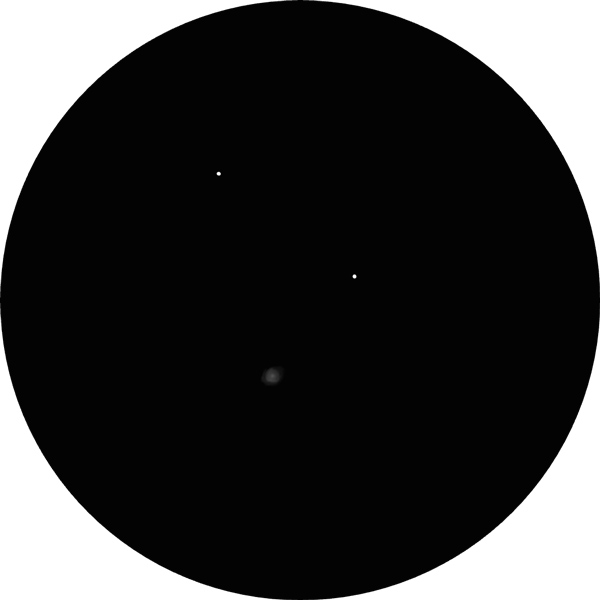
Nearly 244 years ago tonight, Johann Gottfried Koehler set his eyes on M59. Of all nights, I didn’t expect to find this faint galaxy because clouds began to form on the western horizon as the sun sunk below the trees. It had been a month since I’d been under the stars, so I quickly prepared the scope, aligned it, and jumped on my list of objects. After a few double-star observations, patches of clouds scattered across the sky. However, the eastern skies remained fairly clear, so I headed toward this object, M59. Within fifteen minutes of sketching M59, the sky closed up, and my short night of observing ended.
Note from my sketchpad: Using averted vision, I can see a faint, small patch in the 12mm piece. I confirm I’m actually viewing something. As I move the telescope left, and right, the haze moves. In the 12mm, two brighter stars make a triangle with the patch of M59, as illustrated above. I’m sure the fluffy spot I’m seeing is really the brighter nucleus of this great galaxy. I’m certain this orb would spread wider under dark-sky conditions. Nevertheless, I’ll take what I can get under these Seattle skies. The clouds are showing up so fast.
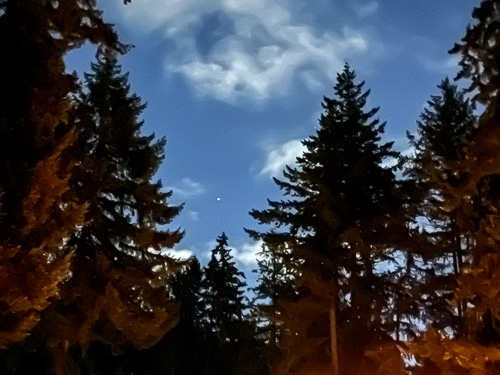
In space news: The upcoming first launch of Space X’s Starship from Texas is to occur tomorrow morning at about 6am my time. I’ll set my alarm to watch the historic occasion—if it happens!
Update to this diary entry: Space X did indeed launch Starship the morning after I wrote this observation. It slowly rumbled up the sky after obliterating every inch of ground around its launch pad. After a minute or so, the ship started to tumble and fall until Space X intentionally detonated the vehicle. I have a feeling many years from now, we will see this huge rocket lifting up in the skies routinely.
Key Stats
| Constellation | Virgo |
| Best Viewing | Spring |
| Visual Magnitude | +9.59 |
| Absolute Visual Magnitude | -21.25 |
| Distance from Earth | 48 million ly |
| My Viewing Grade | C |
Historical Observations
First discovered on April 11, 1779, by Johann Gottfried Koehler. Then, Charles Messier independently discovered the galaxy a few days later, on April 15, 1779.
“Nebula in Virgo & in the neighborhood of the preceding M58 on the parallel of epsilon [Virginis], which has served for its [position] determination: it is of the same light as the above, equally faint. M. Messier reported it on the Chart of the Comet of 1779.”
Sources and Notes
Photo of M59 for the top banner is authored by ESA/Hubble & NASA, L. Ho et al. This file is licensed under the Creative Commons Attribution 4.0 International license. Source file.
1Garner, R. (2018, March 12). Messier 59. NASA. Retrieved April 21, 2023, from https://www.nasa.gov/feature/goddard/2018/messier-59
2McArthur, G., & Frommert, H. (n.d.). Messier 59. Retrieved April 21, 2023, from http://www.messier.seds.org/Mdes/dm059.html
Sketch by Wayne McGraw
 The Garden Astronomer
One thought on “Messier 59 (NGC 4621): A Large Elliptical Galaxy in Virgo”