
83 Leonis is a colorful binary star in the northern constellation of Leo best viewed on spring nights. The astronomer William Herschel first recorded this binary on April 6, 1780.1
The primary star, called 83 Leonis A, is a yellow-orange subgiant that shines down at a magnitude of +6.5. Observers can find the star fairly easily, even with a pair of binoculars. The star’s spectral type is K0IV, and it lies around 58 light years away from us. At 28 arcseconds away is the companion star 83 Leonis B. This dimmer, 8th-magnitude orange star is considered a main sequence dwarf. It’s cooler and slightly less massive than our sun.
Of note, for a nice view of two double-star systems, be sure to look at this area through an eyepiece with a wider field of view. You can see both double star systems, Tau Leonis and 83 Leonis, in the same eyepiece. In my case, I switched out my 12mm eyepiece with a 24mm piece, and voilà, both pairs appeared! See the sketches below.
More than meets the eye
Beyond the aesthetically pleasing pair of stars, 83 Leonis harbors a secret—an exoplanet that orbits the secondary star, 83 Leonis B. This exoplanet boasts a minimum mass of approximately 13 times that of Earth and completes its orbit around its star in just 17 days.
My Observations
| Date | April 27, 2023 |
| Time | 10:18 P.M. |
| Location | Seattle, WA |
| Magnification | 169x |
| Scope | Meade 8″ SCT |
| Eyepiece | 12mm |
| Seeing | Above Average |
| Transparency | Average |
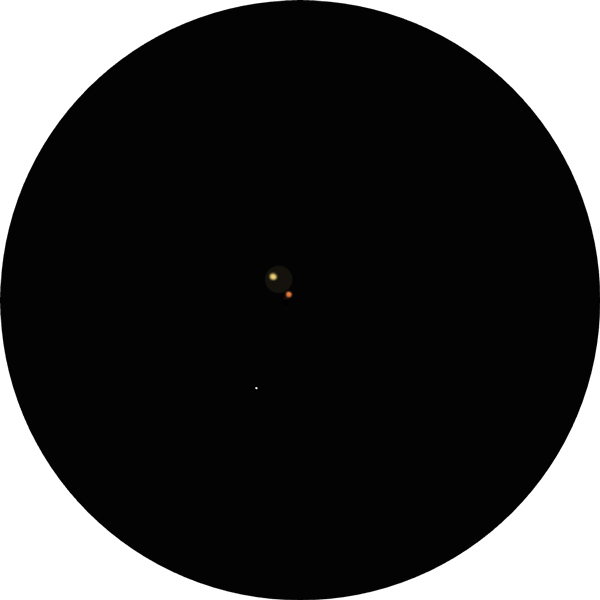
This is an attractive double, bright enough to break through the hazy and half-moon sky. The brighter primary appears yellow to me, while the secondary definitely has a darker appearance leaning toward a darker red or orange tinge. Observer Greg Stone provides an interesting take on the colors of this system, writing:
The closer pair – 83 Leonis – showed pale yellow and pale violet. Sissy Haas describes the colors this way: ‘a lemon-yellow star with a small grey companion.’
Greg Stone, Star Splitter website2
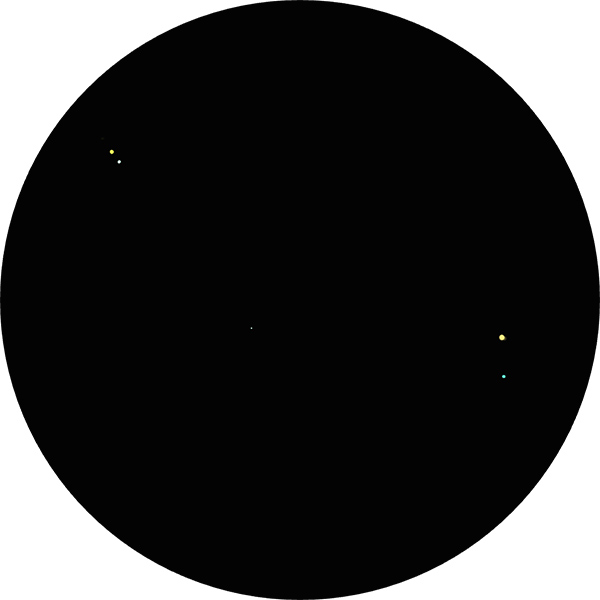
Sketch drawn on April 27, 2023
Key Stats
| Constellation | Leo |
| Best Viewing | Spring |
| Visual Magnitude | +6.4, +7.5 |
| Separation | 28.6″ |
| Position Angle | 146° |
| Spectral Class | Primary=K0IV; Secondary=K2V |
| Absolute Visual Magnitude | +5.21 |
| Distance from Earth | 58 ly |
| Milky Way Location | Orion Spur |
| My Viewing Grade | A- |
| Designations | SAO 118864, STF 1540, HD 99491, HIP 55846 |
Sources and Notes
Banner illustration was created by the European Southern Observatory (ESO) and is under the Creative Commons Attribution 4.0 International License. Per ESO agreement: Here is the original image on the ESO website.
1 William Herschel’s double star catalog. (n.d.). Retrieved April 30, 2023, from http://www.handprint.com/ASTRO/Herschel_All.html
2 Wikimedia Foundation. (2023, February 26). 83 leonis. Wikipedia. Retrieved April 30, 2023, from https://en.wikipedia.org/wiki/83_Leonis
3 Stone, G. (2010, December 17). Tau Leonis. Star-Splitters. Retrieved April 29, 2023, from https://bestdoubles.wordpress.com/tag/tau-leonis/
Sketch by Wayne McGraw
 The Garden Astronomer