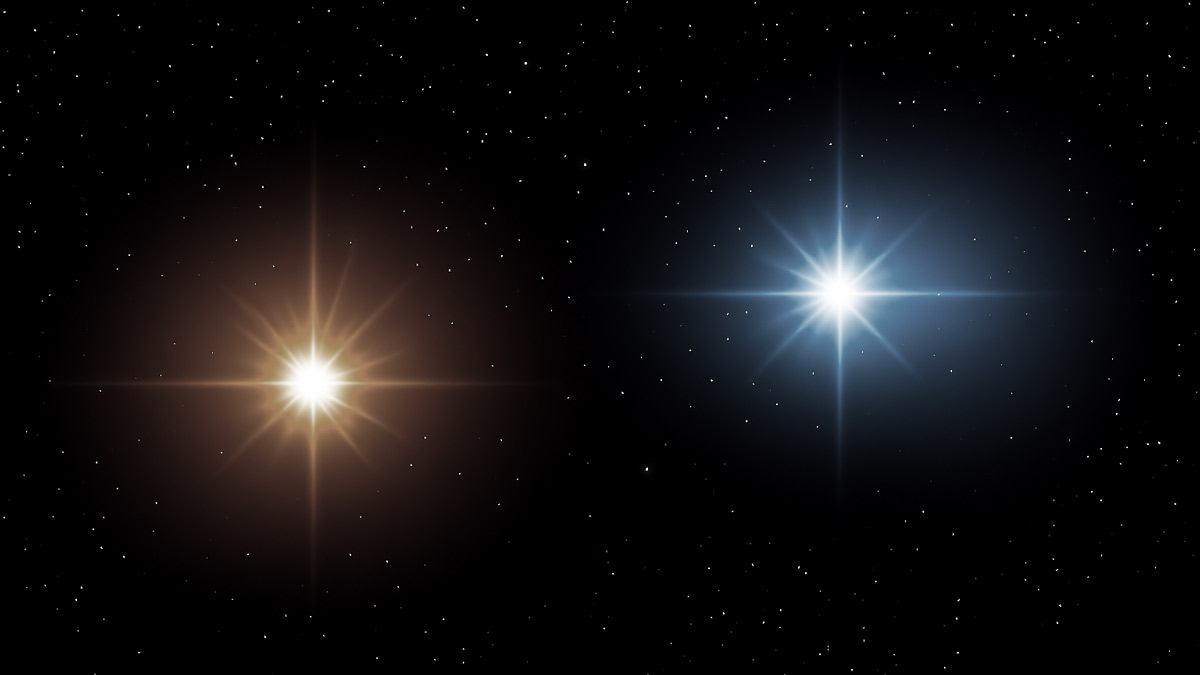
Kappa Boötis is an attractive double star in the northern constellation of Boötes. It’s best viewed during the springtime. It’s a fascinating target to test one’s visual perception since we know both stars are technically white in the sky, but observers see different colors. More on this later in this article.
The first thing you may notice when looking up Kappa Boötis on a sky chart or astronomy app is its other name, Asellus Tertius. The name translates to “third donkey.” If you are wondering, the other two donkey stars are called Iota (ι) Boötis and Theta (θ) Boötis. By the way, regarding names, don’t be surprised if you also see this star designated as 17 Boötis.1
According to Jim Kaler, the actual primary star in the system is named Kappa2 Boötis. It is a subgiant of spectral type A8V. This means that it is a slightly evolved star that has already exhausted its hydrogen supply in its core and is now fusing helium into carbon. Kappa2 Boötis has an apparent magnitude of +6.69. Of note, this star is also a variable.
The secondary but brighter star nearby is Kappa1 Boötis. It is a main-sequence star of spectral type F2V. This means it is a hot, young star fusing hydrogen into helium in its core. Kappa1 Boötis has an apparent magnitude of +4.50, so one can even see it with the naked eye on a dark night. On an exciting note, it has another companion star going around it, but we can’t see it without special equipment. Astronomers refer to this type of binary as a “spectroscopic binary.”
What’s so interesting is that both stars, according to Jim Kaler, are white in color. However, the differences in their magnifications and close proximity can create, as Jim says, “odd” colors that we see.1 For example, Bob Argyle writes on the Webb Deep-Sky Society website that astronomer T. W. Webb found the stars to be “pale yellow and bluish” when observing in 1850. Years later, in 1915, the British astronomer William Franks recorded the colors yellow and purple.2 For me, I tend to fall between both these men. The brighter star is white, while the dimmer did appear a deep blue and almost like a violet. See my observation below.
It’s worth noting that many amateur astronomers will have a good chance of viewing both stars through a telescope due to their brightness. Additionally, the stars are adequately spaced apart (at 13.7 arcseconds) to be distinguished by a smaller telescope in a backyard setting.
My Observations
| Date | April 27, 2023 |
| Time | 10:57 P.M. |
| Location | Seattle, WA |
| Magnification | 169x |
| Scope | Meade 8″ SCT |
| Eyepiece | 12mm |
| Seeing | Above Average |
| Transparency | Average |
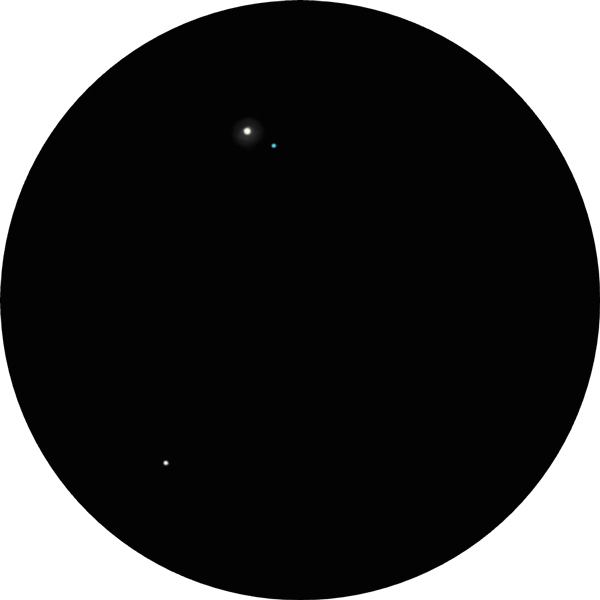
Tonight, I’ve been lucky enough to spot a number of beautiful double stars, and this one is just as stunning. On the upper left of my drawing, the brighter star shines with a brilliant white light, which is consistent with what other observers have noted. The dimmer star, located slightly below and to the left of the brighter one on my sketch, appears to be a captivating deep ocean blue color. If I stare at it long enough, it almost seems to shift between shades of purple and violet. It’s a fascinating target to test one’s visual perception!
Key Stats
| Constellation | Boötes |
| Best Viewing | Spring |
| Visual Magnitude | +4.5, +6.7 |
| Separation | 13.8″ |
| Position Angle | 235° |
| Spectral Class | Primary=A8V, Sec=F2V |
| Absolute Visual Magnitude | +3.07 |
| Distance from Earth | 155 ly |
| Milky Way Location | Orion Spur |
| My Viewing Grade | A- |
| Designations | SAO 29045, HR 5328, HD 124674, HIP 69481 |
Sources and Notes
1Kaler, J. (2009, May 22). Asellus Tertius aka Kappa Bootis. Retrieved May 6, 2023, from http://stars.astro.illinois.edu/sow/asellust.html
2Argyle, B. (2023, May). Double star of the month in Bootes. Webb Deep-Sky Society: Double Star of the Month in Bootes. Retrieved May 6, 2023, from https://www.webbdeepsky.com/double-stars/constellation/Bootes
Sketch by Wayne McGraw
 The Garden Astronomer
2 thoughts on “Kappa Boötis (Asellus Tertius): A Double Star of White and Deep Blue in Boötes”