
Tau Leonis, also known as 84 Leo, is a double star in the northern constellation of Leo. It’s best viewed during the springtime.
Tau Leonis can be spotted with the naked eye, thanks to its +5 magnitude. However, individuals residing in suburban areas may face challenges seeing the star as light pollution can obscure it. But regardless of your location, you can experience this delightful celestial pair with binoculars or a telescope.
As you gaze through your eyepiece, you’ll notice a dazzling lemon-yellow star shining brilliantly. This primary star is classified as a G8-IIIa giant star. It’s enormous. The star’s mass is 390% greater than our Sun, and the radius is 25 times larger. Nearby, you’ll see the secondary star Tau Leonis B, which is a magnitude 7.5 star located at an angular separation of 88 arcseconds.1 As I observed (notes below), this dimmer star appears baby blue.
On a related note, author Greg Stone comments on the color of Tau Leonis and the double star called 83 Leonis, which lies nearby:
…the colors seemed obvious to me. Tau was a lemon yellow and pale blue. The closer pair – 83 Leonis – showed pale yellow and pale violet. Sissy Haas describes the colors this way: ‘a yellow-white star and a lemon-yellow star – each with a small grey companion.’
Greg Stone, Star Splitters website2
But that’s not all there is to the picture! You can see both double star systems, Tau Leonis and 83 Leonis, in the same eyepiece. In my case, I switched out my 12mm eyepiece with a 24mm piece, and voilà, both pairs appeared! See the sketches below.
My Observations
| Date | April 27, 2023 |
| Time | 10:30 P.M. |
| Location | Seattle, WA |
| Magnification | 169x |
| Scope | Meade 8″ SCT |
| Eyepiece | 12mm |
| Seeing | Above Average |
| Transparency | Average |
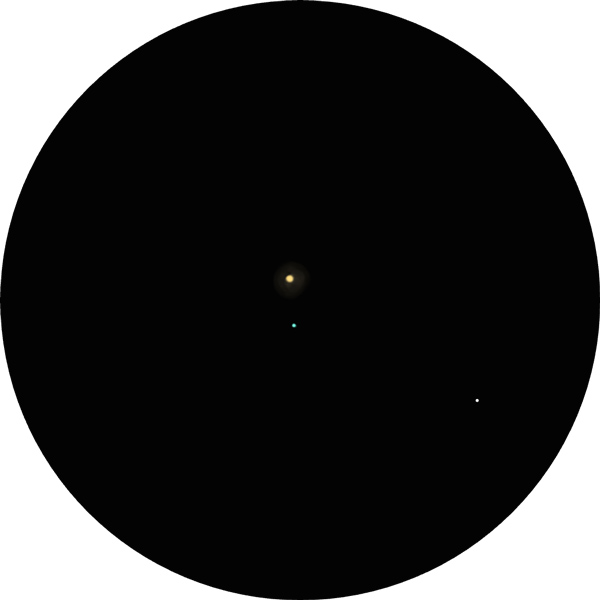
Information on Tau Leonis is scarce. One of my guides merely describes it as a “fairly wide pair.” Despite this, I am delighted by its pretty appearance. I am unsure why Tau captivates me so, but its vibrant yellow hue is mesmerizing and teases my eyes with a hint of orange. I concur with Greg Stone’s observation that this star is reminiscent of lemon yellow.
I see the secondary star hanging directly below at 88 arcseconds away, which appears to be baby blue in color. However, this star also plays some tricks on my eyes because I perceive a hint of green mixed in. Additionally, I notice a third white star located off to the right. This distance star has no relation with the other two.
Before I change targets, I’m going to widen the view by removing my 12mm eyepiece and placing in the 24mm. With the 24mm, I can see both double star pairs (Tau Leonis and 83 Leonis). How cool!
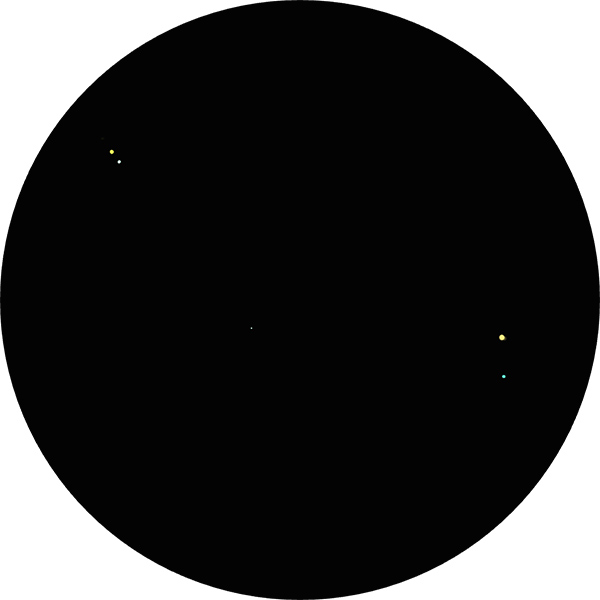
Sketch drawn on April 27, 2023
Key Stats
| Constellation | Leo |
| Best Viewing | Spring |
| Visual Magnitude | +5, +7.5 |
| Separation | 88″ |
| Position Angle | 181° |
| Spectral Class | Primary=G8-IIIa |
| Absolute Visual Magnitude | -1.24 |
| Distance from Earth | 560 ly |
| Milky Way Location | Orion Spur |
| My Viewing Grade | A |
| Designations | SAO 118875, STFA 19, HR 4418, HD 99648, Σ119 |
Sources and Notes
Banner illustration was created by the European Southern Observatory (ESO) and is under the Creative Commons Attribution 4.0 International License. Per ESO agreement: Here is the original image on the ESO website.
1 Wikimedia Foundation. (2023, February 26). Tau Leonis. Wikipedia. Retrieved April 29, 2023, from https://en.wikipedia.org/wiki/Tau_Leonis
2 Stone, G. (2010, December 17). Tau Leonis. Star-Splitters. Retrieved April 29, 2023, from https://bestdoubles.wordpress.com/tag/tau-leonis/
Sketch by Wayne McGraw
 The Garden Astronomer
One thought on “Tau Leonis (84 Leo): A Lemon Drop and Baby Blue Double”