
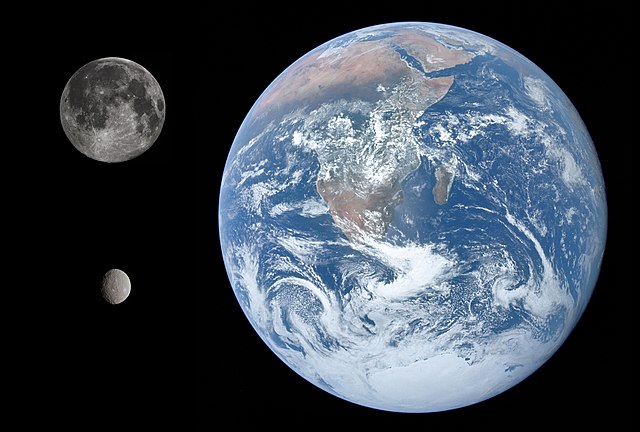
Ceres is a dwarf planet in the asteroid belt between Mars and Jupiter. It is the largest object in the asteroid belt, with a diameter of about 950 kilometers (590 miles). Ceres is thought to have formed from the same material that made the planets, but Jupiter’s gravitational pull prevented it from becoming a planet.
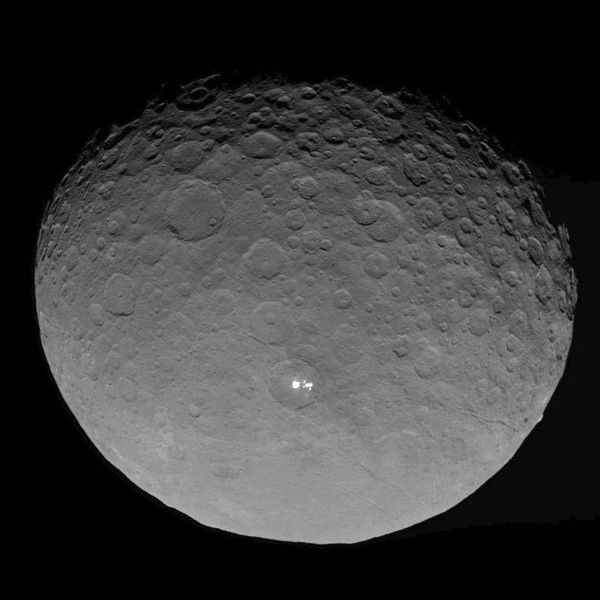
Astronomers believe a massive amount of liquid water and ice lies beneath Ceres’ surface. In 2015, NASA sent a spacecraft called Dawn to orbit Ceres. The craft returned fascinating photos revealing various geological features, including craters, mountains, and valleys. I especially recall seeing the popular news photos of the mysterious bright spots on the planet, such as this one:
Historically speaking, the Catholic priest and astronomer Giuseppe Piazzi discovered Ceres on January 1, 1801. What a great way to kick off a new year! He observed the dwarf planet over several days as he first doubted its planetary status. About his discovery, Piazzi would write:
“The light was a little faint, and of the colour of Jupiter, but similar to many others which generally are reckoned of the eighth magnitude. Therefore I had no doubt of its being any other than a fixed star. In the evening of the second I repeated my observations, and having found that it did not correspond either in time or in distance from the zenith with the former observation, I began to entertain some doubts of its accuracy. I conceived afterwards a great suspicion that it might be a new star. The evening of the third, my suspicion was converted into certainty, being assured it was not a fixed star. Nevertheless, before I made it known, I waited till the evening of the fourth, when I had the satisfaction to see it had moved at the same rate as on the preceding days.”1
So, as you observe Ceres for yourself, imagine those nights more than 200 years ago when Piazzi watched the faint gray orb sailing across the stars.
My Observations
| Date | May 12, 2023 |
| Time | 11:08 p.m. |
| Location | Seattle, WA |
| Magnification | 254x |
| Scope | Meade 8″ SCT |
| Eyepiece | 8mm |
| Seeing | Average |
| Transparency | Above Average |

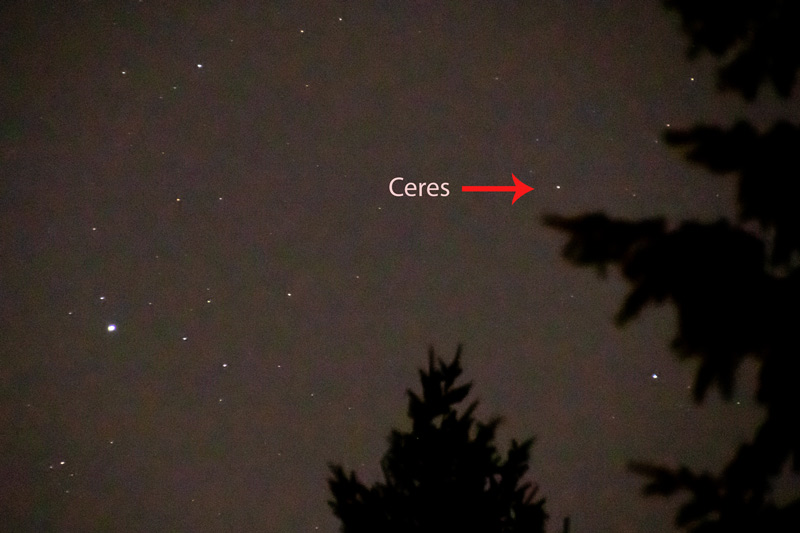
This is the first time in my life to see Ceres. As advertised, the dwarf planet arrives in my eyepiece as a dim gray dot. I think it’s comparable to other stars but has a slight hint of gray. I attempted to enhance my view and differentiate Ceres from nearby stars by utilizing my 8mm eyepiece. Regrettably, I was unable to discern any distinct disc. It appears that a telescope with a minimum 10-inch mirror would be necessary to achieve that level of resolution.
Key Stats
| What constellation When Observed | Leo |
| Visual Magnitude When Observed | +7.8 |
| Distance from Earth When Observed | 1.92 AU | 16 Light Minutes |
Sources
The banner photo of Ceres is in the public domain in the United States because it was solely created by NASA. NASA copyright policy states that “NASA material is not protected by copyright unless noted.” NASA copyright policy page or JPL Image Use Policy.)
The photo comparing the diameter of Ceres with Earth and the moon is from Gregory H. Revera and is licensed under the Creative Commons Attribution-Share Alike 3.0 Unported license. Photo information here.
1“Giuseppe Piazzi.” Wikipedia, Wikimedia Foundation, 8 May 2023, en.wikipedia.org/wiki/Giuseppe_Piazzi. Accessed 27 May 2023.
Sketch by Wayne McGraw
 The Garden Astronomer

One thought on “Ceres: The Largest Object in the Asteroid Belt”