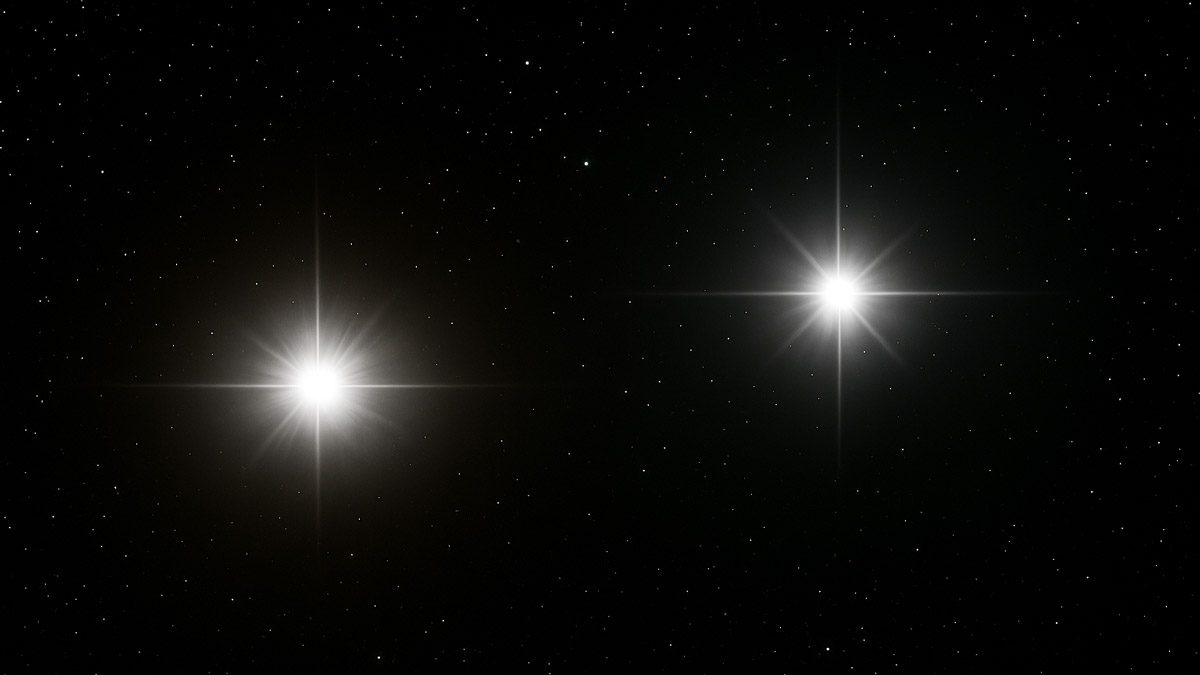
54 Virginis is a tight double star in the constellation Virgo, best viewed on spring nights.
The two stars of 54 Virginis are just outside the naked eye range, so you’ll need some optical help to see the pair. With only 5.4 arcseconds separating the two stars, a telescope will be best to split them.
The primary star is a white main sequence star classified as an A2V star with a surface temperature of around 9,000 Kelvin. With this spectral type, one should expect to see a white-bluish point of light. On the night I observed the stars, the primary appeared white with a tinge of yellow. Granted, double stars have a tendency to play tricks on our eyes. However, in my situation, I suspect that the high-altitude wildfire smoke from Canada may have influenced the color.
Of note, if you are having trouble splitting this tighter pair, perhaps hop over to nearby Struve 1677 to check your optics. This is a similar double, but the stars are farther apart.
My Observations
| Date | May 13, 2023 |
| Time | 11:00 P.M. |
| Location | Seattle, WA |
| Magnification | 254x |
| Scope | Meade 8″ SCT |
| Eyepiece | 8mm |
| Seeing | Average |
| Transparency | Average |
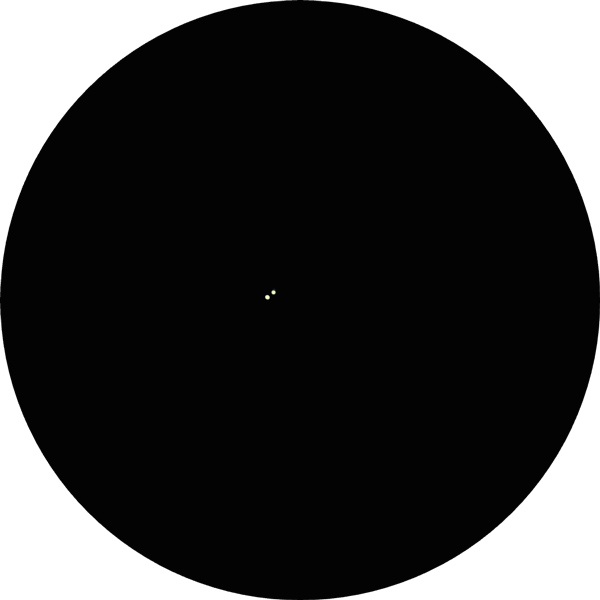
I’m using my 8mm eyepiece to split this pair clearly this evening. I believe there is a light haze of wildfire smoke out of Canada affecting my viewing, though I’m not certain. The primary, which is slightly brighter and above the secondary through my eyepiece and on the sketch, appears white with a very slight touch of yellow. The secondary looks white.
Key Stats
| Constellation | Virgo |
| Best Viewing | Spring |
| Visual Magnitude | +6.68, +7.23 |
| Separation | 5.4″ |
| Position Angle | 214° |
| Spectral Class | Primary=A2V |
| Absolute Visual Magnitude | +0.79 |
| Distance from Earth | 630 ly |
| Milky Way Location | Orion Spur |
| My Viewing Grade | B |
| Designations | LM Vir, SAO 157799, HIP 64520 |
Sources and Notes
Banner illustration was created by the European Southern Observatory (ESO) and is under the Creative Commons Attribution 4.0 International License. Per ESO agreement: Here is the original image on the ESO website.
Sketch by Wayne McGraw
 The Garden Astronomer