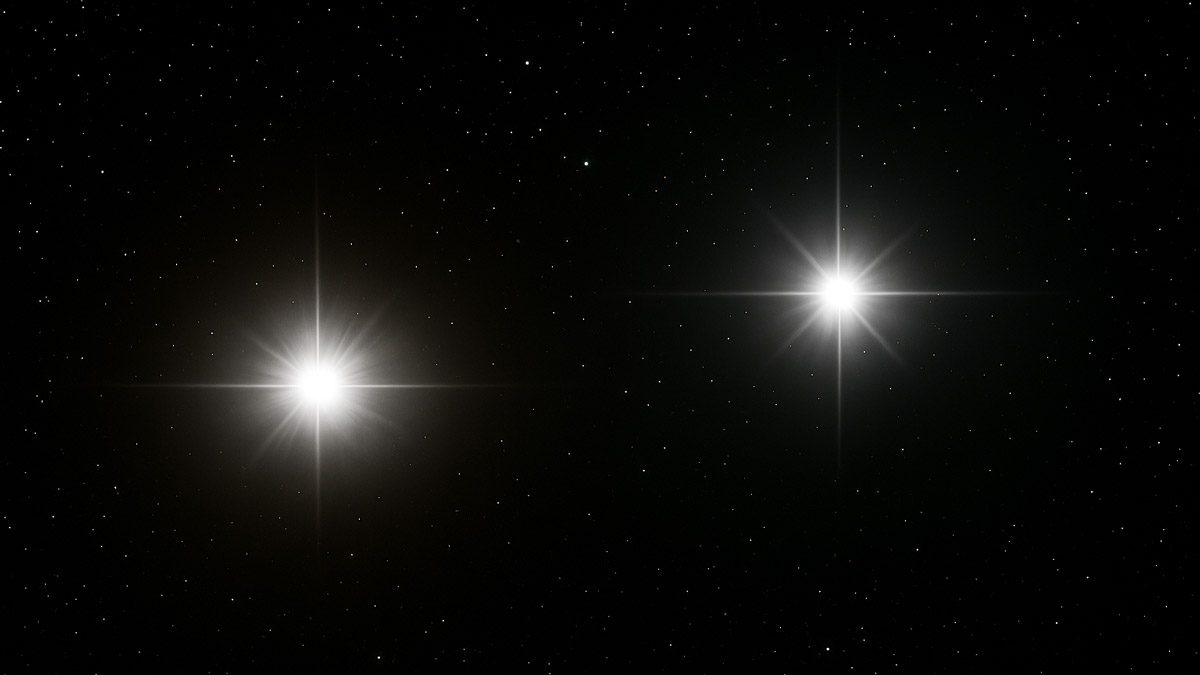
In recent years, I have centered my attention on the wealth of galaxies found within the Virgo constellation, a prominent spring constellation in the northern hemisphere. However, the youthful maiden of the night has much more to offer, including STF 1904, first cataloged by Friedrich Georg Wilhelm von Struve in 1823.
Primary Star
The primary star shines at a magnitude of 7.2 and is classified as a F2IV-type star. This means it’s a subgiant star evolving from a main-sequence star to a red giant, with a temperature of around 6,900–7,000 Kelvin.
Secondary Star
The slightly dimmer secondary star shines at a magnitude of 7.37 and is classified as an F20V-type star. Unlike the primary star in this stellar duo, this is a main-sequence star with a temperature of around 7,300 Kelvin.
It’s estimated that the pair lies 247 light years away from Earth.
My Observations
| Date | June 5, 2023 |
| Time | 10:30 p.m. |
| Location | Seattle, WA |
| Magnification | 127x |
| Scope | Meade 8″ SCT |
| Eyepiece | 12mm |
| Seeing | Above Average |
| Transparency | Above Average |

Now past the 10 o’clock hour, this particular night brings solace with its quietude, warmth, and clear skies. I am grateful for the remarkable double stars scattered across the sky.
As I adjust the focus knob, the single blob of light clearly separates into two distinct, sharp pinpricks. The separation of 10 arcseconds isn’t large, but it’s enough to reveal a definitive and clean sliver of black space between the two stars. Both appear equally bright and white, although the primary star has a slight yellow tint.
Key Stats
| Constellation | Virgo |
| Best Viewing | Spring |
| Visual Magnitude | + 7.2 | +7.3 |
| Separation | 10.1″ |
| Position Angle | 348.1° |
| Distance | 247 ly |
| My Viewing Grade | B |
| Designations | SAO 120822, HD 133408, HR 5610, HIP 73716, STF 1904 |
Sources and Notes
Stelle Doppie. (n.d.). Σ 1904. Retrieved July 8, 2025, from https://www.stelledoppie.it/index2.php?iddoppia=61642
Post updated on July 8, 2025
 The Garden Astronomer