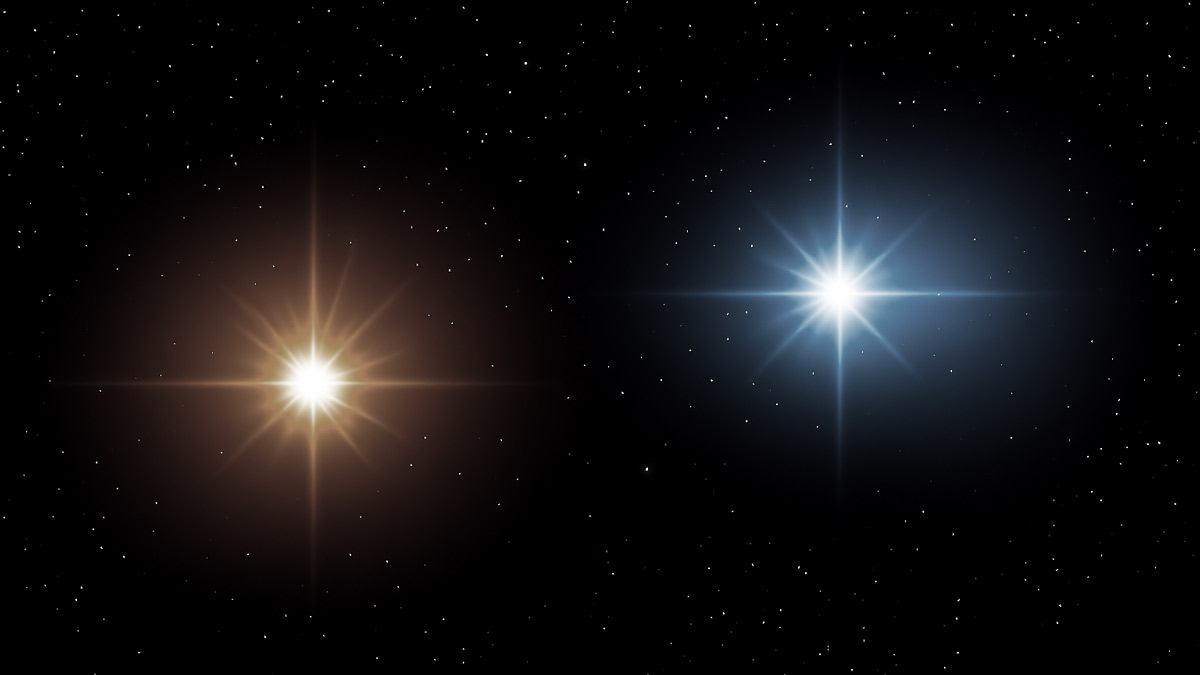
Struve 1919 (STF 1919) is an attractive double star in the constellation of Serpens. It’s best viewed during late spring and summertime.
Both of Struve 1919’s stars are in the +6-7 magnitude range. This makes this pair a bright enough and enjoyable target for suburban stargazers. Additionally, the decent 23.4 arcseconds of space between the stars provide a fairly easy split for beginner backyard astronomers.
The brighter primary star has a spectral type known as G7V, which is classified as a G-type main-sequence star. The star’s magnitude is +6.7 and has a warm yellow glow (and seems to have a bit of an orange tinge to me—see observation below). On the other hand, the slightly dimmer secondary (magnitude +7.5) star has a light blue hue. According to William Herschel’s Double Star Catalog, it appears the dimmer is a companion is a G1V star, so I would expect a light yellow/white star, not blue. But, as well documented, close stars of similar colors can look completely different in a scope.1
My Observations
| Date | June 5, 2023 |
| Time | 10:20 P.M. |
| Location | Seattle, WA |
| Magnification | 169x |
| Scope | Meade 8″ SCT |
| Eyepiece | 12mm |
| Seeing | Above Average |
| Transparency | Above Average |
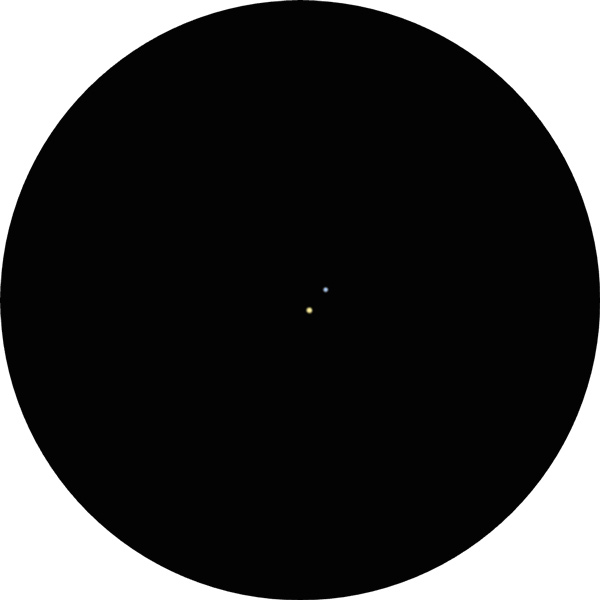
Tonight marks my first time under the stars in June 2023. The sky is phenomenal. All day, the sky has appeared crystal clear, no haze, no water vapor of any kind. I brought my daughter out a few minutes ago to see Spica. We both commented on how crystal clear it appeared.
As I land on this double, my first thought is: What a nice start! This double looks great! I tell my wife this as she sits under a nearby maple tree in the yard; she’s quietly reading a book on her phone.
The primary is a pretty peach color, while the dimmer companion is a light blue.
Key Stats
| Constellation | Serpens |
| Best Viewing | Summer |
| Visual Magnitude | +6.7, +7.5 |
| Separation | 23.4″ |
| Position Angle | 23.4° |
| Spectral Class | Primary=G7V, Sec=G1V |
| Absolute Visual Magnitude | +4.19 |
| Distance from Earth | 152 ly |
| Milky Way Location | Orion Spur |
| My Viewing Grade | A- |
| Designations | STF 1919, SAO 101438, HR5659, HD135101 |
Sources and Notes
1William Herschel’s double star catalog. (n.d.-a). http://www.handprint.com/ASTRO/Herschel_All.html
Sketch by Wayne McGraw
Last updated on July 8, 2025.
 The Garden Astronomer