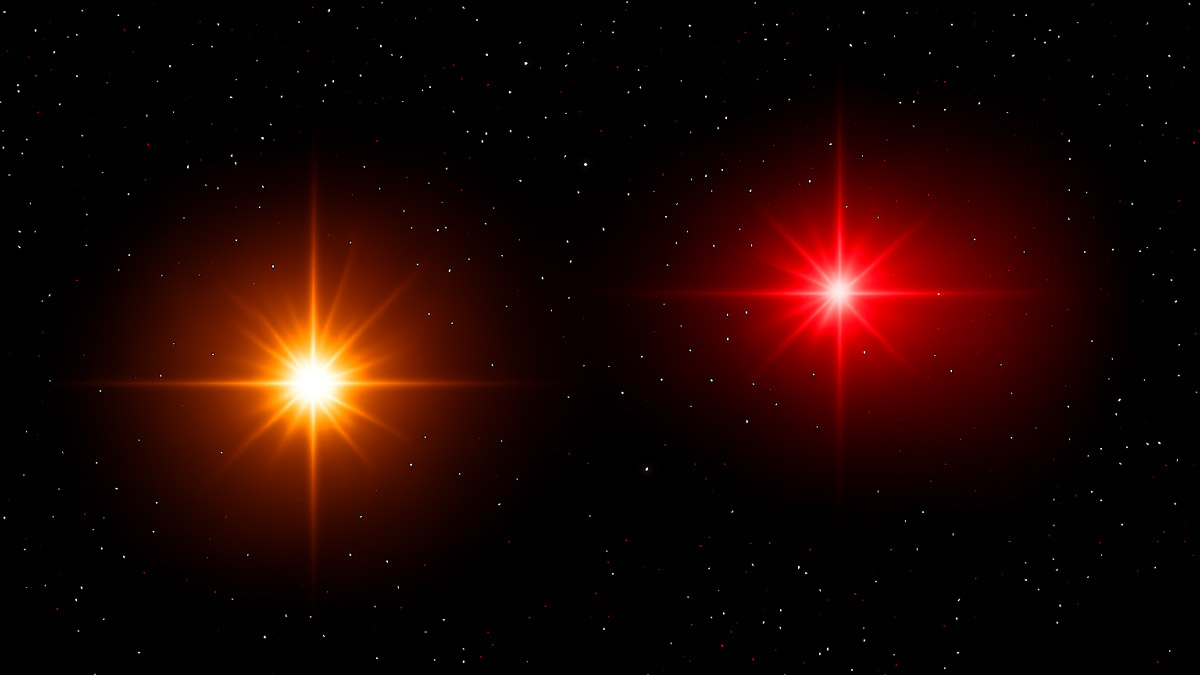
Mu Herculis, also known as μ Herculis or Struve 2220, is a star system only 27 light-years away from Earth, shining down from the constellation Hercules. It’s best viewed on summer nights.
When observing through a telescope, the initial star that catches your attention is Mu Herculis A due to its bright, warm yellow hue. This magnitude +3.4 star provides a glimpse of our sun’s appearance from a distance, as it shares a similar size and luminosity. Furthermore, astronomers believe that Mu Herculis A has a close binary companion, which is unfortunately too close to view with a backyard telescope.1
Nearby, at 35 arcseconds away, lies a dim ruby-red star, Mu Herculis B. Most observers will only see the prominent Mu Herculis A and the dim B staring back at them as a quaint double. Depending on suburban sky conditions and your telescope, you may struggle at first to resolve “B.” But keep looking. In my experience, the red star slowly started to fade in as my eyes adjusted. See more in my observation below.
To add more to the intrigue, Mu Herculis B is paired with a nearby red dwarf named Mu Herculis C!
In 1781, the esteemed astronomer William Herschel discovered the dim Mu Herculis B.
My Observations
| Date | July 3, 2023 |
| Time | 11:10 P.M. |
| Location | Seattle, WA |
| Magnification | 169x |
| Scope | Meade 8″ SCT |
| Eyepiece | 12mm |
| Seeing | Above Average |
| Transparency | Average |
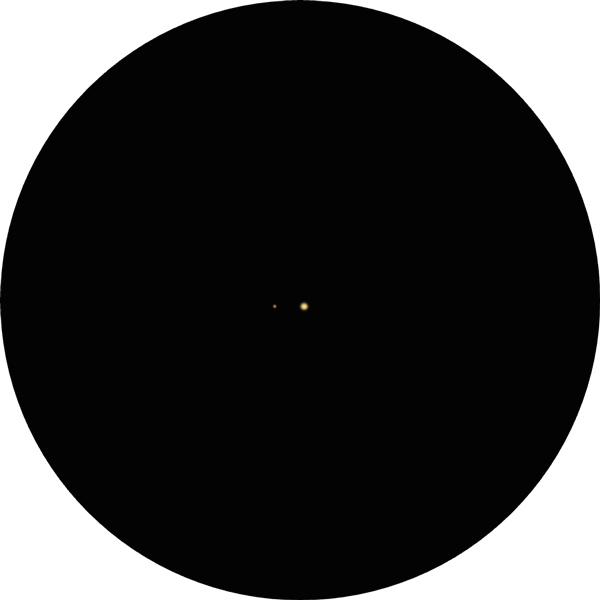
The sunset’s last traces are fading away agonizingly slow tonight, while I attempt to resolve the red dwarf star in Mu Herculis. But as I continue to stare into the eyepiece, a ruby red color “fades” in near the brilliant Mu Herculis A’s yellow-orange light. The A star color is so nice, reminding me of the middle of a candle flame. As I take in this scene, pre-4th fireworks are going off nearby, their light illuminating the darkened shadows lurking in the high trees. Tonight I have everything happening: a glowing ember in my eyepiece, fireworks to my right, and the distant sound of a baby eagle or hawk to my left.
Key Stats
| Constellation | Hercules |
| Best Viewing | Summer |
| Visual Magnitude | +3.42, +9.78 |
| Separation | 35.5″ |
| Position Angle | 249° |
| Spectral Class | Primary=G5 IV, Secondary=M3 |
| Absolute Visual Magnitude | +3.82 |
| Distance from Earth | 27 ly |
| Milky Way Location | Orion Spur |
| My Viewing Grade | B |
| Designations | 86 Her, SAO 85397, HR 6623, Struve STF 2220 |
Sources and Notes
Banner illustration was created by the European Southern Observatory (ESO) and is under the Creative Commons Attribution 4.0 International License. Per ESO agreement: Here is the original image on the ESO website.
1http://stars.astro.illinois.edu/sow/muher.html
Sketch by Wayne McGraw
 The Garden Astronomer
2 thoughts on “Mu Herculis: A Nearby Star Like Ours with a Ruby Companion”