
As you explore the lower southern skies near Sagittarius and the heart of our galaxy, you’ll discover breathtaking regions teeming with star clusters and nebulae. Unfortunately, those of us in the mid to higher latitudes may have to navigate around neighborhood trees to see all these wonderful objects.
The good news is there are a fair number of nice clusters and nebulae just above Sagittarius and Scorpio, which gives us a better shot at seeing these southern gems. One of these is a globular cluster nestled within the depths of our Milky Way galaxy called Messier 9, also known as NGC 6333.
M9 lives low in the constellation Ophiuchus. The cluster lies approximately 25,800 light-years away from Earth and 5,500 light-years away from the Galactic Center, making it one of the closer globular clusters to our solar system and the center of our galaxy.
Charles Messier first recorded M9 on May 28, 1764, noting that it was a “nebula” as he was unable to discern any individual stars in it. It would take another 20 years until astronomer William Herschel observed individual stars.1
My Observations
| Date | July 8, 2023 |
| Time | 11:35 p.m. |
| Location | Seattle, WA |
| Magnification | 169x |
| Scope | Meade 8″ SCT |
| Eyepiece | 12mm |
| Seeing | Above Average |
| Transparency | Above Average |
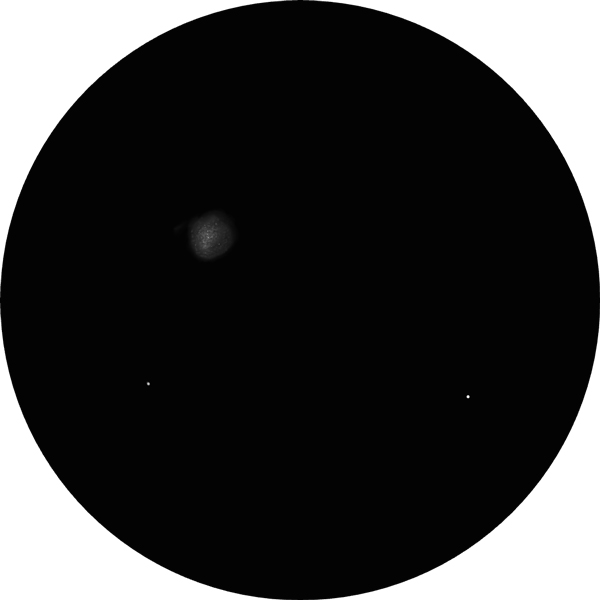
Tonight is one of the best backyard observation sessions I’ve ever had. The skies are clear; the moon is down. The night is settled, restful, and full. I decided to set the scope up further north in the yard, allowing me to see the lower south. I’ve been patiently waiting for these objects to break the tree line. M9 just did. It’s a smaller-looking tight cluster, and I’m unable to resolve any stars in it. I guess I’m like Messier, who reported the same. I believe my telescope should pick out a few single stars, but the city glow of Tacoma won’t allow it.
Key Stats
| Constellation | Ophiuchus |
| Best Viewing | Summer |
| Visual Magnitude | +7.71 |
| Absolute Magnitude | -6.78 |
| Distance from Earth | 26,000 ly |
| Diameter | 90 ly |
| Apparent Size | 12 arcmin |
| My Viewing Grade | B |
| Designations | M9, NGC 6333, M 9 |
Historical Observations
May 28, 1764, observation by Charles Messier
“Nebula, without star, in the right leg of Ophiuchus; it is round & its light is faint. Observed again on March 22, 1781. (Diam. 3′)”1
May 18, 1836, observation by John Herschel
“Globular Cluster; bright; round; gradually much brighter toward the middle; 4′ [diameter]; resolved into stars of 14th magnitude.”1
Sources
Banner photo of M9 by NASA & ESA and licensed under the Creative Commons Attribution-Share Alike 4.0 International license.
McArthur, G., & Frommert, H. (n.d.-b). Messier 9. http://www.messier.seds.org/Mdes/dm009.html
Sketches by Wayne McGraw
 The Garden Astronomer
One thought on “Messier 9 (NGC 6333): Globular Cluster Near the Heart of the Galaxy”