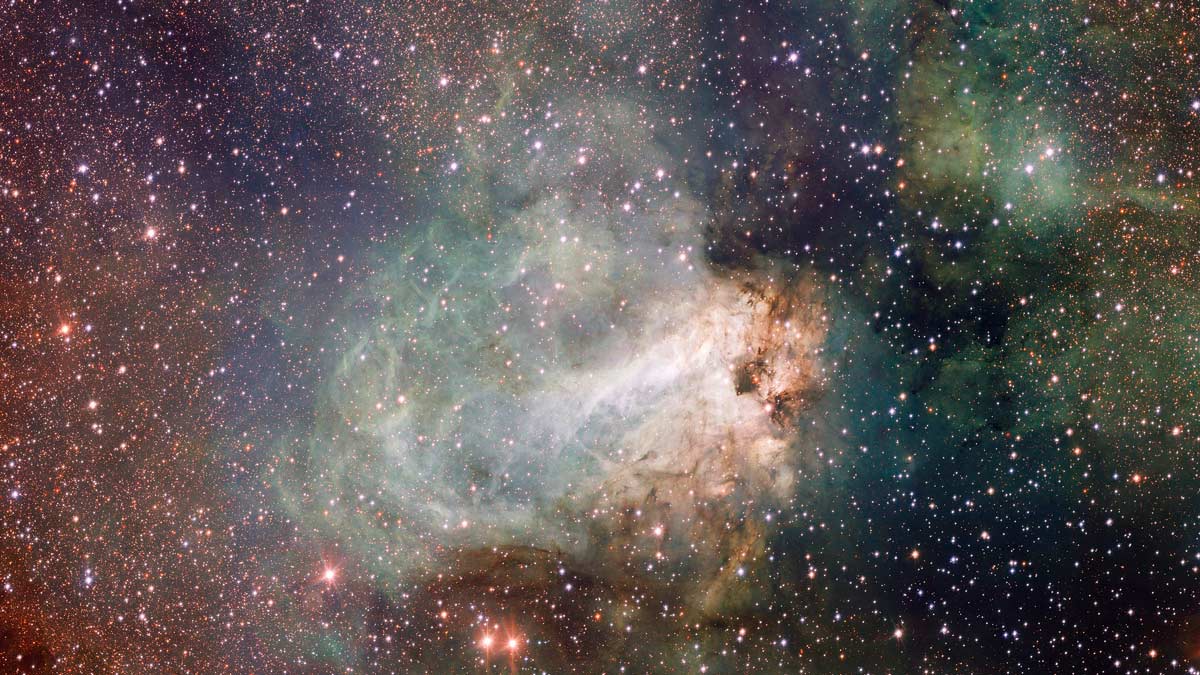
In the vast expanse of our Milky Way galaxy, amidst a sea of stars, lies an ethereal celestial beauty known as Messier 17 (M17), also known as the Swan Nebula. Named after its graceful swan-like appearance, this stellar nursery lies in the southern summer constellation of Sagittarius. Unfortunately, those of us in the mid to higher latitudes may have to navigate around neighborhood trees to see all the beautiful objects in Sagittarius.
Messier 17 is approximately 5,500 light-years away from Earth. The nebula is part of the vast complex of molecular clouds in the Milky Way, where gas and dust collide, giving birth to new stars. These clouds serve as cosmic nurseries, nurturing stellar embryos until they eventually ignite into brilliant stars, illuminating the dark cosmic canvas.
In his famous Celestial Handbook, Robert Burnham, Jr. mentions how M17 is one of the most prominent of the diffuse nebulae in the sky. And, while this nebula appears in Charles Messier’s famous catalog, the astronomer Philippe Loys de Chéseaux most likely first noted it in the spring of 1764. 1
If you’re viewing M17 through a telescope, you’ll be able to see more of its stunning nebulosity, provided that you’re observing from a dark area. However, those who stargaze from their backyard and deal with light pollution might have a harder time seeing the beauty in this region. Nevertheless, based on my observation (see below), it’s still feasible to catch a glimpse of the “s” shape or swan that forms a section of the nebulosity, even though it might only appear as a faint wisp of white vapor.
My Observations
| Date | July 9, 2023 |
| Time | 1:02 a.m. |
| Location | Seattle, WA |
| Magnification | 169x |
| Scope | Meade 8″ SCT |
| Eyepiece | 12mm |
| Seeing | Average |
| Transparency | Average |
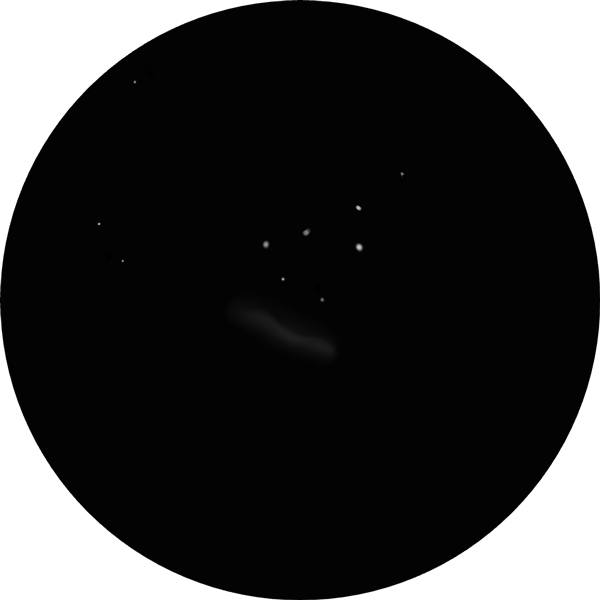
I was sketching Messier 24 around 1 a.m. and decided to pack up my supplies after successfully finding it nestled between two tree limbs. Encouraged by my luck, I then attempted to locate Messier 17. At first, I only saw a few brighter stars and wondered if I had found the correct position in the sky. Using averted vision, I noticed a thin, diagonal, fuzzy line in the nebula, which I believe to be the swan’s body. I quickly grabbed a light pollution filter and screwed it on the 12mm to improve my view. Unfortunately, M24 slid into the trees before I could get a better look. I can’t complain. Tonight was a great night of seeing southern Messier objects.
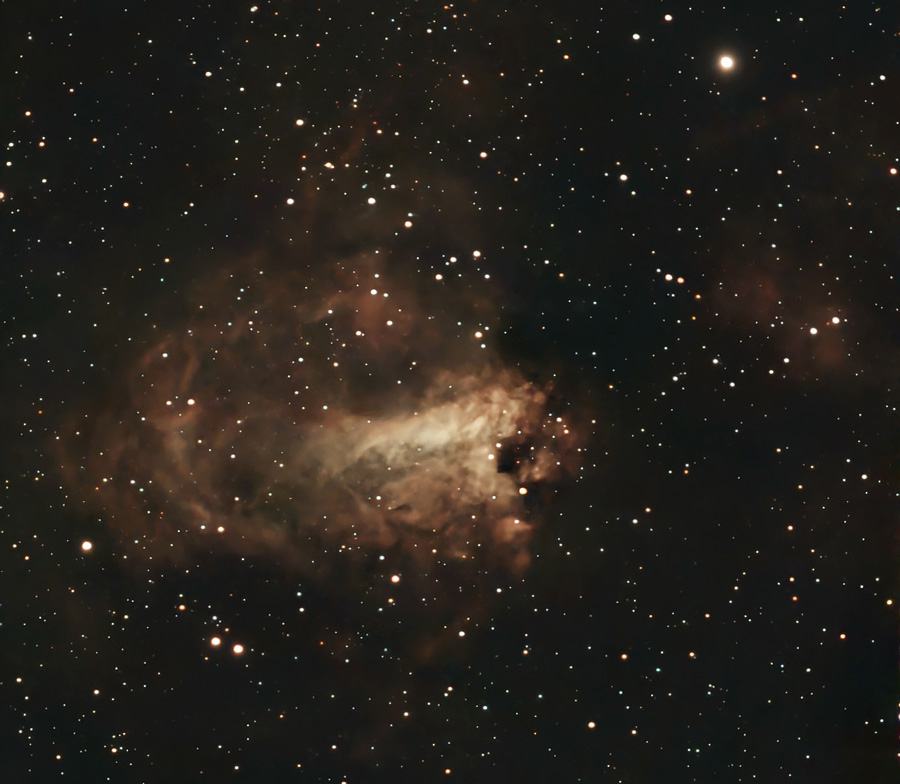
Also observed July 26, 2025, from Tampa, Florida: I’ve only had a few clear nights this summer from the Florida Suncoast with afternoon and evening storms. Tonight remained rather hazy, but at least the skies were clear. With this valuable window, I powered up the Seestar S50 to capture this wonderful nebula.
Key Stats
| Constellation | Sagittarius |
| Best Viewing | Summer |
| Visual Magnitude | +6 |
| Absolute Magnitude | -4.57 |
| Distance from Earth | 5,000-6,000 ly |
| Diameter | 56.7 ly |
| Apparent Size | 46 x 37 arcmin |
| My Viewing Grade | B |
| Designations | M17, NGC 6618, LBN 60, Checkmark Nebula, Lobster Nebula, and the Horseshoe Nebula |
Historical Observations
Spring 1764, observation by Philippe Loys de Chéseaux
“Finally, another nebula, which has never been observed. It is of a completely different shape than the others: It has perfectly the form of a ray, or of the tail of a comet, of 7′ length and 2′ broadth; its sides are exactly parallel and rather well terminated, as are its two ends. Its middle is whiter than the borders; I have found its RA for this year as 271d 32′ 35″ and its southern declination as 16d 15′ 6″. It has an angle [PA] of 50 deg with the meridian.”
June 3, 1764, observation by Charles Messier
“In the same night [June 3 to 4, 1764], I have discovered at little distance of the cluster of stars of which I just have told, a train of light of five or six minutes of arc in extension, in the shape of a spindle, & in almost the same [shape] as that in the girdle of Andromeda M31; but of a very faint light, not containing any star; one can see two of them nearby which are telescopic & placed parallel to the Equator: in a good sky one perceives very well that nebula with an ordinary [non-achromatic] refractor of 3 feet & a half.”
Sources
The banner photo of M23 is by ESO/INAF-VST/OmegaCAM. Acknowledgment: OmegaCen/Astro-WISE/Kapteyn Institute. The image is licensed under the Creative Commons Attribution-Share Alike 4.0 International license. Source here.
1 Burnham, R. (1978). Burnham’s Celestial Handbook: An Observer’s Guide to the universe beyond the solar system. Dover Publications.
2 Guy McArthur, H. F. (n.d.). Messier 17. http://www.messier.seds.org/Mdes/dm17.html
Sketches by Wayne McGraw
Article updated on July 27, 2025.
 The Garden Astronomer