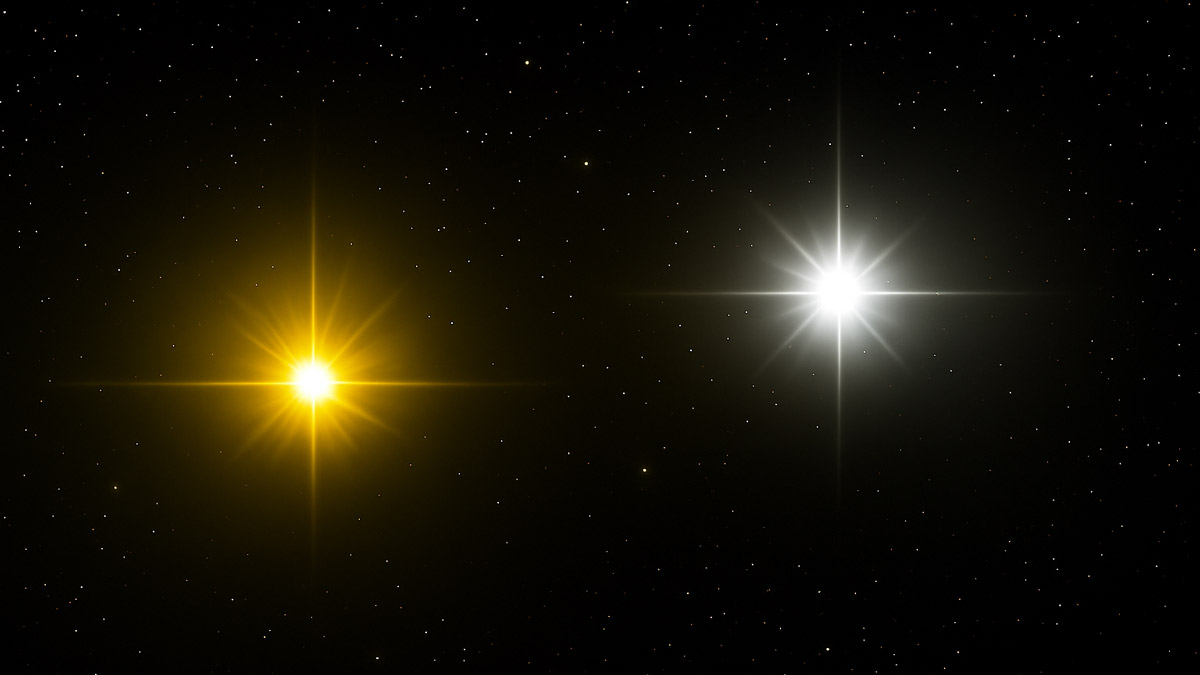
15 Aquilae, also known as h Aquilae, is an orange-yellow double star in the summer constellation of Aquila, which also lies on the celestial equator.
With a magnitude of +5.4, 15 Aquilae is visible to the naked eye from darker locations. This larger star, which happens to be 14 times the diameter of our sun, emits a pretty orange color. Astronomers classify it as a K1 III star. Meanwhile, a dimmer optical companion of magnitude +6.4 lies 39 arcseconds away.
Of note, 15 Aquilae is in the family of galactic disk stars, also known as thin disk population stars, because it follows the Milky Way’s galactic plane closely.
My Observations
| Date | July 14, 2023 |
| Time | 11:05 P.M. |
| Location | Seattle, WA |
| Magnification | 169x |
| Scope | Meade 8″ SCT |
| Eyepiece | 12mm |
| Seeing | Above Average |
| Transparency | Average |
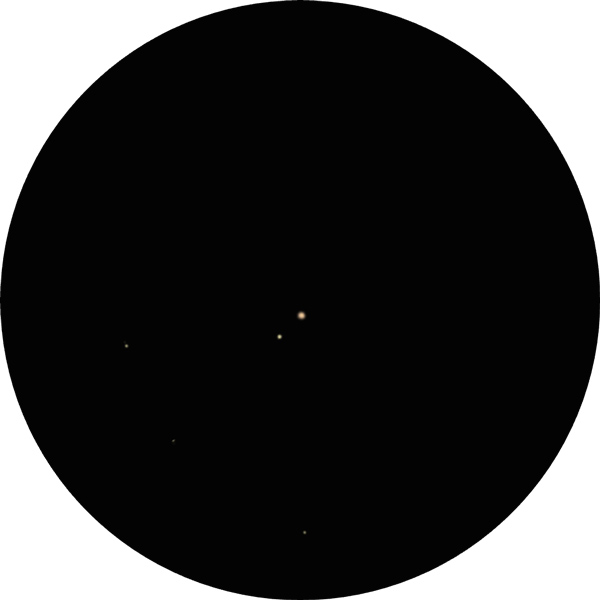
Before closing up for the night, I’ve decided to scan farther east with my scope to the constellation Aquila to observe 15 Aquilae. This double star’s orange glow illuminates my eyepiece and complements this warm July evening of stargazing. While I’m not exactly sure, the dimmer companion star also appears slightly orange-yellow. This is a good pair worth stopping for while passing through Aquila. Its warm hue offers a nice contrast to the blue-green color of the nearby double, 57 Aquilae.
Key Stats
| Constellation | Aquila |
| Best Viewing | Summer |
| Visual Magnitude | +5.40, +6.98 |
| Separation | 39.6″ |
| Position Angle | 211° |
| Spectral Class | Primary=K1 III |
| Absolute Visual Magnitude | +.66 |
| Distance from Earth | 289 ly |
| Milky Way Location | Orion Spur |
| My Viewing Grade | B+ |
| Designations | 15 Agl, HD 177463, SAO 142996, HIP 93717 |
Sources and Notes
1 Wikimedia Foundation. (2023a, February 26). 15 Aquilae. Wikipedia. https://en.wikipedia.org/wiki/15_Aquilae
Sketch by Wayne McGraw
 The Garden Astronomer