
Join me on a summer backyard adventure to discover stars of all colors. We’ll explore all the different stellar classes, from hot blue stars to cool red ones. You can observe these stars with binoculars, but using a telescope will enhance your experience. Remember to bring bug spray as we explore the colorful universe.
Before we start: A quick glance at stellar classifications
As you may have witnessed in a science class growing up, a beam of light enters a glass prism, and a rainbow of colorful lines projects out. You can then study this spectrum to determine the chemical element or molecule of its source. In our case, we can do the same thing with stars! 1
The following simplified star color chart shows the major stellar classifications. I encourage you to read more about these star classes at Britannica online, especially if you are new to this area of astronomy. Then, use any star app or chart to start your colorful journey through the summertime heavens.
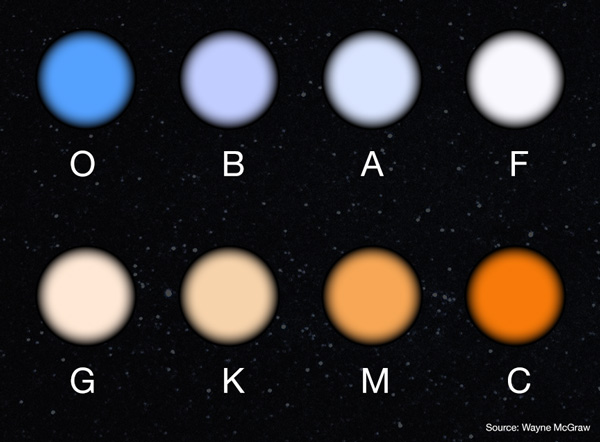
| CLASS | TEMPERATURE | COLOR |
|---|---|---|
| O | ≥ 30,000 K | Blue |
| B | 10,000–30,000 K | Blue-White |
| A | 7,500–10,000 K | White |
| F | 6,000–7,500 K | Yellow-White |
| G | 5,200–6,000 K | Yellow |
| K | 3,700–5,200 K | Light Orange |
| M | 2,400–3,700 K | Orange-Red |
| C | 1,600-3,000 K | Red |
Our colorful summertime star journey
Stellar Class O (Blue Stars)
Our journey begins with O-type stars—stellar objects that are brilliant, hot, and usually blue or blue-white in color. These are like rock stars if you ask me. They are rare, burn extremely hot for a while, and then burn out. O-type stars hold a temperature of more than 30,000k. In most cases, they will appear blue. In the summer, here are two of the more popular O-type stars. If an observation is available for the star, I’ll link to it.
- 10 Lacertae: In the constellation Lacerta at magnitude +4.9.
- Zeta Ophiuchi: In the constellation Ophiuchus at magnitude +2.6.
Stellar Class B (Blue-white Stars)
Next on this list are the B-class stars. Let’s consider them like the opening act to the rock stars above. For starters, they don’t burn as hot with temps between 10,000 and 30,000 K. But, as with the rock stars above, they pack a powerful punch with 2 to 16 times the mass of our sun!
- Alkaid: In the constellation Ursa Major at magnitude +1.7
Stellar Class A (White)
As we fly out of the rarer Class O and B air, we turn our attention to A-type stars. These stars are more common and can even host planets. Their mass ranges from 1.4 to 2.1 of our sun, and they burn at a lower temperature between 7,600 and 10,000 K. Here are a few brighter ones to check out in summer:
- Vega: In the constellation Lyra at magnitude +0.3
- Altair: In the constellation Aquila at magnitude +.8
- Denebola: In the constellation Leo at magnitude +2.1
Stellar Class F (Yellow-white Stars)
The F-type stars have masses ranging from 1.4 to 2.1 of our sun, and they burn at a lower temperature between 6,000 and 7,600 K than their Class A colleagues. What’s more, several Class F stars do support planets, though their high-energy light/radiation output would make it pretty tough for life to exist on surrounding planets. Here are a few brighter ones to check out in summer:
- Polaris (North Star): In the constellation Ursa Minor at magnitude +1.98.
- 39 Herculis: In the constellation Hercules at magnitude +5.
- Tabby’s Star (Boyajian’s Star): In the constellation Cygnus at magnitude +11.7
Stellar Class G (Yellow Stars)
Our sun belongs to this stellar family. In this class, the star masses range from .9 to 1.1 of our sun, and these stars have an effective temperature between 5,300 and 6,000 K. This star type can host planets (thank you sun!) and support living things—in contrast to Class F. People often think of these stars as yellow, but as I’ve noticed, and astronomers point out, the color of these stars is white or slightly yellow in nature. Here are a few brighter ones to check out in summer:
- The Sun: Shining down on us at magnitude -26.7.
- Xi Boötis (A): Found in the constellation Boötes at magnitude +4.7.
- Mu Herculis (A): Found in the constellation Hercules at magnitude +5.
Stellar Class K (Orange Stars)
As we leave the sun behind, we set our sights on the orange-colored Class K. In this family, the stars continue to shrink with ranges in mass from .6 to .9 of our sun and burn even cooler with an effective temperature hovering between 3,900 and 5,300 K. In contrast to the Class B and O rock stars above, these stars maintain a stable existence and have long lifespans. This star type hosts planets, but some emit strong X-rays and radiation that may not support life. Here are a few brighter ones to check out in summer:
- 61 Cygni (A): In the constellation Cygnus at magnitude +5.2.
- 70 Ophiuchi (A): In the constellation Ophiuchus at magnitude +4.2.
- Alsafi (Sigma Draconis): In the constellation Draco at magnitude +4.7.
Stellar Class M (Red-orange Stars)
This class may be last on the main stellar classification list, but not least! In fact, about 76% of the main sequence stars in our neighborhood belong to Class M. Referred to as red dwarfs, these stars are cooler in temperature ranging between 2,400 and 3,700 K. They have low luminosities. Optical aids, like a pair of binoculars or a telescope, must be used to see these orange-red gems.
- Barnard’s Star: In the constellation Ophiuchus at magnitude +9.5
- Lalande 21185: In the constellation Ursa Major at magnitude +7.5
Stellar Class C (Carbon Star)
Our journey ends here at Class C. These Carbon Stars with their ruby color make our star fields even richer. Some good targets for summer include:
- La Superba: In the constellation Canes Venatici at magnitude +4.9.
- VY Ursae Majoris: In the constellation Ursa Major at magnitude +5.9.
- UX Draconis: In the constellation Draco at magnitude +6.2.
Article Sources
Banner photo by Faik Akmd: https://www.pexels.com/photo/photo-of-night-sky-1025469/
1 Encyclopædia Britannica, inc. (n.d.). Stellar classification. Encyclopædia Britannica. https://www.britannica.com/science/stellar-classification
 The Garden Astronomer