
NGC 6811 in the constellation Cygnus features a unique dark center, often referred to as “The Hole in the Cluster.” And the best part is, you don’t need a fancy telescope to see it! Backyard astronomers with modest telescopes can catch a glimpse of it during late summer and fall evenings. This cluster is indeed unique! It’s like a ring made up of tiny diamonds.
Referred to as a “Smoke Ring of Stars,” NGC 6811 contains around 1,000 stars with 70 brighter ones. As I’ve noticed, many of the dimmer stars create an almost nebula effect, like a smoke ring, especially when viewing this cluster under suburban skies. There are plenty of brighter stars in a circle pattern to see, but no concentration of light in the center. What’s more, the cluster in the sky is as large as half a moon.1
Additionally, NGC 6811 has played a significant role in astronomy. Specifically, astronomers have discovered two exoplanets, slightly smaller than Neptune, at home in this cluster: Kepler 66b and Kepler 67b. The significance of this discovery is that exoplanets can, indeed, exist in a crowded neighborhood of stars. In 2013, Sky and Telescope covered this news, a worthy read worth your time.2
Historically speaking, the astronomer John Herschel first recorded the cluster in 1829.
My Observations
| Date | September 1, 2023 |
| Time | 9:30 p.m. |
| Location | Seattle, WA |
| Magnification | 169x |
| Scope | Meade 8″ SCT |
| Eyepiece | 12mm |
| Seeing | Average |
| Transparency | Average |
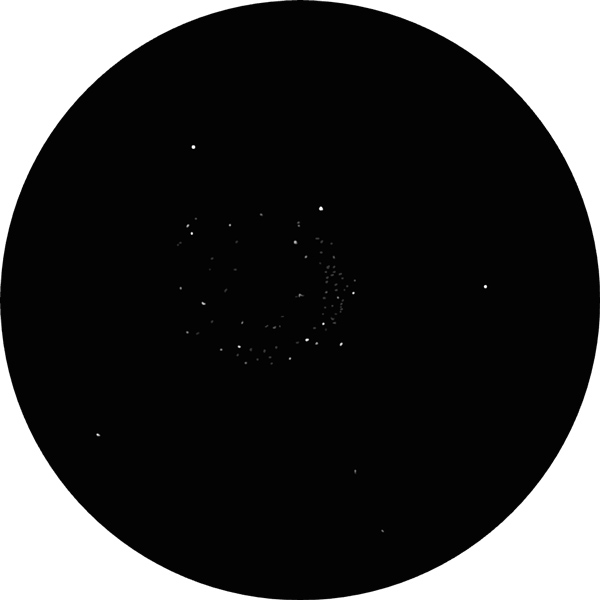
This cluster is not as bright as I was hoping. Tonight, the seeing conditions are only average, so I’ll have to target this NGC on another date. I can confirm there is a “hole” or darker area in the middle. Even though it’s dimmer than I thought it would be, NGC 6811 is a great target for backyard astronomers with a telescope. In fact, as I think about it, this is one of my favorite NGC objects!
I observed this cluster for the first time during the COVID pandemic on August 18, 2020, at 10 p.m. As I write this, three years later, in summer 2023, I reflect on all that has transpired since. Back in the summer of 2020, the world was in the midst of an ongoing crisis. I was not sketching much yet, so the original observation is not published here.
Key Stats
| Constellation | Cygnus |
| Best Viewing | Summer |
| Visual Magnitude | +6.8 |
| Absolute Visual Magnitude | -3.6.2 |
| Distance from Earth | 4,000 ly |
| Diameter | 16 ly |
| Milky Way Location | Orion Spur |
| My Viewing Grade | B |
Sources
The banner photo is by Roberto Mura – Own work, CC BY-SA 3.0, https://commons.wikimedia.org/w/index.php?curid=26035596
1Wikimedia Foundation. (2023, May 2). NGC 6811. Wikipedia. https://en.wikipedia.org/wiki/NGC_6811
2Balouchi, S. (2013, July 9). Crowded clusters host planets. Sky & Telescope. https://skyandtelescope.org/astronomy-news/crowded-clusters-host-planets/
 The Garden Astronomer