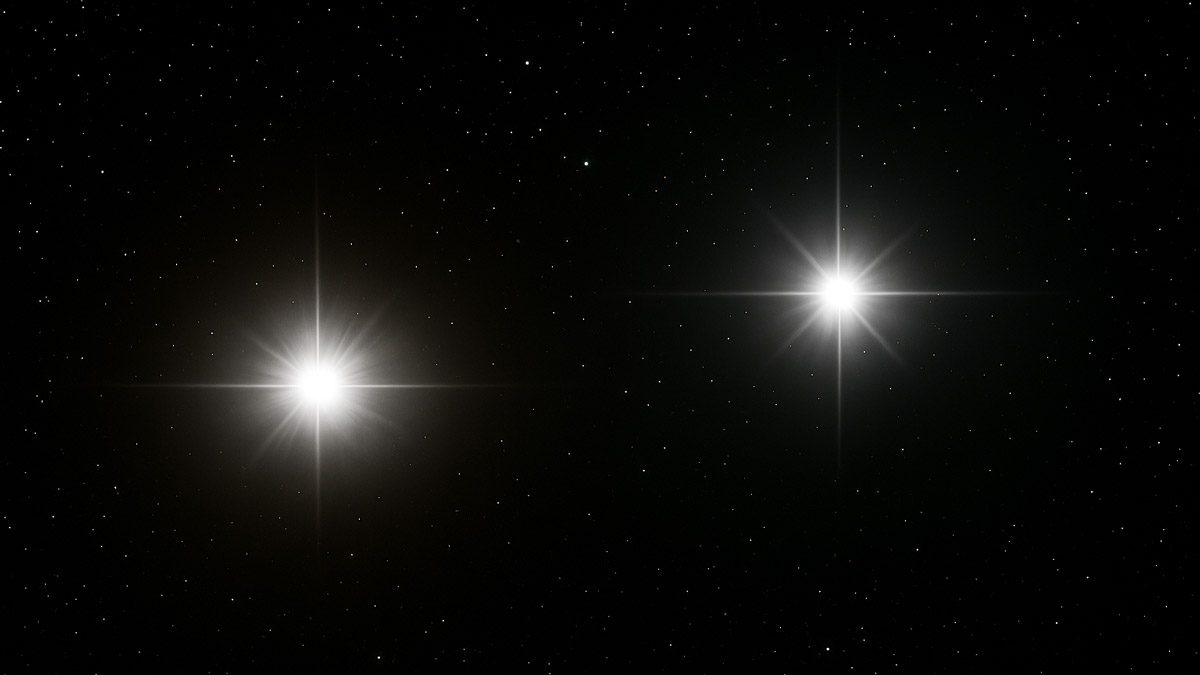
Although not as popular as other major constellations, Delphinus the Dolphin is a captivating constellation located in the northern hemisphere. It boasts a variety of nice celestial objects, including the quaint 15 Delphini multiple-star system that is visible during late summer and autumn nights.
On first look through the telescope, observers will see a close pair of stars nearly identical in magnitude. They are separated by 17.7 arc seconds. But that’s not all to the story here. Near both of these stars are several others. John Nanson discusses these additions to 15 Delphini on his Star Splitters website at length—a worthy read for sure!
As Nanson points out, this star system has received ample attention from plenty of famous astronomers in history, from Herschel to Struve to Reverand Dawes. After reading Nason’s account, I felt grateful to stare into this system, knowing so many notables have enjoyed the same view!1
Historically speaking, the astronomer William Herschel first recorded the star system on November 15, 1779.2
My Observations
| Date | September 1, 2022 |
| Time | 10:00 p.m. |
| Location | Seattle, WA |
| Magnification | 169x |
| Scope | Meade 8″ SCT |
| Eyepiece | 12mm |
| Seeing | Average |
| Transparency | Average |
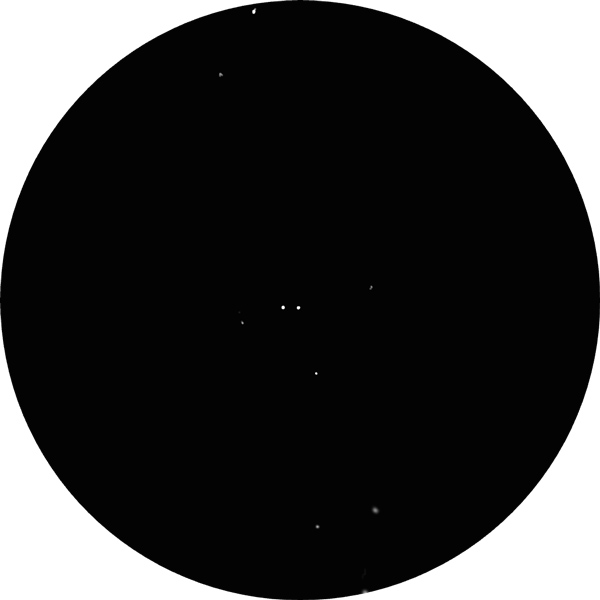
I find equally bright pairs of stars like those in 15 Delphini enjoyable. However, a rising moon is making the sky increasingly brighter, so I’ll have to postpone my search for other companions in the system. Nonetheless, I’m fascinated by the historical observations of this system and plan to return to study it further this autumn. For now, I’ll settle with admiring this charming double of white stars.
Key Stats
| Constellation | Delphinus |
| Best Viewing | Autumn |
| Visual Magnitude | +7.1, +7.4* |
| Separation | 17.7″ |
| Position Angle | 256° |
| Spectral Class | A=F5V |
| Absolute Visual Magnitude | -.17 |
| Distance from Earth | 930 ly |
| Milky Way Location | Orion Spur |
| My Viewing Grade | B |
| Designations | SAO 106196, HIP 101235, STF 2960, 15 Del |
Sources and Notes
Banner illustration was created by the European Southern Observatory (ESO) and is under the Creative Commons Attribution 4.0 International License. Per ESO agreement: Here is the original image on the ESO website.
1 Nanson, J. (2014, November 24). A smorgasbord of Delphinian delights, part one: Σ 2690, Eng 74, and the entanglement of BRT 1344 with lau 4. Star-Splitters. https://bestdoubles.wordpress.com/2014/11/08/a-smorgasbord-of-delphinian-delights-part-one-%CF%83-2690-eng-74-and-the-entanglement-of-brt-1344-with-lau-4/
2 William Herschel’s double star catalog. (n.d.). http://www.handprint.com/ASTRO/Herschel_All.html
Sketch by Wayne McGraw
 The Garden Astronomer