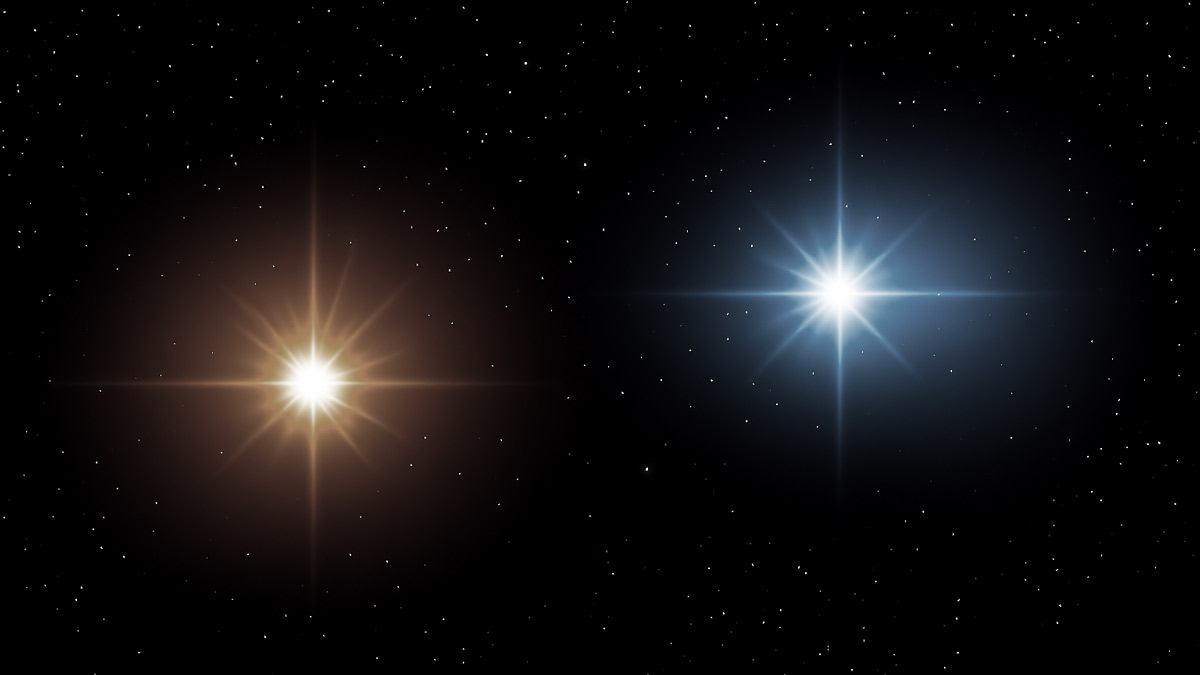
On the evening of August 19, 1780, astronomer William Herschel swept through the stars in the constellation Sagitta and discovered the subtle yet colorful double star known as Epsilon Sagittae. The next time you’re out on a summer night, be sure to look toward the southern sky to find this lovely star pair.
Epsilon Sagittae sits near the “feathers” end of this celestial arrow, not far from the more prominent Alpha and Beta Sagittae. Though its apparent magnitude of around +5.7 puts it on the edge of naked-eye visibility, it stands out beautifully when split into its two components through binoculars or a small telescope.
The yellow primary star shines at a magnitude of +5.7. Its companion, at magnitude 8.36, sits roughly 88.9 arcseconds away with a soft blue color. The wide separation between the stars makes this an easy pair to split, even with steady binoculars. Despite their proximity in the sky, the two stars are not physically related; the secondary is simply a line-of-sight neighbor.
My Observations
| Date | September 14, 2023 |
| Time | 9:30 p.m. |
| Location | Seattle, WA |
| Magnification | 169x |
| Scope | Meade 8″ SCT |
| Eyepiece | 12mm |
| Seeing | Above Average |
| Transparency | Above Average |
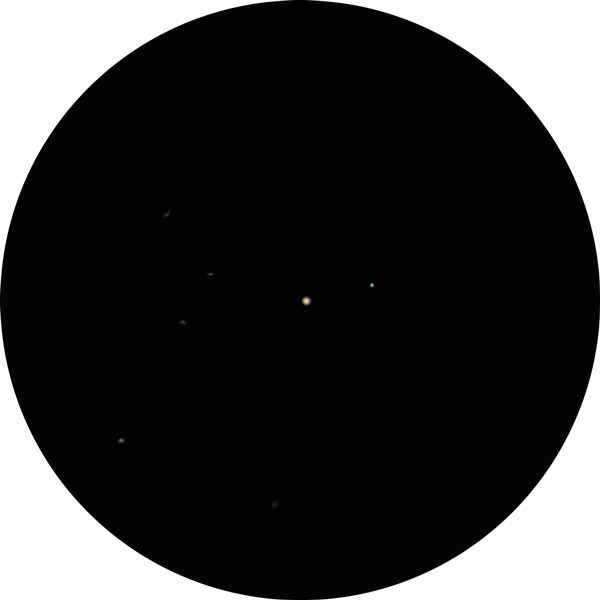
The primary star glows with a warm, golden-yellow hue, commanding attention at the center of the view. The fainter companion appears as a delicate point of light, tinged with a soft, hazy blue. The subtle interplay between the golden primary and its cool-toned partner makes this pair a visual delight.
Key Stats
| Constellation | Sagitta |
| Best Viewing | Summer |
| Visual Magnitude | + 5.77 | +8.35 |
| Separation | 87.4″ |
| Position Angle | 82.8° |
| Distance | 480 ly |
| My Viewing Grade | B |
| Designations | SAO 105061, HD 185194, 4 Sagittae, Eps Sge, HIP 96516, HR 7463, H VI 26, ε Sge |
Sources and Notes
Sketch by Wayne McGraw
 The Garden Astronomer
One thought on “Epsilon Sagittae: A Warm Yellow and Pale Blue Double Star in Sagitta”