
Struve 2816 and 2819 reside in the constellation Cepheus, which represents a mythical king in Greek mythology. This much-loved autumn constellation boasts several remarkable celestial objects, including this set of double and triple stars first observed by William Herschel on September 27, 1782.
For me, few things match the allure of seeing numerous pairs of stars together in the eyepiece. Epsilon Lyrae and Struve 2470/2474 rush to mind. Joining this elite group of gems are Struve 2816 and 2819. They are nestled in the center of the rich Trumpler 37 star cluster, which is surrounded by the large emission nebula IC 1396.
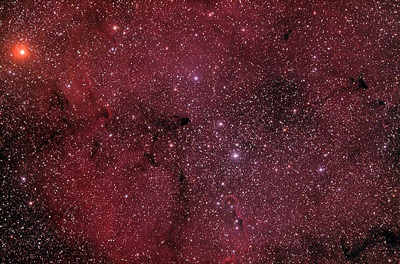
Creative Commons photo by Anton Vakulenko.
Struve 2816
Struve 2816 is a beautiful triple star system that consists of a pale yellow primary star (component A) and two dimmer blue-white colored stars (components C and D). The magnitude of Component A is +5.7. What’s fascinating is Component A’s O6V stellar classification. Typically, an O-type blue star is expected to appear blue in the eyepiece, but Component A appears yellow in this case. It highlights how the eye can perceive the colors of stars differently, especially with double stars.
Components C and D are classified as type B stars, which is why their blue-white appearance is more in line with their stellar type. Component C is located at a distance of 11.8 arcseconds and has a magnitude of +7.48. The other companion, Component D, is situated a little further away at 20.6 arcseconds and has a slightly lower brightness at magnitude +7.53.
Struve 2819
Near Struve 2816, you’ll find a nice pair of yellow stars known as Struve 2819. The primary star shines at a magnitude of +7.4 with a stellar class of F5V. The secondary dimmer star lies 12.7 arcseconds away and shines at a magnitude of +8.6. These two stars are physically related, so they orbit a common center of mass.
My Observations
| Date | September 15, 2023 |
| Time | 10:10 p.m. |
| Location | Seattle, WA |
| Magnification | 169x |
| Scope | Meade 8″ SCT |
| Eyepiece | 12mm |
| Seeing | Average |
| Transparency | Average |
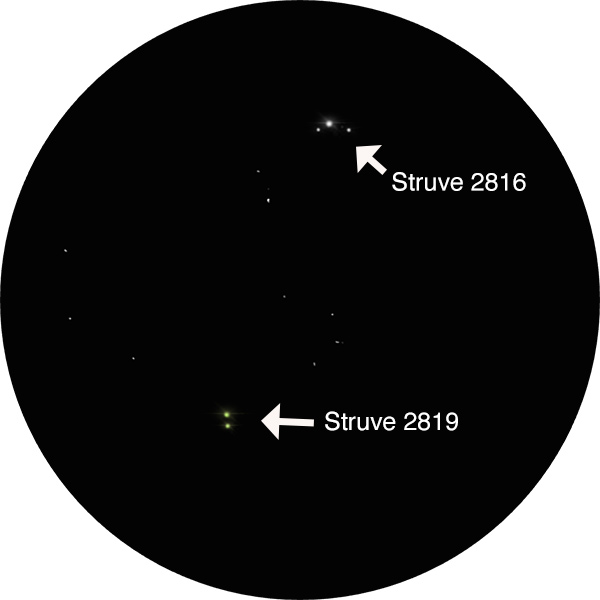
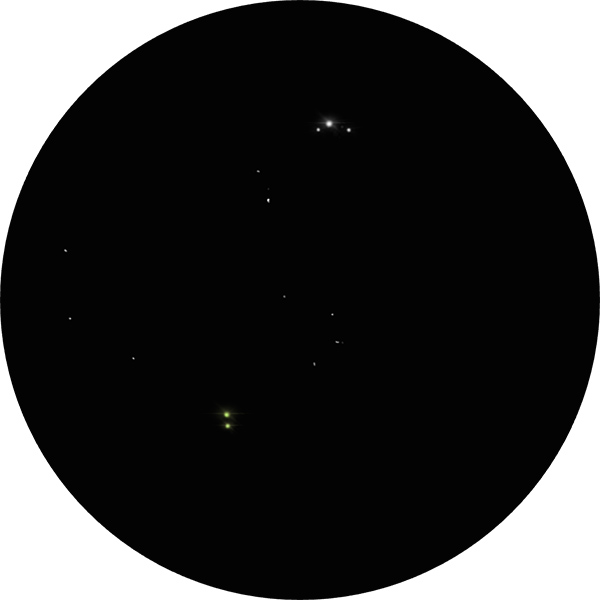
What a remarkable area of the sky! I love how one can see these pairs of stars all together in the eyepiece. With my 12mm eyepiece, I can take a close look at both systems in the same field of view. As I take this view in tonight, I’m struck by all the star colors in one view—from the glowing yellow primary star in Struve 2816 alongside its blue and dimmer companions. Then, you have the faint light yellow stars in Struve 2819 to complete the picture.
Key Stats
Struve 2816
| Visual Magnitude | 5.7 | 7.5 | 7.5 |
| Separation | AC=11.8 | AD = 20.6 |
| Position Angle | AC=119° | AD=338° |
| Distance from Earth | 1976 ly |
| Designations | SAO 33626, HD 206267, HR 8281 |
Struve 2819
| Visual Magnitude | 7.4 | 8.6 |
| Separation | 12.7″ |
| Position Angle | 58.4° |
| Distance from Earth | 960 ly |
| Designations | SAO 33652, HD 206482 |
Sources and Notes
Illustration of Mintaka by Pablo Carlos Budassi is licensed under the Creative Commons Attribution-Share Alike 4.0 International license. Details here.
Sketch by Wayne McGraw
 The Garden Astronomer