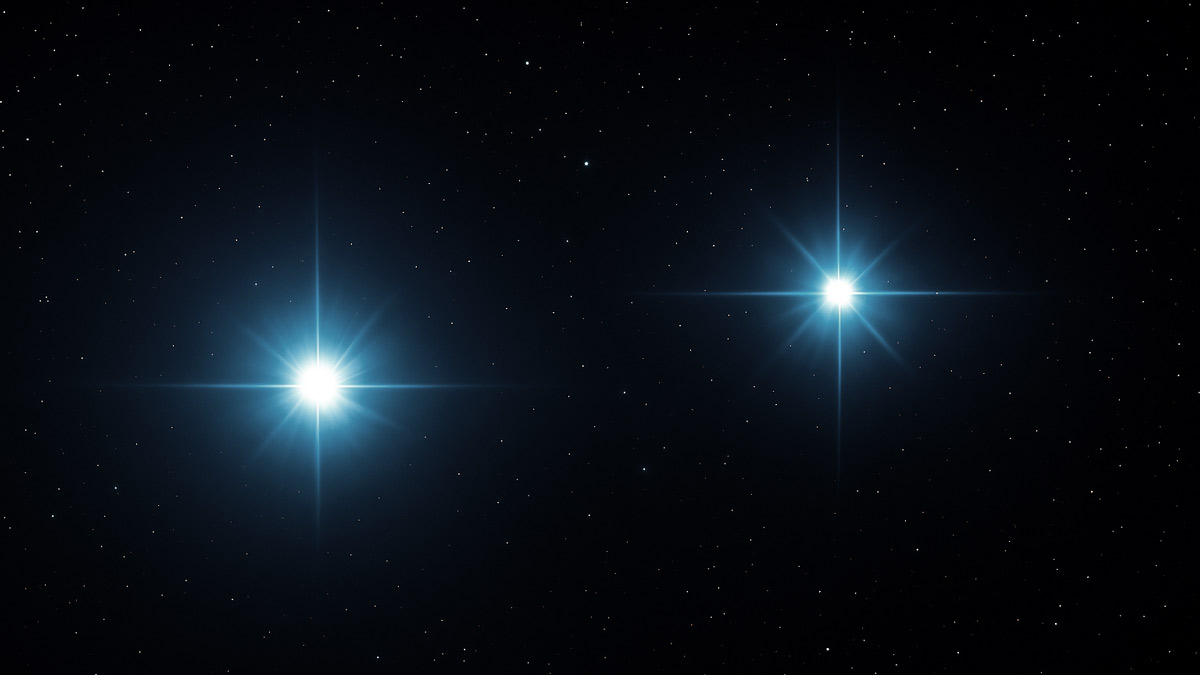
Within the winter constellation of Orion, the celestial hunter, lies Struve 700, also known as V1804 Orionis. This double star system, near the constellation’s iconic belt, is a pretty pair of white-blue stars, which William Herschel first discovered on January 9, 1783.
Struve 700 comprises two stars, designated as A and B, locked in a gravitational dance. The brighter of the pair, Struve 700A, shines with an apparent magnitude of 7.6, while its companion, Struve 700B, glimmers at a slightly fainter magnitude of 7.9. The two stars are separated by a distance of 4.8 arcseconds, making for a tight pair for backyard scopes. The pair lies 760 light-years away.1
More Than Meets the Eye
For many years, it was assumed that Struve 700 was a simple visual binary. However, modern research suggests a more complex story. The brighter of the two stars is an Algol-type eclipsing variable. This means the primary star’s brightness fluctuates slightly as the secondary star passes in front of it from our point of view, blocking some of its light. While this variability is often too subtle for the casual observer to detect, it adds another layer of intrigue to this system.
My Observations
| Date | September 16, 2023 |
| Time | 6:00 a.m. |
| Location | Seattle, WA |
| Magnification | 169x |
| Scope | Meade 8″ SCT |
| Eyepiece | 12mm |
| Seeing | Above Average |
| Transparency | Above Average |
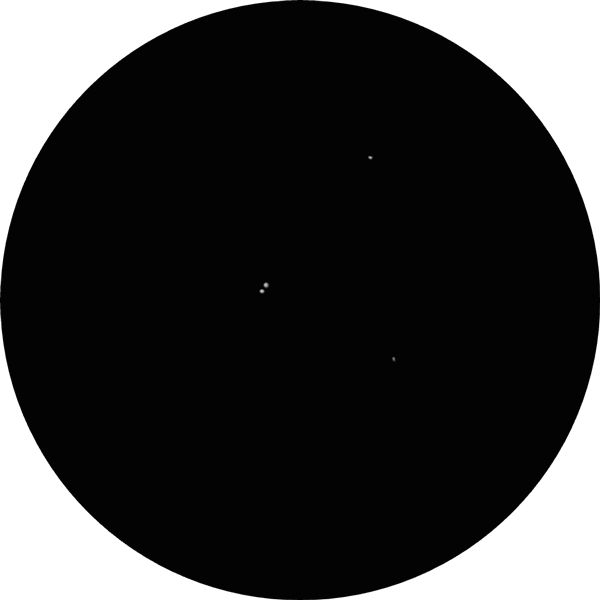
This is the first time I’ve observed in the early morning since starting this site. Autumn is just around the corner, and I can feel it in the cool morning air. The world is peaceful and quiet, as if it’s finally getting some rest. Orion appears from behind the eastern trees, reminding me of late August nights when I would stay up all night, watching the stars until the first sign of Orion appeared.
It’s as if the hunter is calling winter to come. I know that soon the rains of the Pacific Northwest will return, and these early morning moments will disappear. But for now, I will savor every moment. As I review my list of doubles, I focus on Struve 700. A lovely bluish pair of stars that perfectly matches the light blue sky catches my eye. I’m thankful for moments like this in life. I’ll make sure to revisit this pair when winter comes to the land.
Key Stats
| Constellation | Orion |
| Best Viewing | Winter |
| Visual Magnitude | +7.6 | +7.9 |
| Absolute Visual Magnitude | +.84 |
| Distance from Earth | 760 ly |
| Separation | 4.8″ |
| Position Angle | 4° |
| Milky Way Location | Orion Spur |
| My Viewing Grade | B+ |
| Designations | SAO 112704, HD 35192, STF 700, HIP 25174 |
Sources and Notes
1 (N.d.). Retrieved from http://www.handprint.com/ASTRO/Herschel_All.html
Sketch by Wayne McGraw
 The Garden Astronomer
One thought on “Struve 700 (V1804 Orionis): Double Blue in Orion’s Winter Cool”