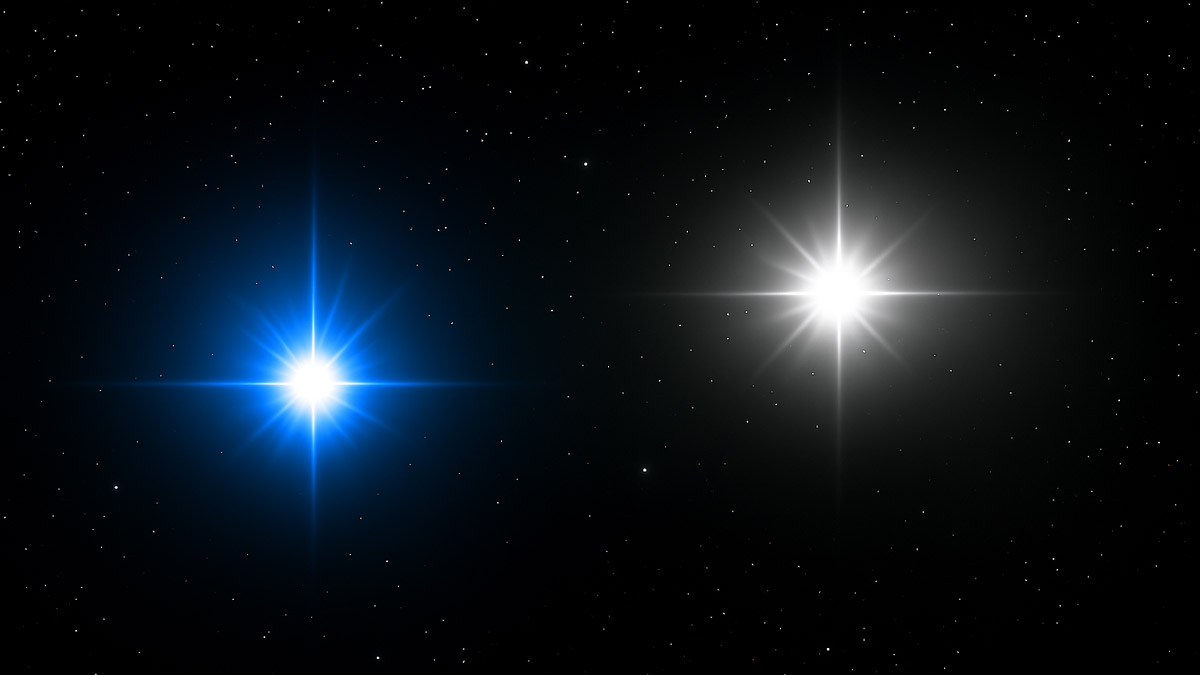
Kappa Cephei, also known as κ Cep, is a binary star located in the Cepheus constellation. This constellation, which is named after a legendary king of Ethiopia, is situated in the celestial tapestry of the northern hemisphere. Although Cepheus is always visible in the sky and never goes below the horizon, it is best observed during autumn when high in the sky.
Kappa Cephei’s two stars are gravitationally bound, waltzing around a common center of mass. The primary star, Kappa Cephei A, is a blue giant at a bright 4.4 magnitude, a luminous celestial beacon that has evolved beyond its main sequence stage. It appears as a brilliant blue-white point of light. Meanwhile, its companion, Kappa Cephei B, is an A-type main-sequence star, slightly smaller and less luminous than its stellar partner. It shimmers at 8.3 magnitude with a fainter gray-white hue.
Kappa Cephei lies roughly 323-326 light years away from us. When observed through a telescope, it appears as a nice, tight binary system with two stars separated by 7.2 arcseconds. This system is especially appealing because one star is brighter than the other. To split the pair, you’ll need ample magnification depending on your scope.
Historically speaking, the astronomer William Hershel first recorded this pair on September 27, 1782, remarking it as a beautiful double star of unequal bright pairs.1
My Observations
| Date | October 6, 2023 |
| Time | 9:00 p.m. |
| Location | Seattle, WA |
| Magnification | 169x |
| Scope | Meade 8″ SCT |
| Eyepiece | 12mm |
| Seeing | Above Average |
| Transparency | Above Average |
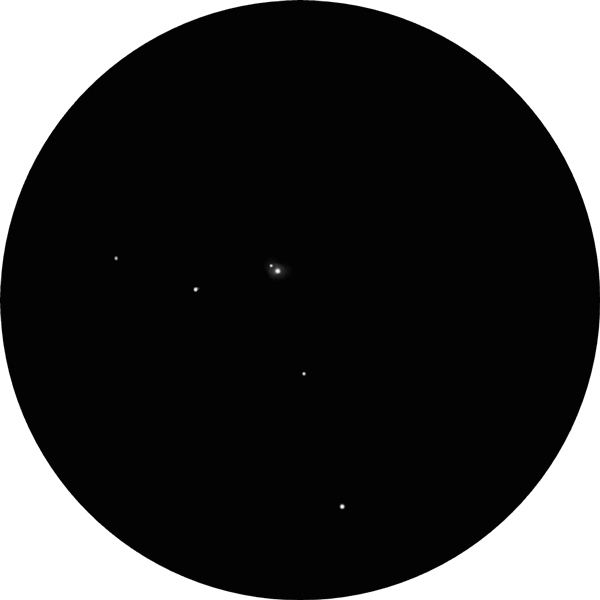
Every time I revisit the Cepheus constellation, I am delighted by the new discoveries that I stumble upon in this vast and abundant region of the sky. Kappa Cephei is a recent addition to the treasure trove of celestial objects in this area. The primary star appears to be white-blue in color, while the secondary star, located nearby, seems to be gray-white.
Key Stats
| Constellation | Cepheus |
| Best Viewing | Autumn |
| Visual Magnitude | +4.4 | +8.3 |
| Absolute Visual Magnitude | -.52 |
| Distance from Earth | 323–326 ly |
| Separation | 7.2″ |
| Position Angle | 120° |
| Milky Way Location | Orion Spur |
| My Viewing Grade | B+ |
| Designations | SAO 9665, 1 Cephei, HD 192907, HIP 99255, HR 7750 |
Sources and Notes
Banner adapted from an illustration created by Pablo Budassi. The illustration is licensed under the Creative Commons Attribution-Share Alike 4.0 International license. Full details here.
1 (N.d.). Retrieved from http://www.handprint.com/ASTRO/Herschel_All.html
Sketch by Wayne McGraw
 The Garden Astronomer