
The binary star Omicron Cephei is located in the northern sky, within the constellation Cepheus. The constellation takes its name from Cepheus, a mythical king in Greek mythology, and it boasts several remarkable celestial objects, with Omicron Cephei being one of them.
Astronomy enthusiasts who observe from their backyards will find Omicron Cephei to be a challenging yet fulfilling target. The pair is separated by only 3.4 arcseconds, which makes it difficult to distinguish them. You will need a moderately sized telescope to observe them properly. As I mention in my observations below, I used a 12mm eyepiece with a 2x barlow lens to clarify the binary star in my telescope.
This binary system comprises two contrasting stars, locked in a graceful cosmic dance. The primary star, Omicron Cephei A, is a F-type main sequence star, slightly larger and more luminous than our own Sun. Its companion, Omicron Cephei B, is a G-type giant star, significantly larger and brighter than its stellar partner. The pair lie 203 light years away from us.1
Historically speaking, the astronomer Friedrich Georg Wilhelm von Struve first determined the binary nature of this pair in 1832.
My Observations
| Date | October 6, 2023 |
| Time | 8:56 p.m. |
| Location | Seattle, WA |
| Magnification | 169x |
| Scope | Meade 8″ SCT |
| Eyepiece | 12mm with 2x Bar |
| Seeing | Average |
| Transparency | Average |
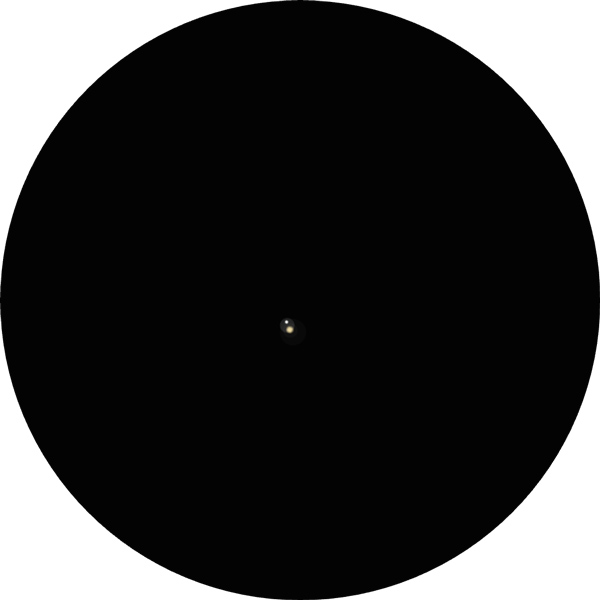
This was a challenging pair to resolve initially. I began my observation using a 12mm eyepiece and noticed an elongated, orange point of light. I then added the 2x Barlow lens, which allowed me to clearly see the two stars. The primary, brighter star has a darker yellow or amber hue, while the fainter secondary star appears gray-white, although it’s difficult to be certain.
Key Stats
| Constellation | Cepheus |
| Best Viewing | Autumn |
| Visual Magnitude | +4.9, +7.2 |
| Separation | 3.4″ |
| Position Angle (between AB & C) | 223° |
| Spectral Class | A=F, B=G |
| Absolute Visual Magnitude | +3.31 |
| Distance from Earth | 203 ly |
| Milky Way Location | Orion Spur |
| My Viewing Grade | B+ |
| Designations | SAO 20554, STF 3001, HIP 115088 |
Sources and Notes
The banner illustration was created by the European Southern Observatory (ESO) and is under the Creative Commons Attribution 4.0 International License. Per ESO agreement: Here is the original image on the ESO website.
1 23186+6807 STF 3001 AB (Omi Cep). WDS 23186+6807 STF 3001 AB (Omi Cep). (n.d.). https://www.stelledoppie.it/index2.php?menu=39&iddoppia=103392
Sketch by Wayne McGraw
 The Garden Astronomer
One thought on “Omicron Cephei: A Challenging but Rewarding Pair in Cepheus”