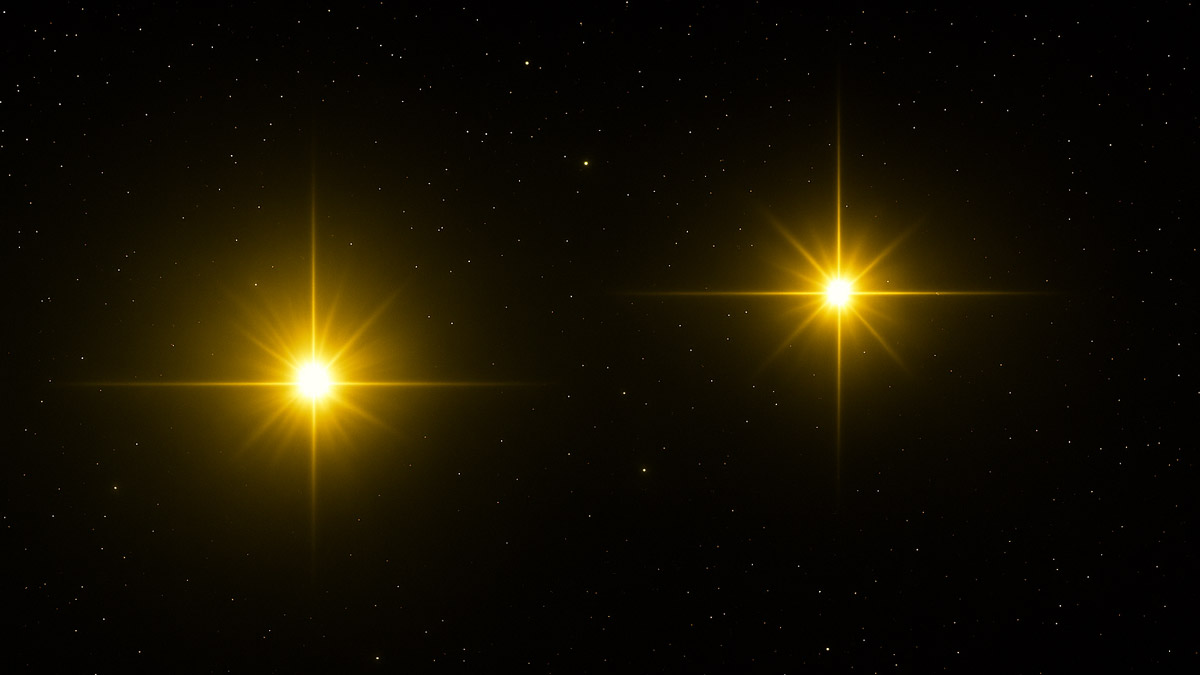
This binary star system appears yellow in color and can be found in the Cygnus constellation. It is best viewed during late summer and early autumn. Cygnus hosts several notable binary stars, including Albireo, which is considered one of the most beautiful double stars in the night sky.
The binary system, Struve 2486, was first recorded in 1819 by astronomer Friedrich Georg Wilhelm Struve. It can be easily observed through most modest backyard telescopes. Both stars in this binary system are bright and yellow and have a similar magnitude. The primary star has a magnitude of +6.5 and belongs to the yellow G2V spectral class. Similarly, its companion star belongs to the yellow G3V spectral class and has a magnitude of +6.7. The two stars are separated by a distance of 7 arcseconds. Struve 2486 is located about 80 light years away from Earth and is quite an attractive binary system to observe.
This site provides a good orbital illustration of these two stars.
My Observations
| Date | October 28, 2023 |
| Time | 9:00 p.m. |
| Location | Seattle, WA |
| Magnification | 169x |
| Scope | Meade 8″ SCT |
| Eyepiece | 12mm |
| Seeing | Above Average |
| Transparency | Above Average |

Tonight, the region is experiencing near-freezing temperatures combined with 80% humidity. Despite this, the skies directly above me are clear and tranquil. Cygnus is moving towards the west while the winter stars rush from the eastern horizon. The buttery stars of Struve 2486 remind me of the past summer. It’s a great binary to enjoy!
Key Stats
| Constellation | Cygnus |
| Best Viewing | Autumn |
| Visual Magnitude | +6.5 | +6.7 |
| Separation | 7″ | 302 AU |
| Position Angle | 202.8° |
| Distance | 80 ly |
| My Viewing Grade | B+ |
| Designations | SAO 48192, HIP 94336, HR 7293 |
Sources and Notes
19121+4951 STF 2486 AB (HD 179958). WDS 19121+4951 STF 2486 AB (HD 179958). (n.d.). https://www.stelledoppie.it/index2.php?iddoppia=79491
 The Garden Astronomer