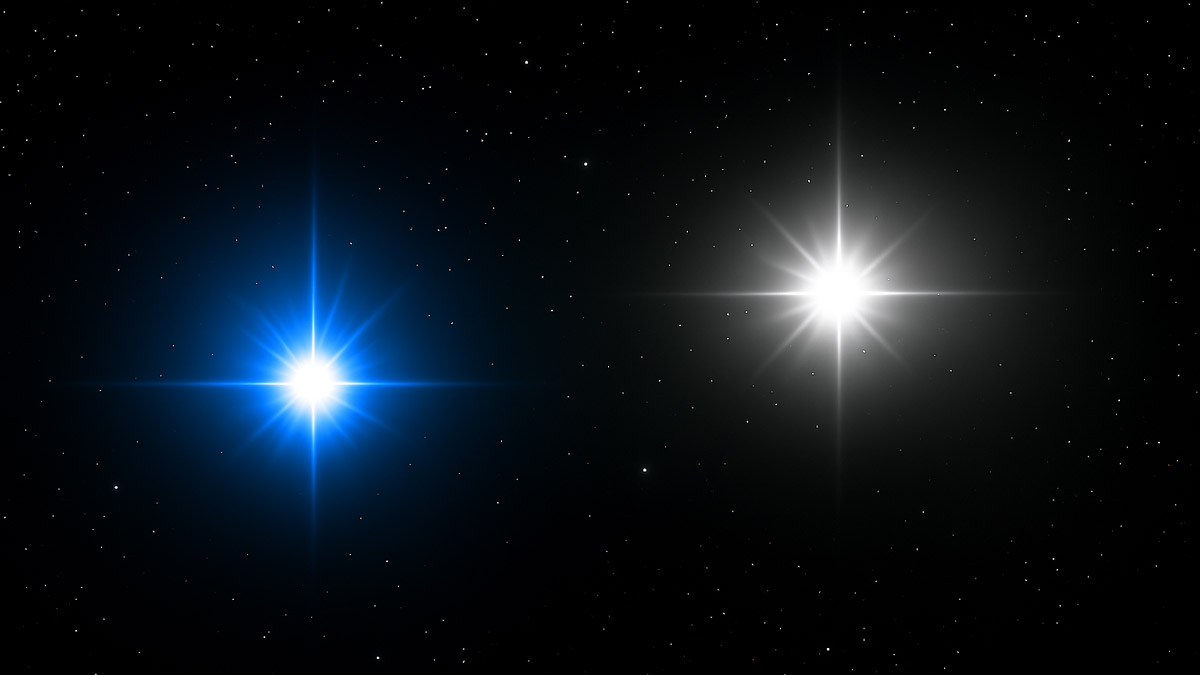
14 Aurigae is a multiple-star system featuring a bright pair of stars in the constellation Auriga, the Charioteer. Auriga is most prominent during winter evenings in the Northern Hemisphere. Put on a warm jacket and gloves and head out on cooler nights to view this pair first recorded by William Herschel on September 24, 1780.1
The magnitude +5 primary star shines white and is classified as stellar type A9IV. The dimmer viewable secondary star, at magnitude +7.3, appears blue in color to other observers and me, though it is classified as a yellow-white F2V star. The two stars are separated by 14 arcseconds and lie 286 light-years away from Earth.
For a comprehensive review of 14 Aurigae, including its role in stellar evolution, I recommend Jim Kaler’s 14 Aurigae post.
My Observations
| Date | November 24, 2023 |
| Time | 9:57 p.m. |
| Location | Seattle, WA |
| Magnification | 169x |
| Scope | Meade 8″ SCT |
| Eyepiece | 12mm |
| Seeing | Above Average |
| Transparency | Above Average |

14 Auriga joins a family of beautiful objects in Auriga, from the alluring 41 Aurigae to the bright Messier objects (namely M 36, 37, and 38).
14 Aurigae’s brighter primary appears off-white. As I stare at it, it seems to put off a tinge of yellow. Meanwhile, the nearby dimmer secondary appears pale blue.
Key Stats
| Constellation | Auriga |
| Best Viewing | Winter |
| Visual Magnitude | +5.0 | +7.3 |
| Separation | 14″ |
| Position Angle | 225° |
| Spectral Class | A9IV & F2V |
| Milky Way Location | Orion Spur |
| My Viewing Grade | A- |
| Designations | SAO 57799, 14 Aur, HD 33959, HR 1706, KW Aurigae |
Sources and Notes
1 William Herschel’s double star catalog. (n.d.). https://www.handprint.com/ASTRO/Herschel_All.html
Sketch by Wayne McGraw
 The Garden Astronomer
One thought on “14 Aurigae (Struve 653): A Multiple Star System in Auriga”