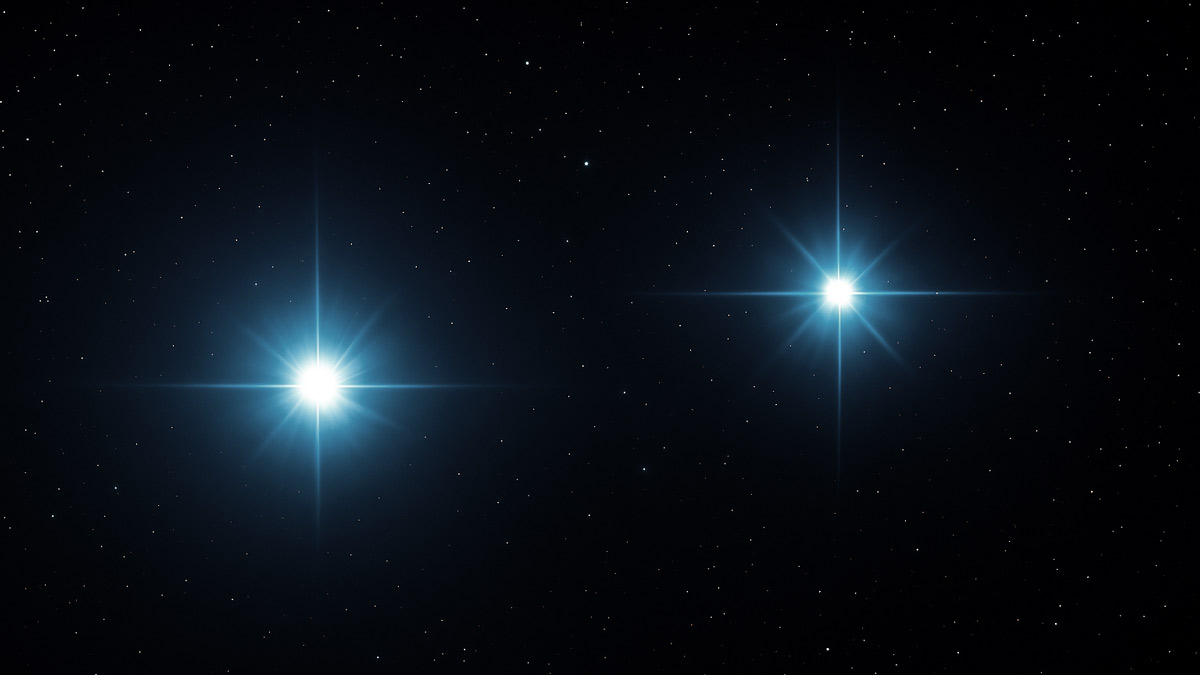
In the autumn constellation of Perseus, Epsilon Persei shines with a beautiful blue-white hue. Backyard astronomers will appreciate the star’s pretty aquamarine color and the challenge of seeing the dim nearby companion star. The famed astronomer William Herschel first recorded this celestial jewel on August 8, 1780.1
Epsilon Persei’s primary star shines at magnitude +2.8, plenty bright enough to see from darker suburban areas with the naked eye. It’s a massive, hot, and luminous blue-white giant eight times larger than our sun with a spectral classification of B0.5V.2 It lies 638 light years away from us.
A dim magnitude +8.9 companion star lies in strong contrast to the bright primary. The secondary makes its home only 8.8 arcseconds away from the primary. Because of this, one needs a higher-power eyepiece and modest scope to see it hiding among the primary star’s bright glow. But once you see the two stars together, you can’t stop staring at them. The small white star nestled by the glowing large blue star creates a great visual contrast.
Most sources refer to Epsilon Persei as a multiple-star system. According to Jim Kaler, there’s evidence of a very close companion star and a spectral class K dwarf star some 78 arcseconds away.
My Observations
| Date | December 16, 2023 |
| Time | 8:17 p.m. |
| Location | Seattle, WA |
| Magnification | 254x |
| Scope | Meade 8″ SCT |
| Eyepiece | 8mm |
| Seeing | Average |
| Transparency | Average |
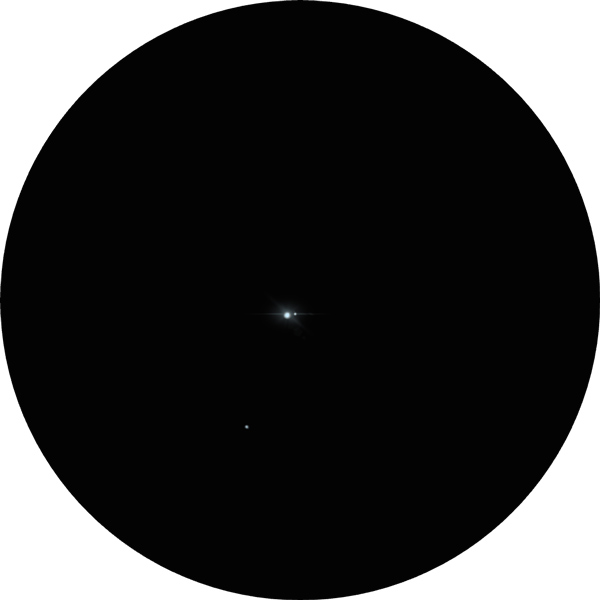
The smoke from nearby chimneys wafts, and I momentarily worry about my scope’s optics. But I know I can’t stop as it’s a rare clear and moonless night in the Pacific Northwest. So I enter Struve 471 into my navigation and land on this most piercing aquamarine light, which reminds me of a light blue LED Christmas bulb.
Through the 12mm eyepiece, I stare at Epsilon Persei, and I can’t distinguish the dim companion in the wavy light. I change over to my 8mm eyepiece (254x power), and the magnitude 9 star falls into view. What a piercing light this is, also known by its proper name of Adid Australis. In fact, this is becoming one of my favorite stars.
Key Stats
| Constellation | Perseus |
| Best Viewing | Autumn |
| Visual Magnitude | +2.8 | +8.8 |
| Separation | 8.8″ |
| Position Angle | 11.8° |
| Spectral Class | B0.5V & A2V |
| Milky Way Location | Orion Spur |
| My Viewing Grade | A |
| Designations | Struve 471, STF 471, HD 24760, SAO 56840, HR 1220, Eps Per, HIP 18532, Adid Australis, 45 Per |
Sources and Notes
1 William Herschel’s double star catalog. (n.d.). https://www.handprint.com/ASTRO/Herschel_All.html
203579+4001 STF 471 AB (EPS per). WDS 03579+4001 STF 471 AB (Eps Per). (n.d.). https://www.stelledoppie.it/index2.php?iddoppia=13699
Sketch by Wayne McGraw
 The Garden Astronomer
One thought on “Epsilon Persei (Struve 471): An Aquamarine Celestial Jewel in Perseus”