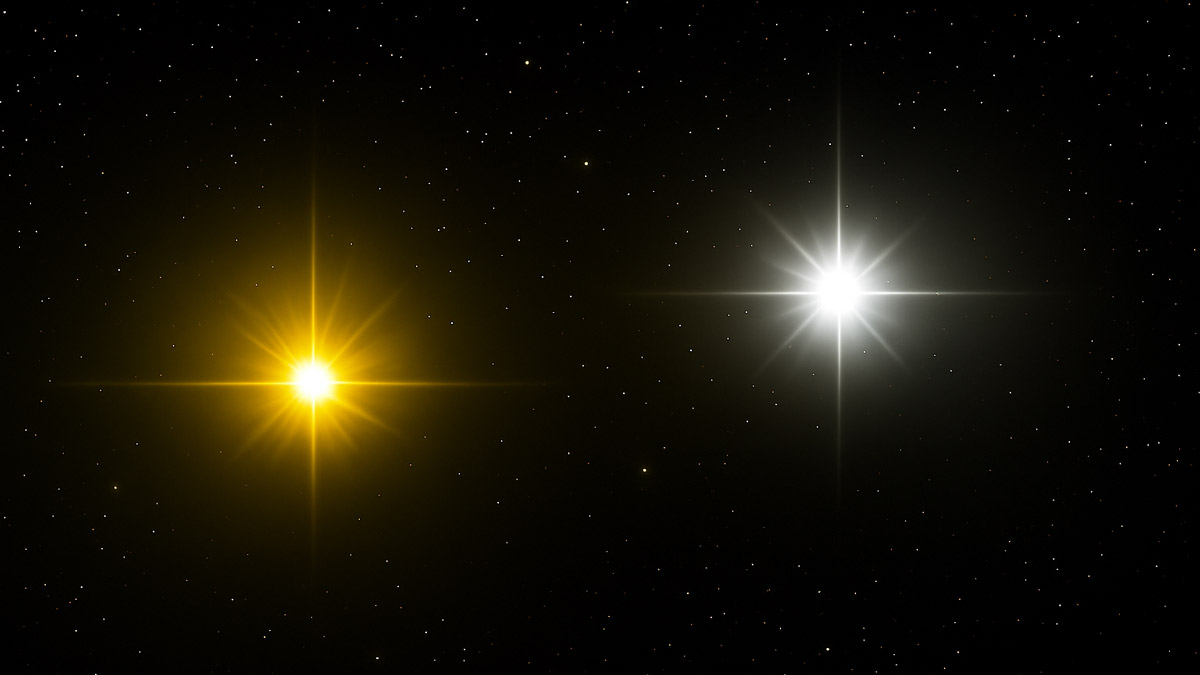
Cetus sprawls out on the late autumn night sky, and the binary star Nu Ceti, also known as v Ceti, makes its home among this sea monster’s notable stars. In the 19th Century, astronomer Admiral William Henry Smyth called Nu Ceti a “delicate object” requiring “ardent gazing” to view the tight binary.1 While astronomers since then clearly see the two stars with better conditions, I ran into some challenges viewing the pair on the night I spotted it—read my personal observation below.
The main star of Nu Ceti is a bright yellow star that can be seen with the naked eye in darker skies. However, its magnitude of +4.9 may make it too faint for most suburban astronomers to observe without some optical help. If you have a modest telescope, you can enjoy the sight of this yellow primary star and enjoy the challenge of spotting its dim companion, which is located 8 arcseconds away. Some observe the dim companion as blue, while I see it more as off-white.
Regarding the stellar classification of Nu Ceti’s binary stars, the primary yellow star we see is classified as G3III, and the dim magnitude +9 white star is an F-type star, specifically F7V. Jim Kaler provides more detail and an interesting take on the pair. Also, it should be noted that astronomers believe Nu Ceti belongs to the Ursa Major moving group of stars. Furthermore, another star hides out near the primary as a spectroscopic companion.
My Observations
| Date | December 16, 2023 |
| Time | 7:25 p.m. |
| Location | Seattle, WA |
| Magnification | 169x |
| Scope | Meade 8″ SCT |
| Eyepiece | 12mm |
| Seeing | Average |
| Transparency | Average |
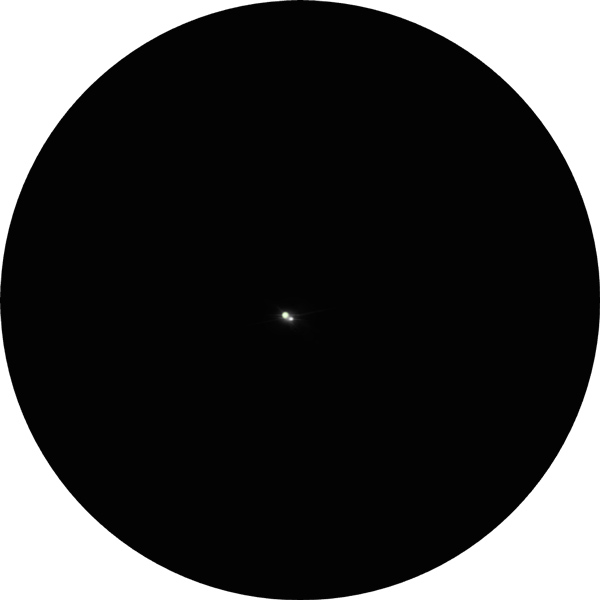
Tonight, I return to Cetus after a year of observing. The constellation barely lifts over the tall Douglas Fir trees near my home. But for just long enough, I have the opportunity to sweep my scope through the sea monster. Nu Ceti joins my Cetus collection of objects along with 66 Ceti and Struve 274.
I’ve enjoyed studying this binary on this cold December night. The primary has a yellow hue and shines brightly in the scope. Due to my atmospheric conditions, the dim white companion peeks in and out from the primary’s bright light, making this pair a fine, yet somewhat challenging, study.
Key Stats
| Constellation | Cetus |
| Best Viewing | Late Autumn |
| Visual Magnitude | +4.9 | +9.0 |
| Separation | 8″ |
| Position Angle | 80.1° |
| Distance | 340 ly |
| My Viewing Grade | B+ |
| Designations | STF 281, Nu Cet, SAO 110635, HIP 12093, HD 16161, HR 754, v Cet |
Sources and Notes
The banner illustration was created by the European Southern Observatory (ESO) and is under the Creative Commons Attribution 4.0 International License. Per ESO agreement: Here is the original image on the ESO website.
Noble, W. (1873a, December 12). On the double star ν ceti (Struve 281). OUP Academic. https://academic.oup.com/mnras/article/34/2/56/975047
02359+0536 STF 281 (nu cet). WDS 02359+0536 STF 281 (Nu Cet). (n.d.-a). https://www.stelledoppie.it/index2.php?iddoppia=9368
 The Garden Astronomer