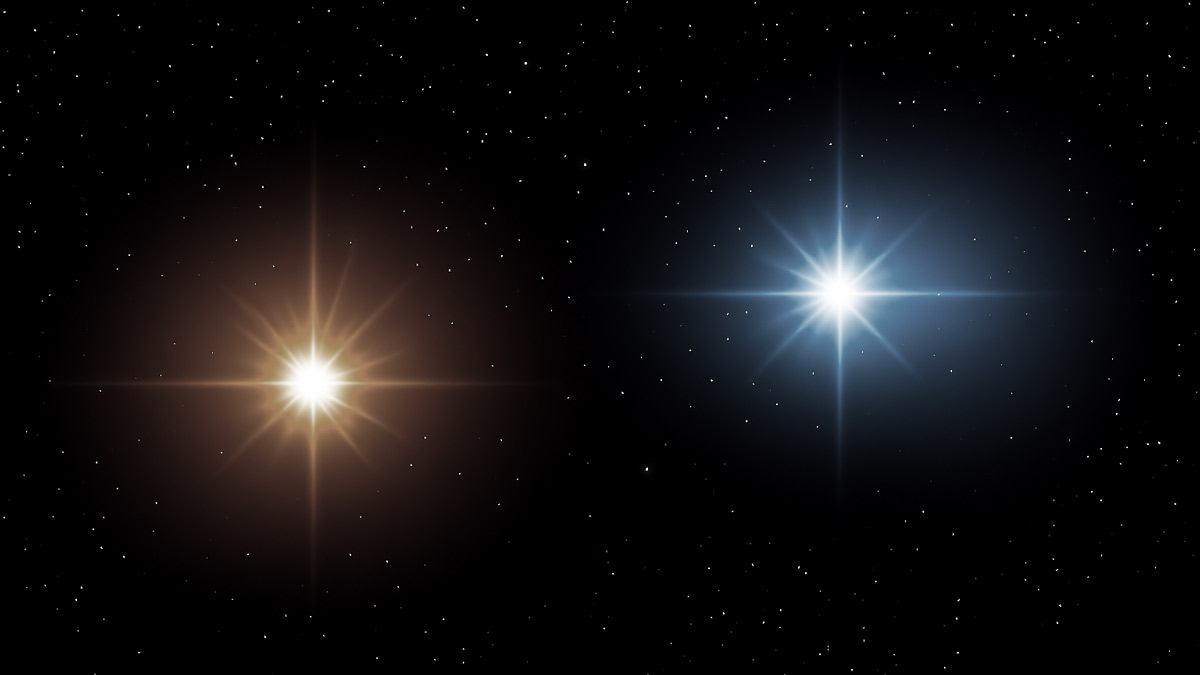
Triangulum is a small constellation in the northern sky best viewed in the autumn and winter months. While home to the notable Messier 33 galaxy, Triangulum also features numerous double stars for backyard observers to enjoy, including the colorful binary 6 Trianguli, also called Iota or Struve 227. The astronomer William Hershel discovered this binary on October 8, 1781, remarking that it is a “pretty object, resembling alpha Herculis but smaller and not so bright.”
The primary yellow/bronze-colored star shines at a magnitude of 5.3 and is classified as a G5 giant. Its fainter blue-colored companion star has a magnitude of 6.7 and is classified as a F5 dwarf. It lies a mere 4 arcseconds away from the primary, so a good beginner or moderate-size scope with a higher power eyepiece is recommended to split these two stars.
Of particular interest is that 6 Trianguli is actually a quadruple-star system! Both the primary (the yellow one) and secondary (the blue one) have stars orbiting them. These stars are spectroscopic binaries as they are too close for our instruments to capture visually. I recommend reading Jim Kaler’s summary of this intricate and beautiful system.
My Observations
| Date | January 27, 2024 |
| Time | 8:33 p.m. |
| Location | Seattle, WA |
| Magnification | 169x |
| Scope | Meade 8″ SCT |
| Eyepiece | 12mm |
| Seeing | Above Average |
| Transparency | Above Average |

This is a night of finding close doubles for me. The temperature is falling below freezing now, and the humidity is rising. One breath too close, and my eyepiece gets clouded over. However, I’m so glad that the elements don’t deter me this evening, as this binary is a fantastic sight. The primary brighter star appears yellow—one could say bronze. The nearby secondary is a darker blue. The contrast between the colors is fantastic, and I can split the two stars using my 12mm eyepiece.
Key Stats
| Constellation | Triangulum |
| Best Viewing | Autumn / Winter |
| Visual Magnitude | +5.3 | +6.7 |
| Distance from Earth | 290 ly |
| Separation | 4″ |
| Position Angle | 67.2° |
| Milky Way Location | Orion Spur |
| My Viewing Grade | A |
| Designations | Iota Trianguli, SAO 55347, HD 13480, i Tri, Iot Tri |
Sources and Notes
Sketch by Wayne McGraw
 The Garden Astronomer