
Orion the Hunter emerges from the eastern horizon, a constellation of myth and majesty, etching his mythic silhouette against the canvas of the winter sky. Marking Orion’s head is the bright star, Meissa. But it’s more than that. Aim your binoculars or telescope toward Meissa, and you’ll find a beautiful grouping of related stars. While Orion, and its notable stars like Meissa, have been known since ancient days, it was the astronomer William Herschel who first recorded Meissa’s family of stars on October 7, 1779.1

February 2024
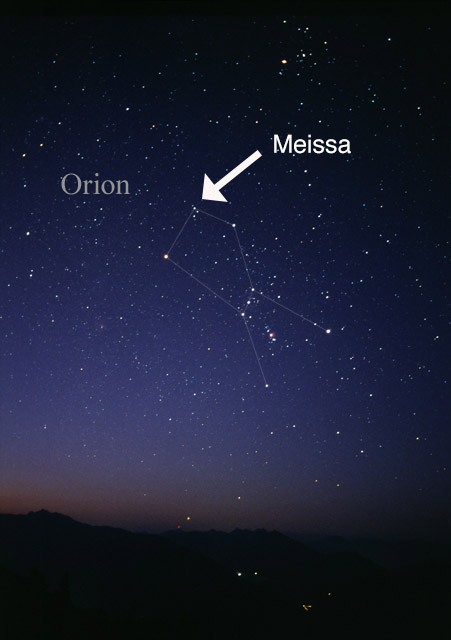
Credit: Till Credner/Wikimedia
Meissa’s bright primary star, which you can see with the naked eye, is a hot, giant star 25 times the size of our sun, classified as a spectral type of O8 III. Nestled right by is a binary companion, a quaint blue-white star shining around 6th magnitude only 4.4 arcseconds away. Depending on your seeing conditions, a modest telescope will be needed to see this pair. But that’s not the only companion. Meissa, in fact, has several other related stars. To see these illustrated, I suggest checking out John Nanson’s sketch on Star Splitters.
My Observations
| Date | January 27, 2024 |
| Time | 8:00 p.m. |
| Location | Seattle, WA |
| Magnification | 169x |
| Scope | Meade 8″ SCT |
| Eyepiece | 12mm |
| Seeing | Above Average |
| Transparency | Above Average |
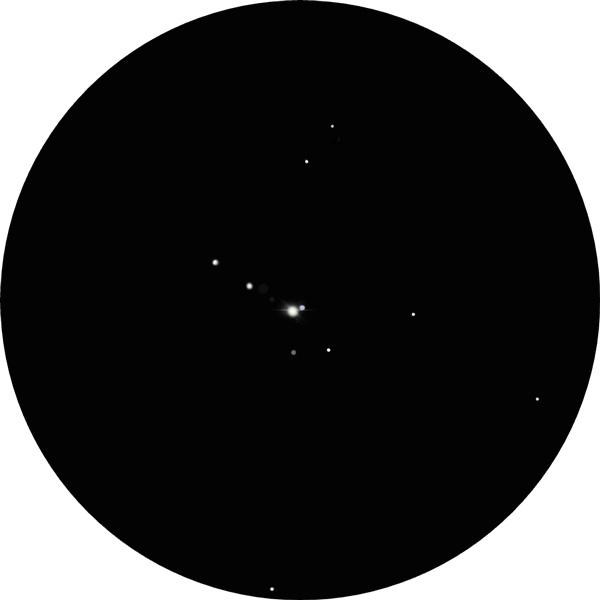
I love it when Pacific Northwest skies open up in winter, allowing us to sail through Orion and its innumerable gems. Of all the years I’ve peered at Orion, I’m surprised this is my first time taking in Meissa and this fantastic area of sky to study. The nearby fainter blue binary star glimmers in Meissa’s white wavering light while the other nearby stars fill up the eyepiece, completing a mesmerizing view.
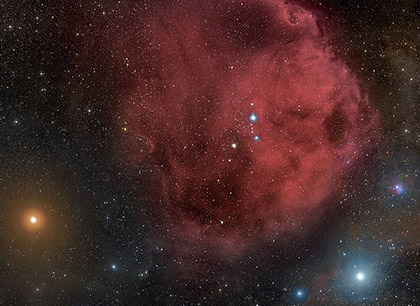
While I am unable to make out any gas clouds around Meissa, I understand one can use averted vision to catch a glimpse of nebulosity. I’ll remember to try this the next time Orion greets me with clear skies.
Key Stats
| Constellation | Orion |
| Best Viewing | Winter |
| Visual Magnitude | +3.5 | +5.4 * |
| Separation | 4″ |
| Position Angle | 43° |
| Spectral Class | A=O8III, B=B0V |
| Milky Way Location | Orion Spur |
| My Viewing Grade | A |
| Designations | SAO 112921, HD 36861, Lam Ori, Struve 738, STF 738, HD 36861, λ Ori, Collinder 69 |
Sources and Notes
The banner image is credited to Lithopsian/Wikimedia Creative Commons and licensed under the Creative Commons Attribution-Share similar to 4.0 International license. Source here.
1 William Herschel’s double star catalog. (n.d.). https://www.handprint.com/ASTRO/Herschel_All.html
Sketch by Wayne McGraw
 The Garden Astronomer