
If you go out on an autumn or winter evening, locate the constellation Perseus. Once you find it, make your way to one of the brighter stars in the constellation called Algol. This star is one of the most popular and, some would say, notorious variable stars in the sky.
So, what makes Algol so special? It changes its brightness over a period of 3 days, or 2.87 days, to be exact.
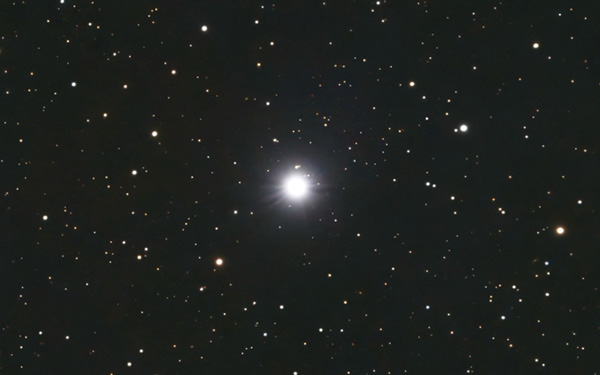
In fact, Algol’s nature captivated ancient skywatchers, sparking myths and legends that sought to explain its fluctuating luminosity. In Greek mythology, Algol was associated with the Gorgon Medusa, whose gaze could turn people to stone. The periodic dimming of Algol was interpreted as the winking eye of the demon-like Medusa, reinforcing its reputation as the “Demon Star.”
But there is more to this winking star than meets the eye. At roughly 93 light-years away, Algol performs a captivating cosmic dance between itself and another star in a dramatic, eclipsing embrace.

Creative Commons animation by Merikanto
So imagine a giant, hot star (Algol A) orbiting a cooler, fainter companion (Algol B) every 2.87 days. As Algol B crosses in front of its brighter partner, it blocks a portion of its light, causing Algol to dim by about 2.3 magnitudes—a noticeable change among the sea of steady stars we see every night. This phenomenon creates a mesmerizing effect.
From ancient myths to modern scientific exploration, Algol’s ever-changing light has inspired awe and curiosity across generations. And you, too, can study Algol, even from the suburbs with the naked eye.
My Observations
| Date | February 9, 2024 |
| Time | 7:54 p.m. |
| Location | Seattle, WA |
| Magnification | 254x |
| Scope | Meade 8″ SCT |
| Eyepiece | 8mm |
| Seeing | Average |
| Transparency | Average |
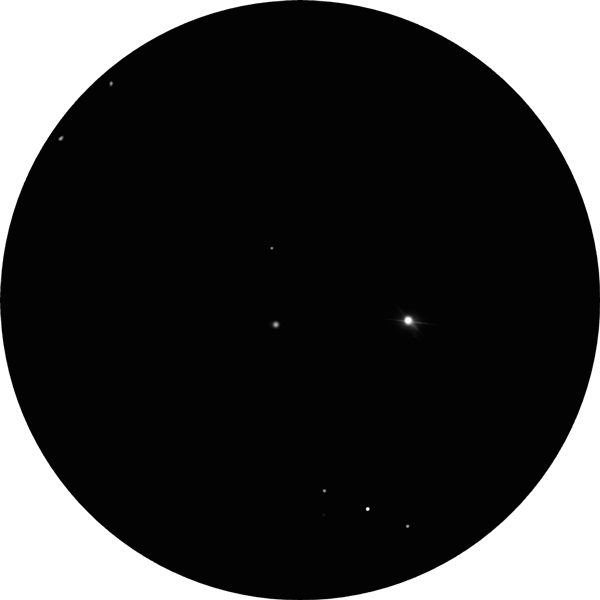
I can see Algol sparkling in the sky above on this winter night. Its white light illuminates the edges of my eyepiece, creating a warm glow amid the colder, blackened sky. While I was sketching, I heard rustling in the nearby blackberry bushes.
The sudden noise caught me off guard, and my heart started racing. It turned out to be a raccoon family that frequently visits this time of year. I am guessing they decided to pay me a visit to give me a scare while I draw the demon star! Or maybe they were just curious about my telescope—the little stargazers they are.
Key Stats
| Constellation | Perseus |
| Best Viewing | Autumn / Winter |
| Visual Magnitude | +2.1 | +12.7 |
| Separation | 58″ |
| Position Angle | 156° |
| Spectral Class | B0.5V & A2V |
| Milky Way Location | Orion Spur |
| My Viewing Grade | A |
| Designations | β Persei, β Per, 26 Persei, HD 19356, HIP 14576, HR 936, SAO 38592. |
Sources and Notes
Banner made from animation produced by Merikanto, and shared under the Creative Commons Attribution-Share Alike 4.0 International license.
Raccoon photo by Volker Thimm: https://www.pexels.com/photo/close-up-of-a-raccoon-19745509/
Sketch and photograph of Algol by Wayne McGraw
 The Garden Astronomer