
17 Canis Majoris is a dim star located in the southern constellation of Canis Major, with a visible magnitude of +5.8 under dark sky conditions. Backyard astronomers in the Northern Hemisphere (in winter) and the Southern Hemisphere (in summer) can view this white-hued star with the naked eye.
But there’s a nice surprise for observers viewing the star with binoculars or a telescope! Seeing 17 Canis Majoris up close unveils two nearby orange-colored stars, creating an attractive triangle system. Upon first observing the star on March 3, 1782, the renowned astronomer William Herschel wrote the word “treble” in his notes, adding that the “three stars [i.e. 17ABC] form a rectangle, the hypotenuse of which contains the largest and smallest.”1 While the stars surrounding 17 Canis Majoris form a colorful triangle, they are not physically related.
My Observations
| Date | February 22, 2023 |
| Time | 9:00 p.m. |
| Location | Seattle, WA |
| Magnification | 169x |
| Scope | Meade 8″ SCT |
| Eyepiece | 12mm |
| Seeing | Under Average |
| Transparency | Above Average |
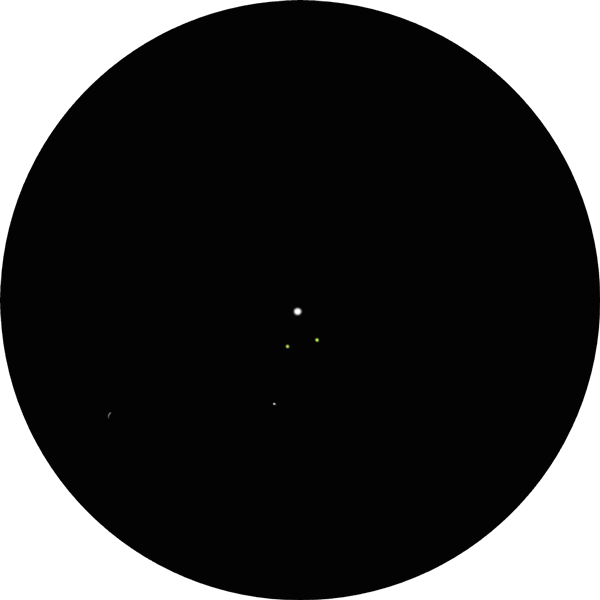
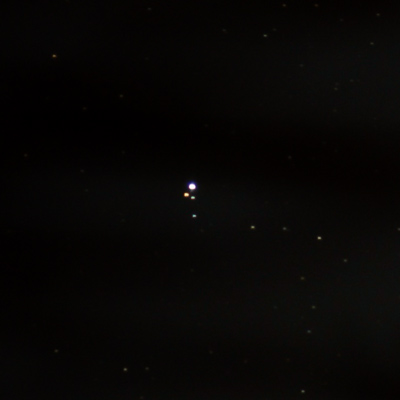
A few sparse clouds dot the sky as I hasten to capture objects in the deep southern sky. 17 Canis Majoris moves in and out of the Douglis Fir trees, but I’m able to steal away a few minutes of observing it with my scope and the Seestar. The star shines a bright white. Below the star, I see two prominent orange-colored stars that make out a triangle. The colors of these three stars contrast beautifully.
Key Stats
| Constellation | Canis Major |
| Best Viewing | Winter |
| Visual Magnitude | +5.8 | +8.6 | +9.2 |
| Separation | 43″ (AB) | 38″ (AC) |
| Position Angle | 147° (AB) | 148° (AC) |
| Distance | 504 ly |
| My Viewing Grade | B+ |
| Designations | H V 65, 17 CMa, SAO 172569, HD 51055, HR 2588 |
Sources and Notes
The banner illustration was created by the European Southern Observatory (ESO) and is under the Creative Commons Attribution 4.0 International License. Per ESO agreement: Here is the original image on the ESO website.
1 Richard Dibon-Smith, R. (n.d.). Alpha Canis majoris (sirius). http://www.dibonsmith.com/cma_a.htm
 The Garden Astronomer