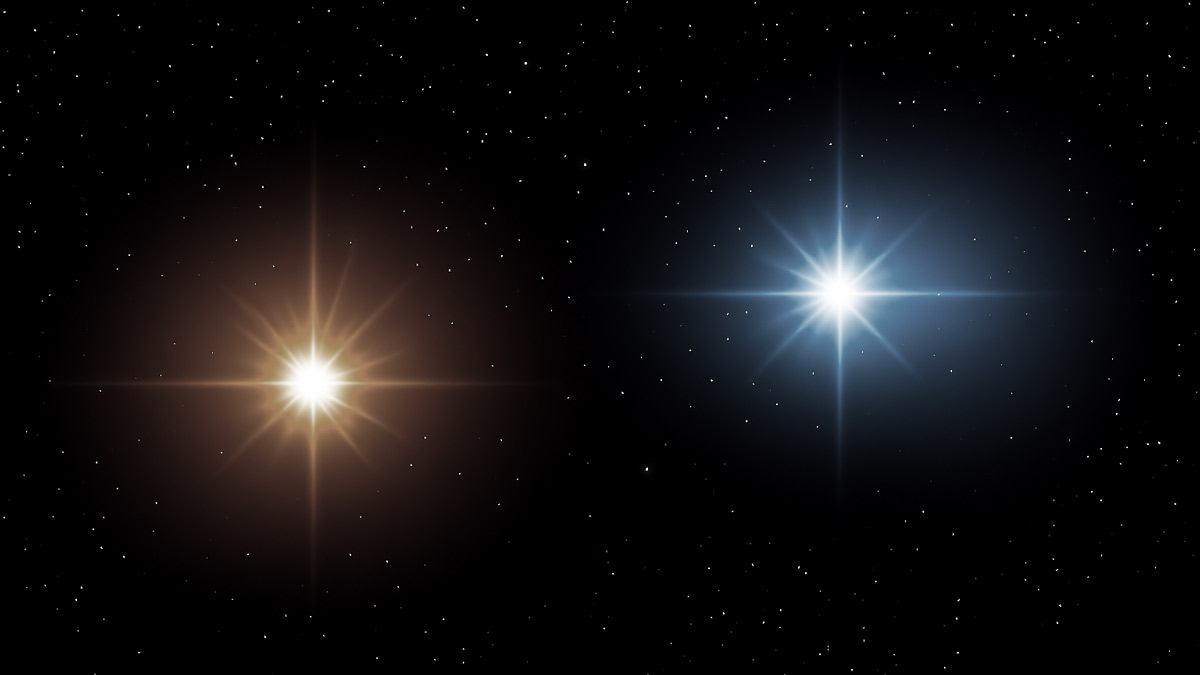
There’s something poetic about comparing winter’s 145 Canis Majoris (145 CMa) to summer’s Albireo. While Albireo is celebrated for its striking colors and brilliance on summer nights, 145 CMa offers a subtler yet captivating spectacle for crisp winter nights. Skygazers seeking its beauty must explore the rich depths of Canis Major, just as John Herschel did in 1837 when he first recorded the double star.
Double stars with contrasting colors, like 145 CMa and Albireo, create a stunning visual effect that captivates observers. In the case of 145 CMa, the bright primary star shines at magnitude +5.0 with a warm orange-yellow hue, while its nearby secondary star glows with an aqua tint. Adding to their appeal, the two stars are separated by a comfortable 26.4 arcseconds, making the pair an accessible winter jewel for most backyard stargazers.
My Observations
| Date | February 24, 2022 |
| Time | 9:00 p.m. |
| Location | Seattle, WA |
| Magnification | 169x |
| Scope | Meade 8″ SCT |
| Eyepiece | 12mm |
| Seeing | Above Average |
| Transparency | Above Average |
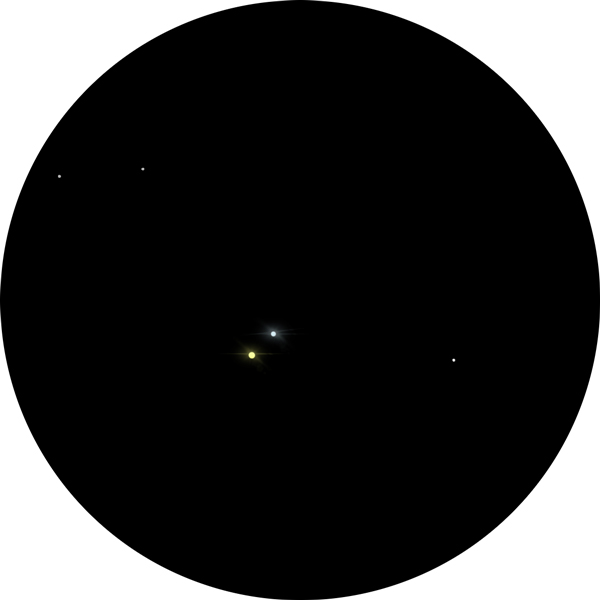
This is undoubtedly one of the best double stars in the winter sky. To me, the primary star appears more yellow than orange, but I’ve come across other observers who describe it as clearly orange—or even red. This could be due to the varying atmospheric conditions experienced by different observers. Using my 12mm eyepiece on my 8-inch scope, I can easily split the pair, providing a pleasant view of this sparkling gem.
Key Stats
| Constellation | Canis Major |
| Best Viewing | Winter |
| Visual Magnitude | +5.0 | +5.8 |
| Separation | 26.4″ |
| Position Angle | 47.9° |
| Spectral Class | K0 & F0 |
| Milky Way Location | Orion Spur |
| My Viewing Grade | A+ |
| Designations | 145 CMa, SAO 173349, HR 2764, HD 56577, HIP 35210, G Canis Majoris |
Sources and Notes
Sketch by Wayne McGraw
 The Garden Astronomer
One thought on “145 Canis Majoris: Winter’s Beautiful Version of Albireo”