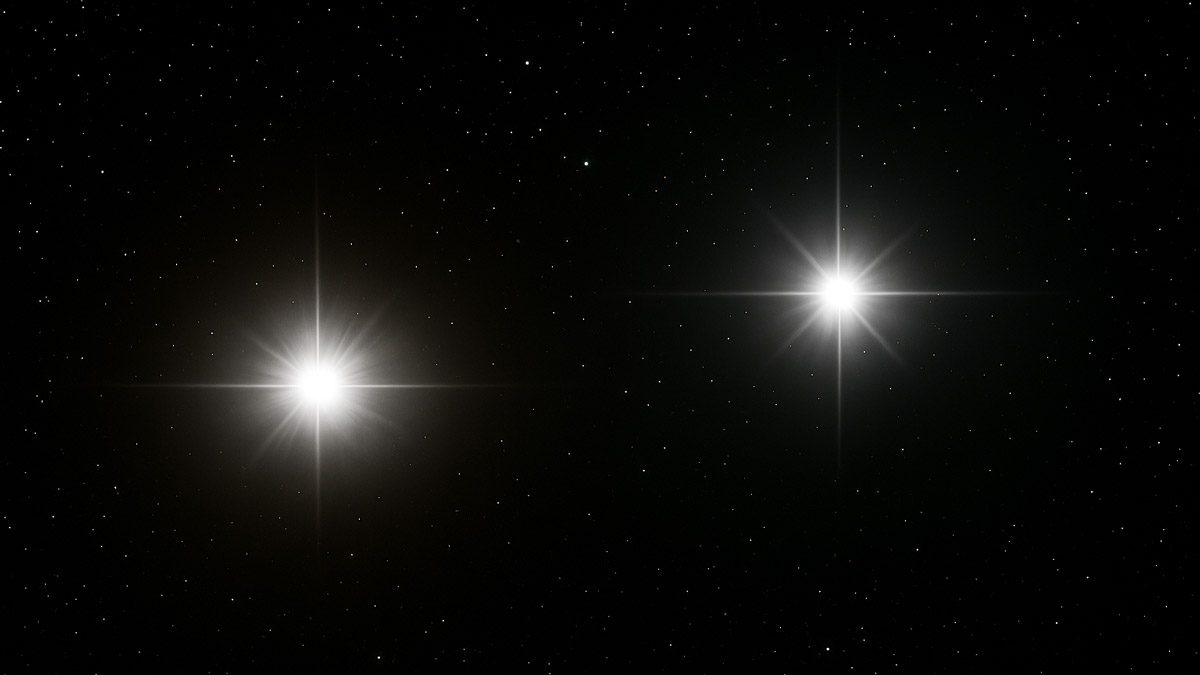
On early spring nights, the constellation of Cancer takes its prominent place on the firmament. Several stellar gems, including the wonderful Beehive Cluster and a smattering of double stars, make their home in the celestial crab. Among them is a quaint triple star in Cancer called 24 Cancri, known to astronomers since February 2, 1782, when astronomer William Hershel first spotted these stars staring back at him.
While 24 Cancri is known as a triple star system, backyard astronomers will only see two of them, 24 Cancri A and B. The third in the bunch is a binary brother to 24 Cancri B. Unfortunately, a meager 0.15 arcseconds separate the two, making the pair practically impossible to view for backyard astronomers. Nevertheless, both 24 Cancri A & B don’t disappoint in the eyepiece as a nice tight pair.
Both A & B shine white with a slight yellow tinge and are classified as F-type main sequence stars. 24 Cancri A shines at a magnitude of 6.9, while 24 Cancri B is a touch dimmer at 7.5. The pair of stars present an enjoyable challenge to separate for backyard astronomers.1
My Observations
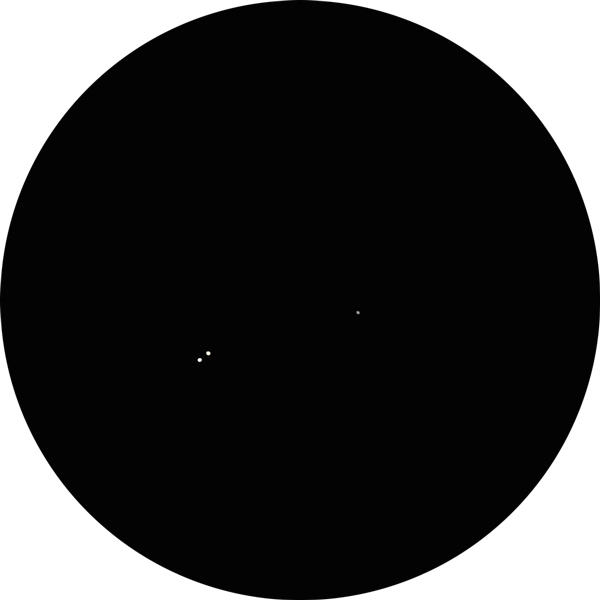
24 Cancri is a tight double-star system with two stars of close brightness, though they are clearly not equal. Both stars appear white with a slight tinge of yellow. On this clear Ides of March night, I reflect on the alluring yet simple close pairs like this one. They are always welcome in my eyepiece, resembling two eyes looking back at me.
| Date | March 15, 2024 |
| Time | 9:33 p.m. |
| Location | Seattle, WA |
| Magnification | 254x |
| Scope | Meade 8″ SCT |
| Eyepiece | 8mm |
| Seeing | Good |
| Transparency | Average |
Key Stats
| Constellation | Cancer |
| Best Viewing | Spring |
| Visual Magnitude | +6.9 | +7.5 |
| Distance from Earth | 260 ly |
| Separation | 5.6″ |
| Milky Way Location | Orion Spur |
| My Viewing Grade | B |
| Designations | 24 Cnc A, HD 71152, HR 3312, SAO 80184, STF 1224, Struve 1224, upsilon |
Sources and Notes
The double star banner on this page is an artist’s impression showing the double star OGLE-LMC-CEP0227 in our neighboring galaxy the Large Magellanic Cloud. This media was created by the European Southern Observatory (ESO). This file is licensed under the Creative Commons Attribution 4.0 International license.
1 Handprint. (n.d.). William Herschel’s star gages. Retrieved June 3, 2024, from https://www.handprint.com/ASTRO/Herschel_All.html
Sketch by Wayne McGraw
 The Garden Astronomer