On early spring nights, the constellation of Cancer takes its prominent place on the firmament between Gemini and Leo. Several stellar inhabitants, including the wonderful Beehive Cluster and the pretty double star, Theta Cancri, make their home in the celestial crab.
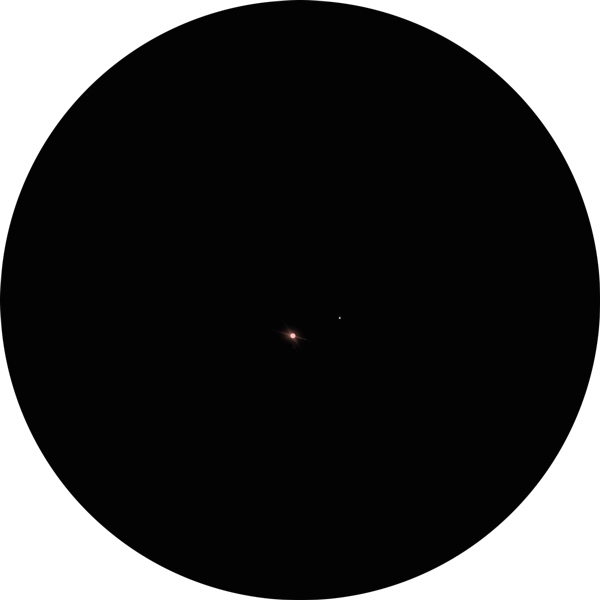
Theta Cancri is a double star with a magnitude of 5. It is technically visible to the naked eye but is best observed using a telescope. Theta Cancri’s primary star is 40 times the size of our sun and shines in the eyepiece with a beautiful orange-reddish hue. The star is classified as a K5 III star, indicating that it’s cooler than our sun. The secondary star is much dimmer, with an 11.7 magnitude, and lies 74 arcseconds away from the primary.1
My Observations
With my 8mm eyepiece this evening, I enjoyed looking at the close binary Zeta Cancri A — also known as Tegmine. Now, I turn my attention to Theta Cancri and immediately notice the orangish, almost red primary star. What a pretty cherry star.
| Date | March 15, 2024 |
| Time | 9:55 p.m. |
| Location | Seattle, WA |
| Magnification | 254x |
| Scope | Meade 8″ SCT |
| Eyepiece | 8mm |
| Seeing | Good |
| Transparency | Average |
Key Stats
| Constellation | Cancer |
| Best Viewing | Spring |
| Visual Magnitude | +5.5 | +11.8 |
| Distance from Earth | 127 ly |
| Separation | 74.5″ |
| Milky Way Location | Orion Spur |
| My Viewing Grade | B+ |
| Designations | 08316+1806 HJ 2452 AB (The Cnc), 31 CNC, SAO 97881, HD 72094, HIP 41822, HR 3357 |
Sources and Notes
The double star banner on this page is an artist’s impression showing the double star OGLE-LMC-CEP0227 in our neighboring galaxy the Large Magellanic Cloud. This media was created by the European Southern Observatory (ESO). This file is licensed under the Creative Commons Attribution 4.0 International license.
1Theta Cancri. (2024, February 4). In Wikipedia. https://en.wikipedia.org/wiki/Theta_Cancri
Sketch by Wayne McGraw
 The Garden Astronomer