
As winter wanes and spring comes alive, the constellation Ursa Major slides high above on the firmament. Messier 97 follows the bear up the sky, giving backyard astronomers a good view of this planetary nebula, also known as the Owl Nebula. When viewed through a larger telescope, it resembles the piercing eyes of an owl. Those of us observing under suburban skies with modest telescopes will usually only see a circular, hazy smudge.
The term “planetary nebula” could be a little confusing for those new to astronomy. Essentially, planetary nebulae are stunning clouds of gas and dust formed around a dying star. Despite what the name may suggest, planetary nebulae have nothing to do with planets. Instead, they represent the final stage of a small or medium-sized star’s life, similar to our Sun. The famed astronomer William Hershel noticed how these nebulae resemble the planet Uranus in the scope, so he came up with the name.
M97 was first discovered by the French astronomer Pierre Méchain on February 16, 1781, and later cataloged by Charles Messier in his renowned list of celestial objects.
I recommend the following video on YouTube for additional insight on M 97:
My Observations
| Date | March 17, 2024 |
| Time | 9:30 p.m. |
| Location | Seattle, WA |
| Magnification | 169x |
| Scope | Meade 8″ SCT |
| Eyepiece | 12mm |
| Seeing | Average |
| Transparency | Average |
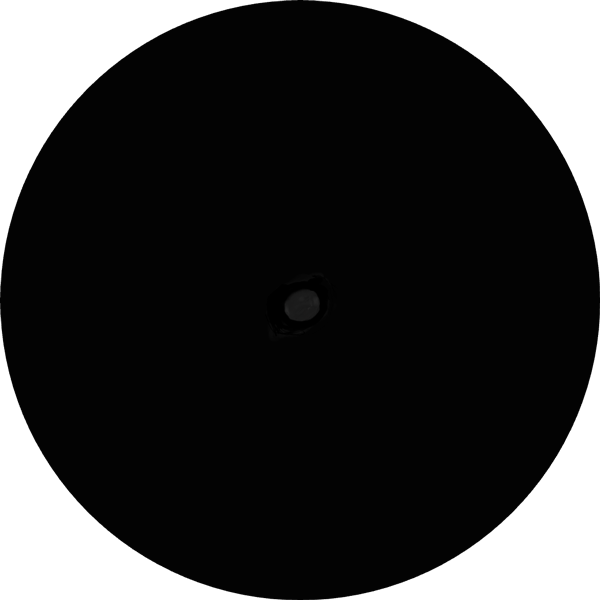
After repeatedly passing by the coordinates for M97, I began using averted vision by looking slightly off-center from the center of the eyepiece. Then, as I swept the scope across the sky left and right using small movements, a hazy, ghostly image appeared. Due to the sky full of half-moon light, I was unable to see any distinguishing features, such as the dark circles that make the owl’s eyes. I only see a faint, hazy patch.
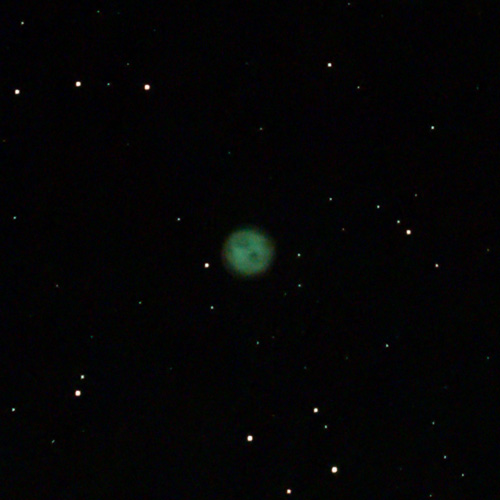
Key Stats
| Constellation | Ursa Major |
| Best Viewing | Spring |
| Visual Magnitude | +9.80 |
| Absolute Magnitude | +1.17 |
| Distance from Earth | 1,700 ly |
| Diameter | 1.7 ly |
| Apparent Size | 3.4 x 13.3 arcmin |
| My Viewing Grade | C+ |
| Designations | M97, NGC 3587, ARO 25 |
Historical Observations
Pierre Méchain first recorded the nebula on February 16, 1781. Weeks later, Charles Messier recorded the following entry in his notes on March 24, 1781:
“Nebula in the great Bear [Ursa Major], near Beta: It is difficult to see, reports M. Méchain, especially when one illuminates the micrometer wires: its light is faint, without a star. M. Méchain saw it the first time on Feb 16, 1781, & the position is that given by him.”1
For additional historical observations, please see this page.
Sources
The banner photo of Messier 97 is NOIRLab / NSF / AURA. The file is licensed under the Creative Commons Attribution 4.0 International license.
1 Messier 97. (2006, May 16). http://www.messier.seds.org/Mdes/dm097.html
Sketch and Seestar photo by Wayne McGraw
 The Garden Astronomer
This is so cool – and bizarre. Just when I think I know all the major and most interesting you introduce something I have never seen before or heard of. This is fabulous!!
LikeLike