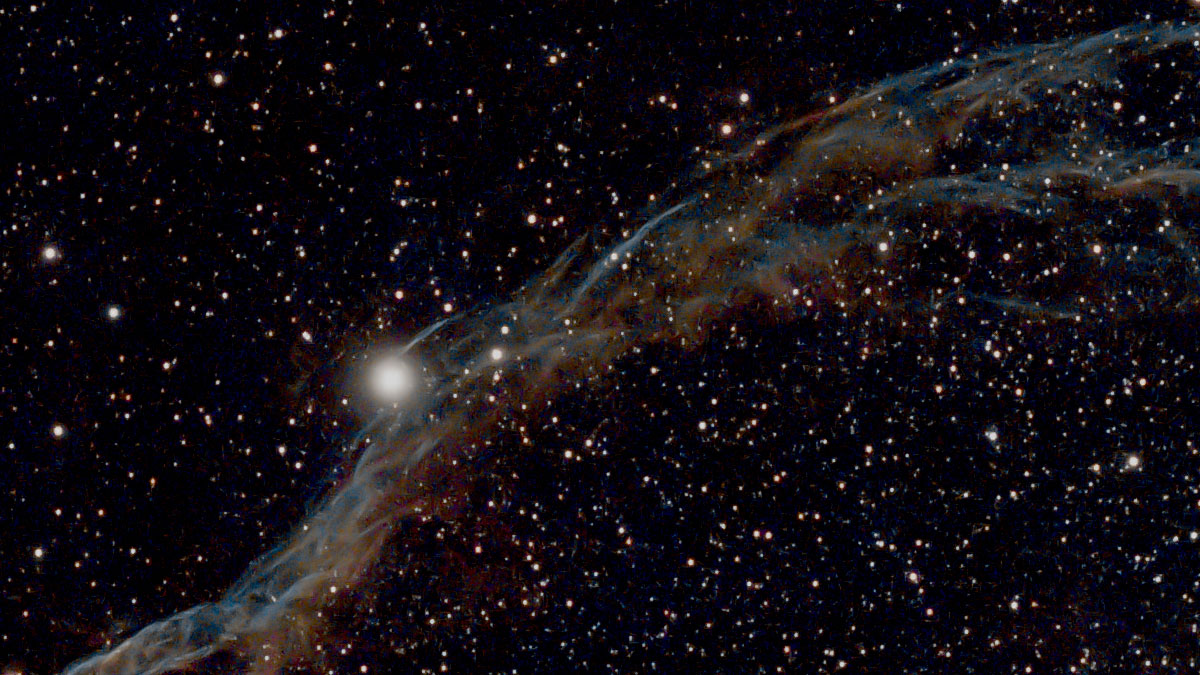
Astrophotos of the Western Veil Nebula in the constellation Cygnus are stunning.
This celestial wonder mesmerizes with its intricate filaments of glowing gas, showcasing a vibrant palette of colors from blues to fiery reds. While looking at the veil, observers will notice a bright star called 52 Cygni shining like a metaphorical lighthouse in a sea of nebulae. In fact, astronomers often use 52 Cygni to navigate their way to the dim veil. The star and the nebula are not physically related, however. 52 Cygni lies nearer to us at 201 light-years away, while the nebula floats a distance of 2,400 light-years away, much further out in the cosmos.
While no one can deny the beauty of the Western Veil Nebula, 52 Cygni (Struve 2726) provides a visual treat to backyard observers who like double stars. The primary star, 52 Cygni A, is a yellow-orange star of spectral type KO III, shining at a magnitude of 4.3. Nearby lies the dimmer companion star 52 Cygni B with a magnitude of 9.5. The two stars lie nearly six arcseconds apart, making these two a tight double that requires some powerful magnification to split.
The astronomer William Hershel first recorded 52 Cygni on September 8, 1780.
My Observations
| Date | June 5, 2024 |
| Time | 11:55 p.m. |
| Location | Seattle, WA |
| Magnification | 338x |
| Scope | Meade 8″ SCT |
| Eyepiece | 12mm+2x Bar |
| Seeing | Above Average |
| Transparency | Above Average |
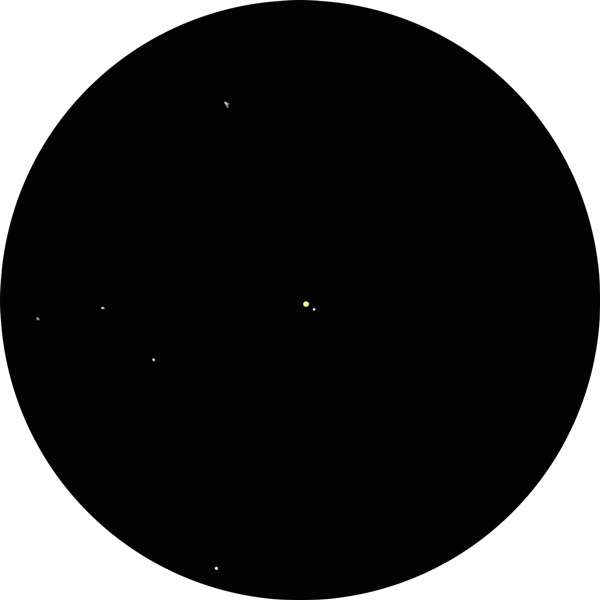

As I navigate to 52 Cygni on this late June evening, I first strain my eye using averted vision to discern any haze from the Western Veil nebula through my 8-inch SCT scope. I’m afraid my urban Seattle skies prevent me from picking up any of the pretty filaments.
So I decide to focus my attention on the star itself. Using a 12mm eyepiece, I cannot discern the double star system well, so I insert my 2x Barlow to increase the magnification in the image. There, the two stars split. The primary brighter star appears a buttery yellow, while I cannot make out the secondary’s color, though it may have a tinge of red.
Key Stats
| Constellation | Cygnus |
| Best Viewing | Summer / Autumn |
| Visual Magnitude | +4.3 | +9.5 |
| Separation | 5.7″ |
| Position Angle | 74° |
| Distance | 201 ly |
| My Viewing Grade | B+ |
| Designations | STF 2726, SAO 70467, HD 197912, HR 7942, 52 Cyg, HIP 102453, NGC 6960 |
Sources and Notes
Banner photo by Wayne McGraw shot by a Seestar S50 and processed in Lightroom and Photoshop. Sketch by Wayne McGraw.
 The Garden Astronomer