
On a July night in 1781, while searching near Ursa Major in the constellation Canes Venatici, French astronomer Pierre Méchain made the discovery of the spiral galaxy Messier 106. Seven years later, on March 9, 1788, the renowned astronomer William Herschel independently rediscovered the galaxy. Herschel noted the galaxy’s “brilliant bright nucleus” with “milky branches” extending north and south from the center.1
All these years later, backyard astronomers have a good opportunity to relive the experiences of Méchain and Herschel. Most observers with a modest telescope can make out Messier 106’s relatively bright and distinct structure. And speaking of structure, one of the most fascinating aspects of Messier 106 is its unique arms. In contrast to regular spiral galaxies, where the arms are primarily made up of stars, the additional arms of M106 consist largely of gas. These unusual arms seem to be streams of material being expelled from the core of the galaxy, probably due to interactions with the supermassive black hole at its center.
As one of the largest and brightest nearby galaxies, similar in size and luminosity to Andromeda, Messier 106 has unique characteristics that have played an important role in helping us understand cosmic distances. This is due to the presence of water masers (which are microwave lasers!) orbiting close to its black hole. This has led to one of the most accurate measurements of the distance to a galaxy outside our Local Group of close galaxies.
To learn more about Messier 106, I suggest watching Dr Becky Smethurst’s discussion on YouTube.
My Observations
| Date | June 7, 2024 |
| Time | 11:04 p.m. |
| Location | Seattle, WA |
| Magnification | 169x |
| Scope | Meade 8″ SCT |
| Eyepiece | 12mm |
| Seeing | Above Average |
| Transparency | Above Average |

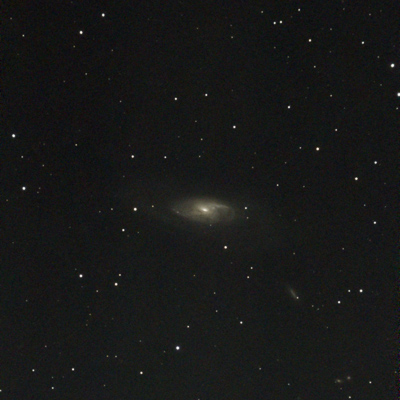
Tonight is beautiful. The Pacific Northwest skies are clear, and there is no moon in sight. I haven’t been able to be out under the stars since March. I’ve tried several times in the past to catch a glimpse of the M106’s light, but the glow from streetlamps and neighbors’ houselights has fought me tooth and nail on this.
However, tonight, the sky is dark and clear, and the minute the scope hit the area, M106 came into view. There is a clear nucleus of light, and it appears there are wisps of haze around it, spreading out diagonally.
Key Stats
| Constellation | Canes Venatici |
| Best Viewing | Spring |
| Visual Magnitude | +8.31 |
| Absolute Magnitude | -21.10 |
| Distance from Earth | 25 million ly |
| Diameter | 123,000 ly |
| Apparent Size | 17 x 7.2 arcmin |
| My Viewing Grade | B |
| Designations | M106, NGC 4258, UGC 7353 |
Sources
Banner photo credit: NASA, ESA, the Hubble Heritage Team (STScI/AURA), and R. Gendler (for the Hubble Heritage Team). Acknowledgment: J. GaBany. The file is licensed under the Creative Commons Attribution 4.0 International license.
1 Plotner, T. (2010, January 9). Messier 106. Universe Today. Retrieved June 8, 2024, from https://www.universetoday.com/50138/messier-106/
Sketch and Seestar photo by Wayne McGraw
 The Garden Astronomer