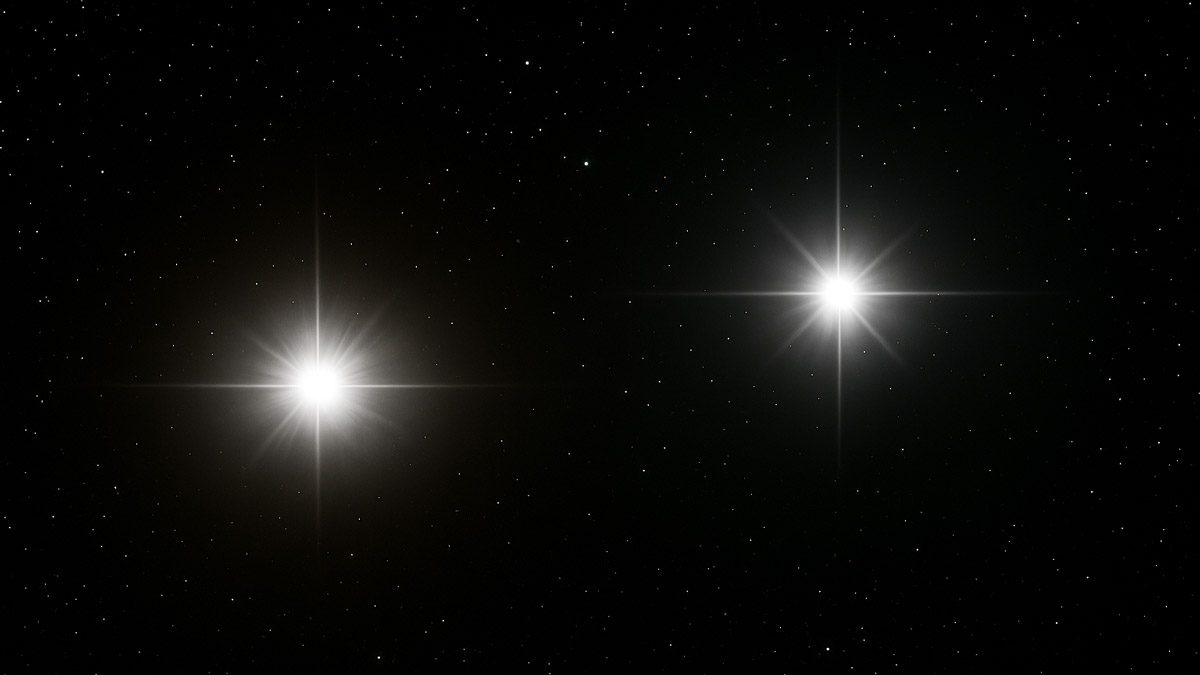
During late summer and early autumn nights, backyard astronomers can focus on the constellation Aquila (the Eagle) and discover several celestial wonders, including the binary star Struve 2443. The 19th-century astronomer Friedrich Georg Wilhelm von Struve cataloged this pair of stars in 1828.
The two stars in Struve 2443 are relatively close to each other, with an angular separation of 6.8 arcseconds. This makes them a challenging but rewarding target for amateur astronomers with modest telescopes. Like the stars in nearby Struve 2446, the stars in Struve 2443 have a stellar classification of F5. The primary star shines at a magnitude of 8.9, and the dimmer secondary star has a magnitude of 9.3.
Splitting the tiny pair of stars in Struve 2443 may be challenging, but it is rewarding, as they appear as two small white eyes looking back at you.
My Observations
| Date | August 30, 2024 |
| Time | 10:28 p.m. |
| Location | Seattle, WA |
| Magnification | 169x |
| Scope | Meade 8″ SCT |
| Eyepiece | 12mm |
| Seeing | Average |
| Transparency | Average |

The two stars are closely positioned and appear off-white in color. They look almost identical through the telescope, although one is slightly dimmer than the other. This charming pair of stars resembles two tiny white eyes staring back at me.
Key Stats
| Constellation | Aquila |
| Best Viewing | Late Summer |
| Visual Magnitude | +8.9 | +9.3 |
| Absolute Visual Magnitude | +2.8 |
| Separation | +6.8″ |
| Position Angle | 311° |
| Distance from Earth | 916 ly |
| Milky Way Location | Orion Spur |
| My Viewing Grade | B |
| Designations | SAO 104432, HIP 93635, HD 177434, STF 2443, Struve 2443 |
Sources and Notes
Banner shared under the Creative Commons Attribution-Share Alike 4.0 International license. Photo by David Ritter. Details here.
Stelle Doppie. (n.d.). Struve 2446. Retrieved March 20, 2025, from https://www.stelledoppie.it/index2.php?iddoppia=78693
Sketch by Wayne McGraw
 The Garden Astronomer