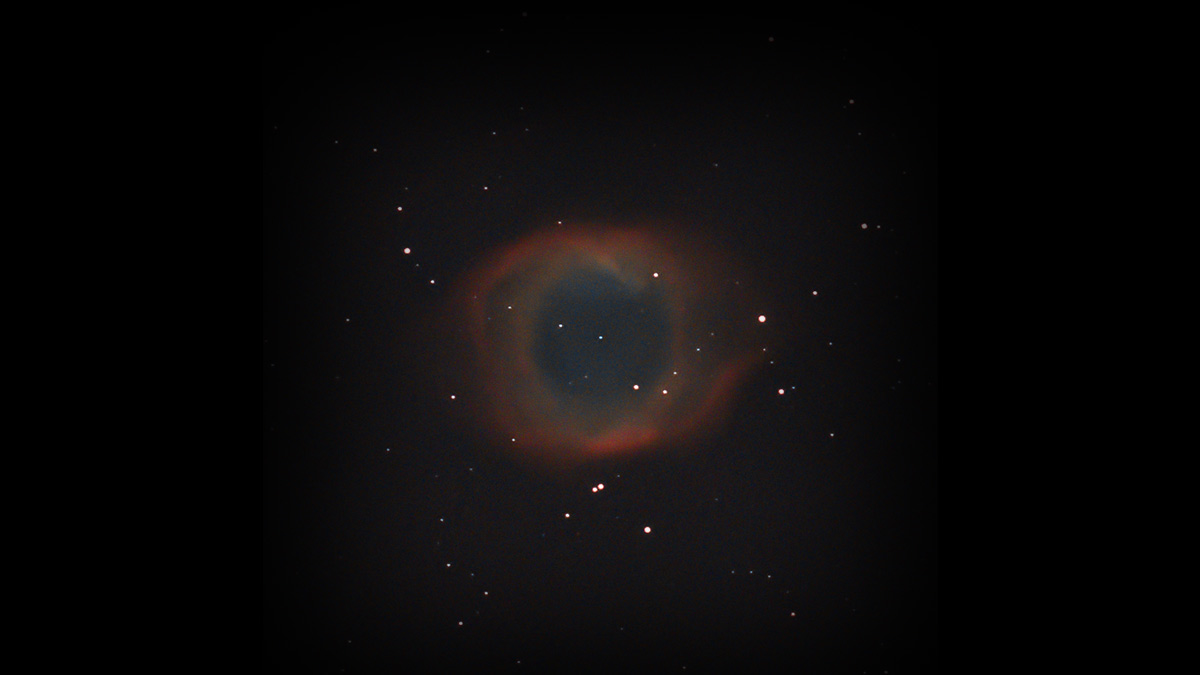
In late summer and autumn, the constellation Aquarius, known as the Water Bearer, is prominent in the southern skies of the Northern Hemisphere. Among its features is the Helix Nebula, one of the closest planetary nebulae to Earth. This makes it appear larger than its distant cousins, like the Ring, Cat’s Eye, and Dumbbell. The German astronomer Karl Ludwig Harding, who also discovered the asteroid Juno, first recorded the Helix Nebula back in 1823.
The Helix Nebula is the remnant of a Sun-like star that exhausted its nuclear fuel. When a star not massive enough to go supernova reaches the end of its life, it expands into a red giant, ejecting its outer layers into space. Over thousands of years, these layers spread outward, forming the intricate structures we see in the nebula.
At the heart of the Helix Nebula lies the stellar core, which has collapsed into a white dwarf—a dense, Earth-sized remnant that will gradually cool over billions of years. The intense ultraviolet radiation emitted by this white dwarf ionizes the ejected gases, causing them to glow and creating the nebula’s vibrant colors.
Backyard astronomers often consider the Helix Nebula one of the top attractions in the night sky due to its brightness and size. In fact, under relatively dark skies, it is possible to see the wisps of its ring using binoculars. Additionally, Sue French writes in Sky & Telescope about being able to see the nebula with the naked eye when observing from dark locations.
My Observations
Observation on November 22, 2024, at 7pm Eastern Time
Now that I live further south in North America, I have the opportunity to view the Helix Nebula, which was often hidden by tall trees at my old home in the Pacific Northwest. Through binoculars, it appears as a faint donut shape. Once I finish unpacking from my recent move, I will sketch it through my 8-inch SCT telescope. Although it isn’t as bright as the smaller Ring Nebula, its ghostly appearance is still captivating.
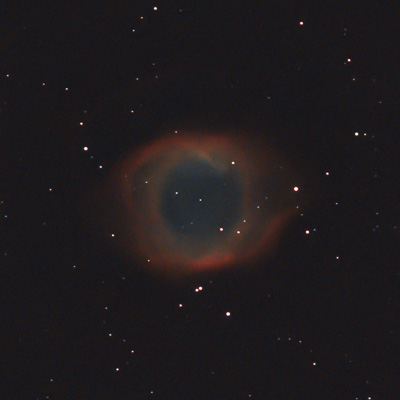
I also took out my digital scope to capture its beautiful light. On this cool evening in Florida, I spent 40 minutes taking 10-second exposures to photograph this stunning planetary.
Key Stats
| Constellation | Aquarius |
| Best Viewing | Late Summer-Autumn |
| Visual Magnitude | +7.6 |
| Absolute Magnitude | -19.81 |
| Distance from Earth | 650 ly |
| Diameter | 2.5 ly |
| Apparent Size | 25 arcmin |
| My Viewing Grade | B+ |
| Designations | NGC 7293, Caldwell 63, Arp 336 |
Sources
Photos by Wayne McGraw
 The Garden Astronomer
5 thoughts on “The Helix Nebula: The “Eye of God” Looks Back at You”