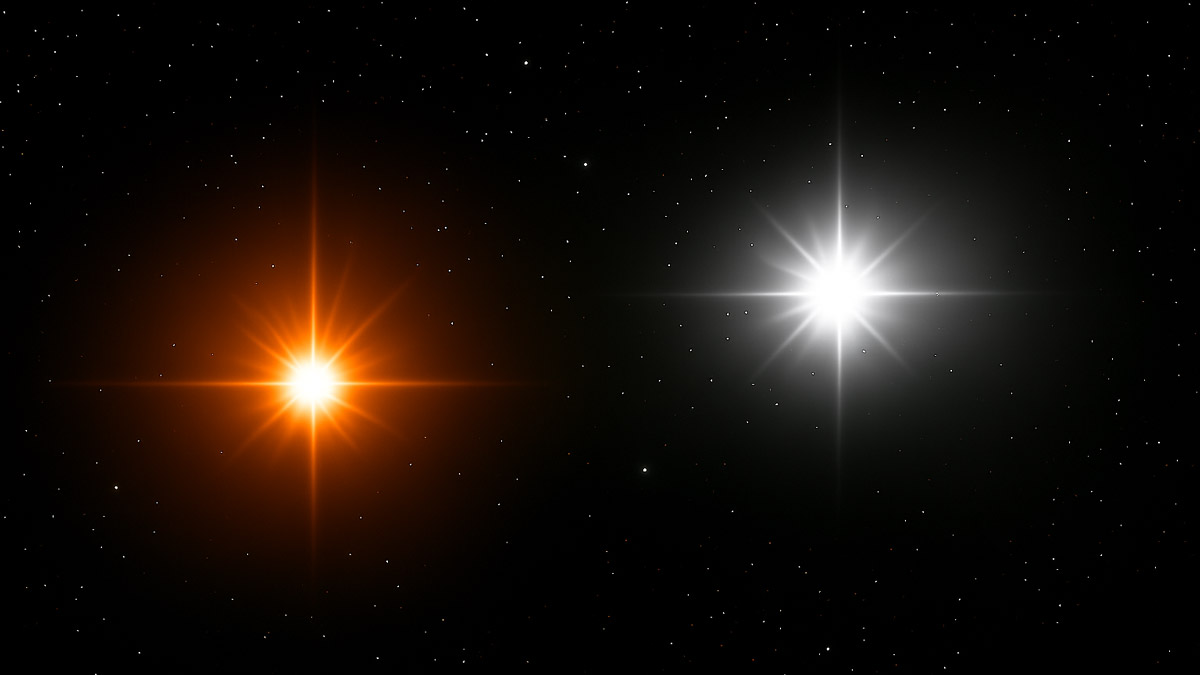
The constellation Canis Major (the “Greater Dog”) features one of my favorite clusters, M41, as it was one of the first clusters I spotted as a child. Among other nice doubles in the constellation lies Nu1 Canis Majoris (also known as ν1 Canis Majoris), which is viewable with the naked eye from darker sky locations.
Like our sun, the yellow-colored primary star is classified as a G-type star and shines at a magnitude of 5.7. At about 17 arcseconds away lies the yellow-white companion shining at magnitude 7.6. It is classified as a F-type star. The distance between the two stars allows smaller scopes to observe both.
Historically speaking, the astronomer William Herschel first discovered the binary all the way back on September 30, 1782.
My Observations
This binary system is quite beautiful and relatively easy to observe. The primary star appears to be a mix of orange and yellow, while the nearby secondary star looks predominantly white but has a hint of yellow.
| Date | February 2, 2024 |
| Time | 8:30 p.m. |
| Location | Seattle, WA |
| Magnification | 169x |
| Scope | Meade 8″ SCT |
| Eyepiece | 12mm |
| Seeing | Above Average |
| Transparency | Above Average |

Key Stats
| Constellation | Canis Major |
| Best Viewing | Winter / Spring |
| Visual Magnitude | +5.7 | +7.6 |
| Distance from Earth | 198 ly |
| Separation | 17.4″ |
| Milky Way Location | Orion Spur |
| My Viewing Grade | A- |
| Designations | Nu1 CMa, SHJ 73, SAO 151694, HIP 31560, HR 2423, HD 47138, 6 Canis Majoris, ν1 CMa |
Sources and Notes
Sketch by Wayne McGraw
 The Garden Astronomer