
The stunning Andromeda Galaxy is a favorite target for backyard astronomers during autumn and winter nights. Close by, racing across the sky, is Messier 33, also known as the Triangulum Galaxy or Pinwheel Galaxy. Both of these galaxies are special because they are our celestial neighbors. They belong to the Local Group of galaxies, including our Milky Way. Messier 33 is the third-largest galaxy in this group, containing 40 billion stars! It might sound far at around 3 million light-years away, but in galactic terms, it’s practically our next-door neighbor.
This spiral galaxy shines at a magnitude of 5.7 and is the fourth brightest galaxy in the night sky. One would think it would be easy to see from suburban locations, but there is a catch. Unfortunately, M33 has low surface brightness, so most folks have difficulty spotting the galaxy with a telescope. Those under dark skies, free from light pollution, will fare better in spotting this lovely spiral. I suggest reading Tony Flander’s blog post from Sky & Telescope on visualizing M33.
Italian astronomer Giovanni Battista Hodierna first recorded this remarkable galaxy in the 1600s. Hodierna was ahead of his time, cataloging faint celestial objects. Though his work remained relatively obscure for centuries, it laid the groundwork for later astronomical discoveries.
Fast forward to August 25, 1764, when the French astronomer Charles Messier added this celestial gem to his famous catalog of “fuzzy” objects that weren’t comets. Little did he know that Messier 33 would become one of the most studied galaxies in modern astronomy!1
My Observations
| Date | January 4, 2025 |
| Time | 9:26 p.m. |
| Location | Tampa Bay, FL |
| Magnification | 81x |
| Scope | Meade 8″ SCT |
| Eyepiece | 25mm |
| Seeing | Above Average |
| Transparency | Above Average |
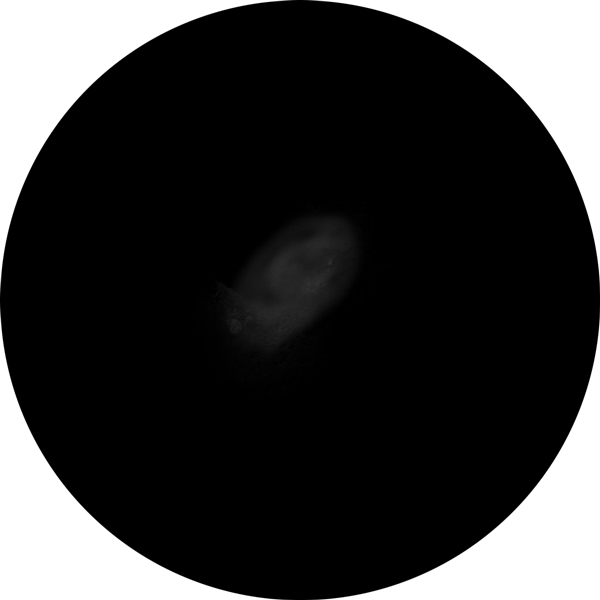
As expected, M33 is a tough target to see under suburban skies. Currently, the moon has set, and the sky is remarkably transparent. I’m using a 25mm eyepiece, and at first, I didn’t notice anything in my view. However, using peripheral vision and moving the scope right and left, I notice a very faint “smudge” moving in and out.
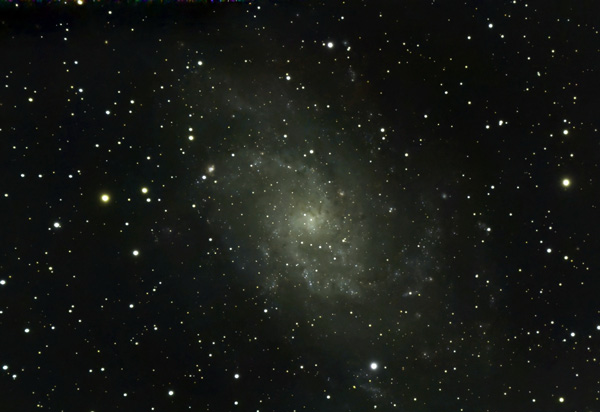
My sketch is an approximation of size, as I’m unsure of the edges. While I observe, I have my Seestar S50 nearby, photographing the galaxy, and the image is posted below. This picture is composed of 620 10-second exposures under suburban north Tampa skies. On nights like this, I’m grateful for the digital scope to see this beautiful galaxy.
Key Stats
| Constellation | Triangulum |
| Best Viewing | Autumn / Winter |
| Visual Magnitude | +5.7 |
| Absolute Magnitude | -18.88 |
| Distance from Earth | 2,800 kly |
| Diameter | 50.7 kly |
| Apparent Size | 62 x 36 arcmin |
| My Viewing Grade | C |
| Designations | M33, Pinwheel Galaxy, UGC 1117, PGC 5818, IRAS 01310+3024, NGCs 588, 592, 595, and NGC 603 |
Historical Observations
Charles Messier first observed the galaxy on August 25, 1764.
“Nebula discovered between the head of the Northern Fish [of Pisces] & the great Triangle, a bit distant from a star of 6th magnitude: The nebula is of a whitish light of almost even density [of brightness], however a little brighter along two-third of its diameter, & contains no star. One sees it with difficulty with an ordinary telescope of 1-foot [FL]. Its position was determined from Alpha Trianguli. Seen again September 27, 1780. (diam. 15′)”
For additional historical observations, please see this page.
Sources
Banner, sketch, and photo by Wayne McGraw
1 SEDS Messier Database. (n.d.). Messier 33. Retrieved January 5, 2025, from http://www.messier.seds.org/m/m033.html
 The Garden Astronomer