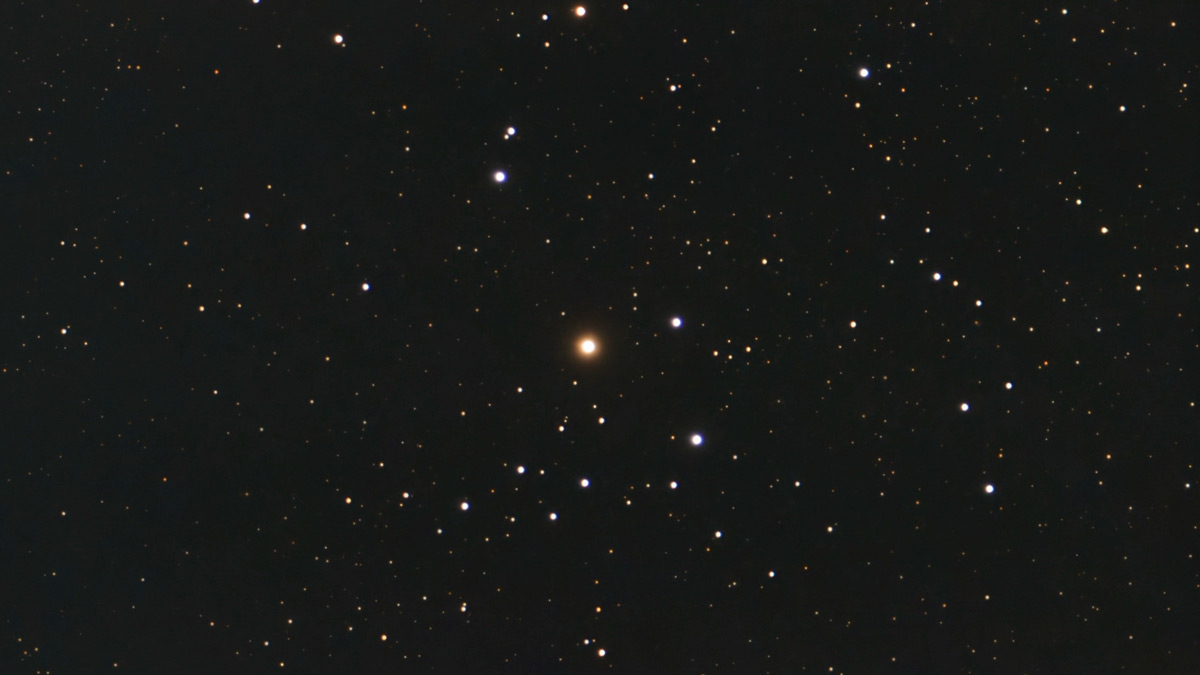
The shimmering star cluster NGC 2451 is located in the southern constellation of Puppis and is best observed during late autumn and winter nights. With its sparkling brilliance, this cluster captivates viewers, much like the swift and surprising sting of a scorpion—an unforgettable experience!
For those in northern latitudes, the cluster sits low on the horizon, adding a sense of adventure when trying to find it. In fact, as of this writing, this is the “lowest” astronomical object I’ve observed since starting this website. With a magnitude of 3, even modest binoculars or a small telescope will reveal its scattered stars.
Interesting facts about NGC 2451
The brightest star in the cluster, C Puppis, has a magnitude of 3.6, making it easily visible to the naked eye. This striking orange-red giant star belongs to the spectral type K4III and serves as a prominent guidepost for locating the cluster. This cluster contains around 40 stars of 6th to 11th magnitude.
What makes this cluster unique is that it is actually a celestial optical illusion; it consists of two distinct clusters that lie along the same line of sight. Astronomers refer to these clusters as NGC 2451A and NGC 2451B, which are situated at distances of approximately 600 and 1,200 light-years from Earth, respectively.
Historically speaking, Giovanni Battista Hodierna first observed the cluster in the mid-17th century, followed up by John Herschel in 1835.
My Observations
| Date | January 9, 2025 |
| Time | 9:59 p.m. ET |
| Location | Tampa Bay, FL |
| Magnification | 15x |
| Binoculars | 15 x 70 Celestion |
| Seeing | Average |
| Transparency | Average |
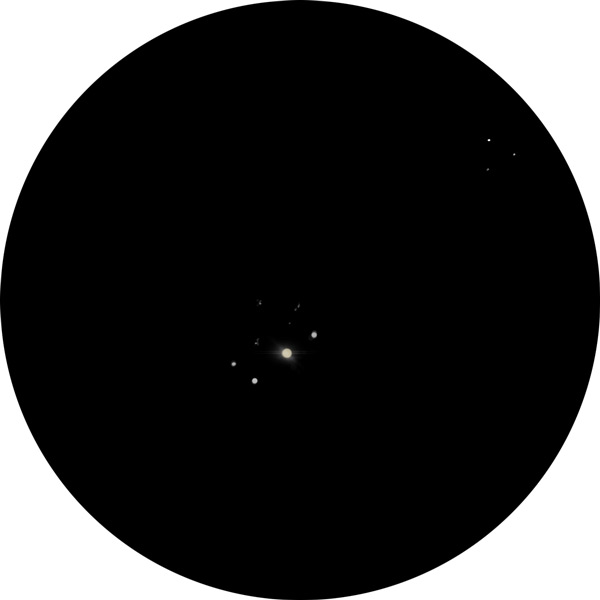
With the half-moon illuminating the sky above me, I decided to take advantage of my new location in Tampa to explore celestial objects near the horizon. While scanning my astronomy books, I discovered a beautiful cluster featuring a prominent orange star located in Puppis. Armed with my binoculars and digital scope, I began my journey southward, starting with Sirius. I continued past the star Wezen and eventually arrived at NGC 2451.

And there it is: a small cluster with an orange star on top! I’m thrilled that my binoculars can resolve several stars “floating” around C Puppis. In the upper right corner of my view, I can see a few stars that appear clustered together, but my research indicates that they do not actually form a star cluster.
Key Stats
| Constellation | Puppis |
| Best Viewing | Late autumn / Winter |
| Visual Magnitude | +3 |
| Absolute Visual Magnitude | +2.79 |
| Milky Way Location | Orion Spur |
| My Viewing Grade | B+ |
| Designations | Cr 161 |
Sources
Sketch and banner photo by Wayne McGraw.
 The Garden Astronomer