Ursa Major is a familiar sight in the northern night sky, home to the easily recognizable Big Dipper. While the stars of the Dipper often steal the show, the constellation is filled with other fascinating celestial objects, including one of my favorite galaxies, M51. Amongst all these significant objects is the binary star system 23 Ursae Majoris. The famous astronomer William Herschel first discovered the pair on April 25, 1781.
Located approximately 77 light-years away, 23 Ursae Majoris’ primary star, called 23 Ursae Majoris A, is a yellow-white subgiant. It’s more massive and luminous than our Sun, with about 1.9 times the Sun’s mass and radiating roughly 15 times the Sun’s luminosity.
Orbiting this primary star is a fainter companion, 23 Ursae Majoris B. This secondary star is much less luminous, appearing at about magnitude 9.2 compared to the primary’s magnitude of 3.6. The two stars are separated by an angular distance of about 22.8 arcseconds, making them resolvable as a double star through a small to medium-sized telescope.
My Observations
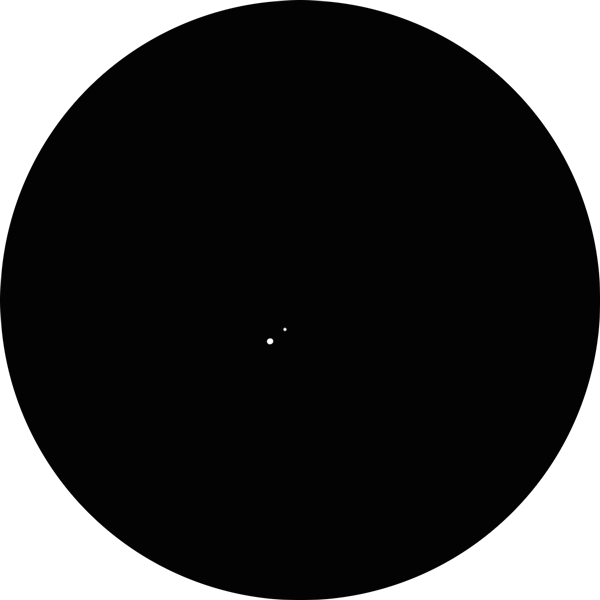
This is a nice binary star system that is easy to split. The two stars are an uneven pair, with the brighter primary star significantly outshining its companion. The primary appears bright white to me, while the dim secondary star is more challenging to identify. However, as I continue to observe it and allow my eyes to adjust, it seems to have a topaz-yellow hue.
| Date | March 15, 2025 |
| Time | 10:04 p.m. |
| Location | Seattle, WA |
| Magnification | 169x |
| Scope | Meade 8″ SCT |
| Eyepiece | 12mm |
| Seeing | Above Average |
| Transparency | Above Average |
Key Stats
| Constellation | Ursa Major |
| Best Viewing | Spring |
| Visual Magnitude | +3.6 | +9.1 |
| Distance from Earth | 77 ly |
| Separation | 22.7″ |
| Milky Way Location | Orion Spur |
| My Viewing Grade | B- |
| Designations | SAO 14908, HD 81937, 23 UMa, HIP 46733, HR 3757, h Ursae Majoris. |
Sources and Notes
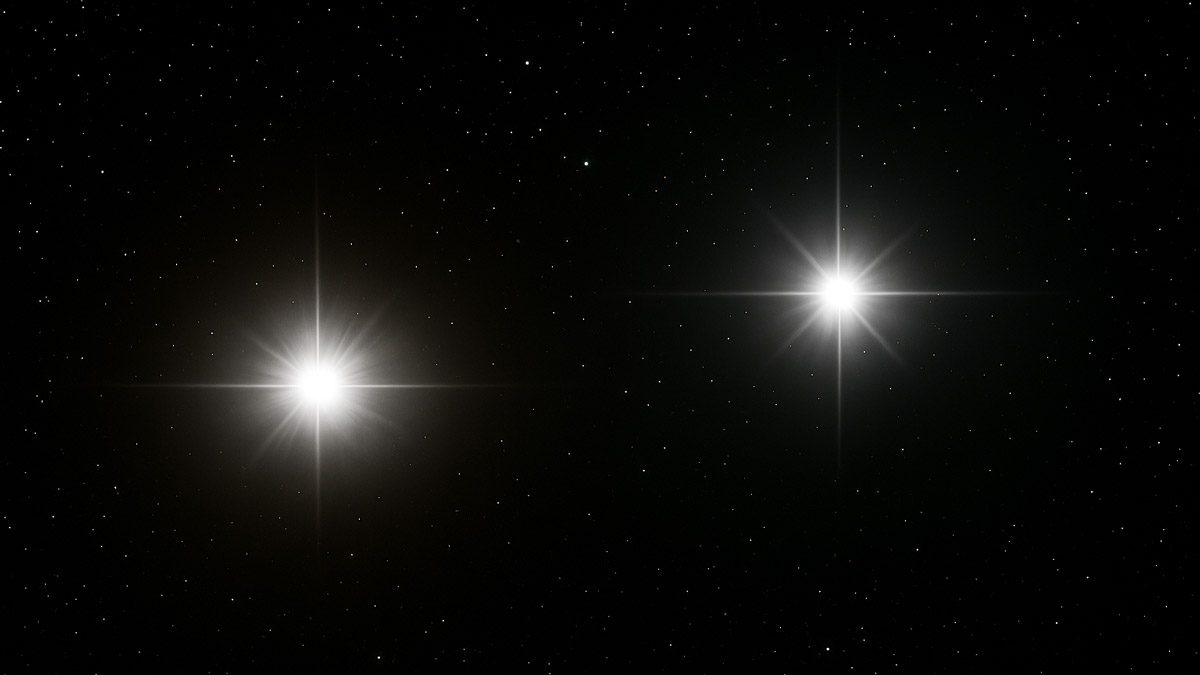
The double star banner on this page is an artist’s impression showing the double star OGLE-LMC-CEP0227 in our neighboring galaxy the Large Magellanic Cloud. This media was created by the European Southern Observatory (ESO). This file is licensed under the Creative Commons Attribution 4.0 International license.
Stelle Doppie. (n.d.). WDS 09315+6303 (23 Ursae Majoris). Retrieved from https://www.stelledoppie.it/index2.php?iddoppia=43962
Here is the APA citation for the Handprint website page on Herschel:
MacEvoy, B. (n.d.). [Material related to Herschel]. Handprint. https://www.google.com/search?q=https://www.handprint.com/ASTRO/Herschel_All.html
Sketch by Wayne McGraw
 The Garden Astronomer