As summer nights near, Scorpius, the Scorpion, rises along the southern horizon. The bright star Antares, located at the heart of Scorpius, serves as a guiding light on our journey through this fascinating constellation. Within its impressive claws lies a true gem visible even to modest telescopes: the captivating double star Beta Scorpii, traditionally known as Graffias or Acrab.
When you point your telescope at Graffias (Beta Scorpii), which shines at magnitude 2.6 and is easily visible to the naked eye, you’ll spot a second, fainter companion nearby. This dimmer star shines at a magnitude of 4.5 and sits approximately 13.5 arcseconds away—close enough to see both clearly in the same field of view. Both stars are hot, blue-white B-type stars, radiating intense energy and making for a striking pair through the eyepiece.
But there’s more to Acrab than meets the eye. Astronomers have discovered that each component of the Beta Scorpii pair is itself a multiple-star system. There is a nest of six stars in total, bound together by gravity. I suggest reading Jim Kaler’s summary for a good understanding of this fascinating system.
Historically speaking, the astronomer William Herschel first viewed the double on September 19, 1779.
My Observations
| Date | June 24, 2022 |
| Time | 10:40 p.m. |
| Location | Seattle, WA |
| Magnification | 127x |
| Scope | Meade 8″ SCT |
| Eyepiece | 16mm |
| Seeing | Above Average |
| Transparency | Above Average |
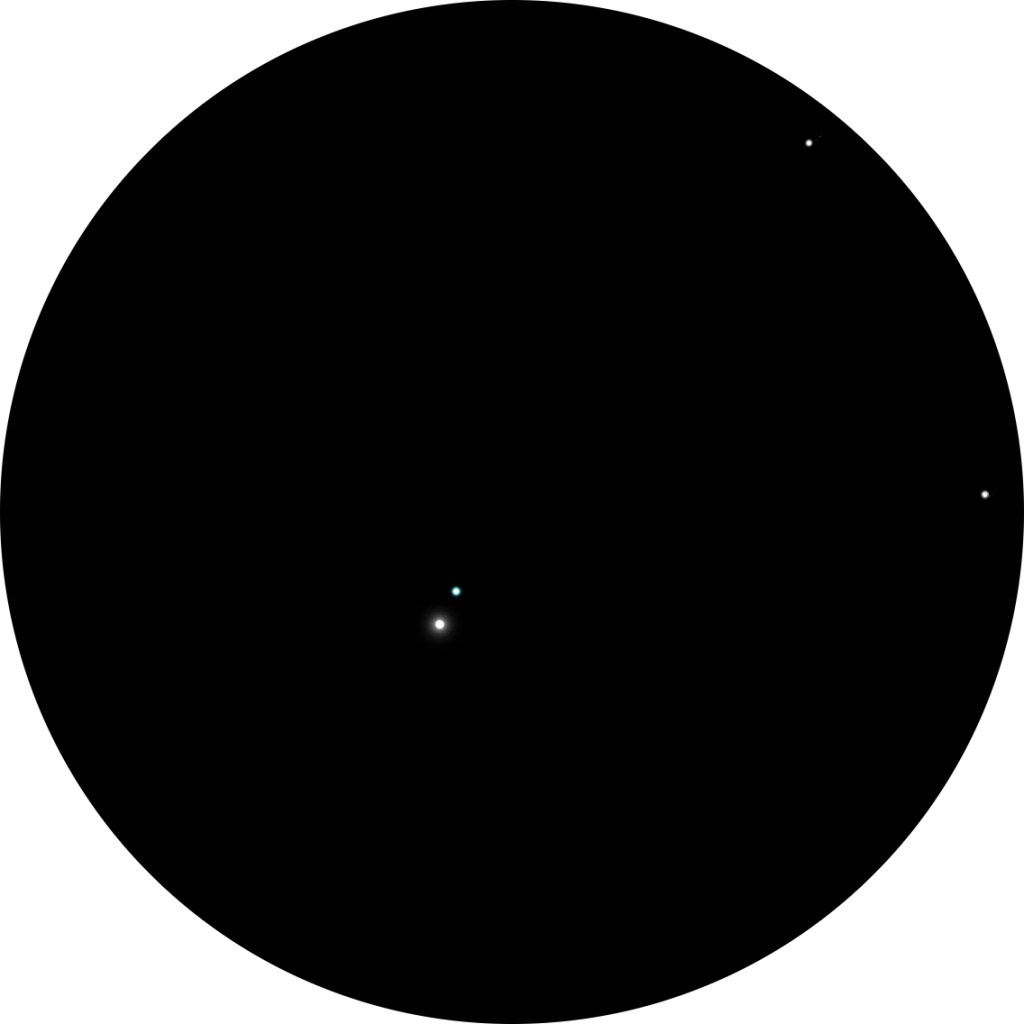
My first observation of Graffias (Beta Scorpii) occurred on June 24, 2022: As June settles in over Seattle, the skies finally begin to clear, offering a fresh view of the stars. To get a better look, I move my telescope from its usual spot near the garden to a more open area in the backyard, one that gives me a clearer view past the tall trees to the south. The bright flicker of Antares appears and disappears between the branches, so I use it to orient my telescope. But soon, I notice a clearer patch of sky above and decide to aim for Graffias (Beta Scorpii) instead. With my 16mm eyepiece in place, I adjust the scope and almost immediately, both stars in the pair come into view.
Through the telescope, the primary star of the pair shines brightly with a crisp white hue. The fainter companion appears to have a subtle mix of blue and green tones. Interestingly, others who observe this double star report seeing different colors—some describe the secondary as yellow instead of blue or white. It’s a great reminder that the appearance of double stars can vary based on their brightness, proximity, and even atmospheric conditions.
Key Stats
| Constellation | Scorpius |
| Best Viewing | Summer |
| Visual Magnitude | + 2.6 | +4.5 |
| Separation | 13.38″ |
| Position Angle | 19.7° |
| Distance | 404 ly |
| My Viewing Grade | A- |
| Designations | 8 Sco, Elacrab, HD 144217, HIP 78820, HR 5984, Bet1 Sco, Grafias, SAO 159682 |
Sources and Notes
Stelle Doppie. (n.d.). HD 144667. Retrieved June 1, 2025, from https://www.stelledoppie.it/index2.php?iddoppia=64939
 The Garden Astronomer