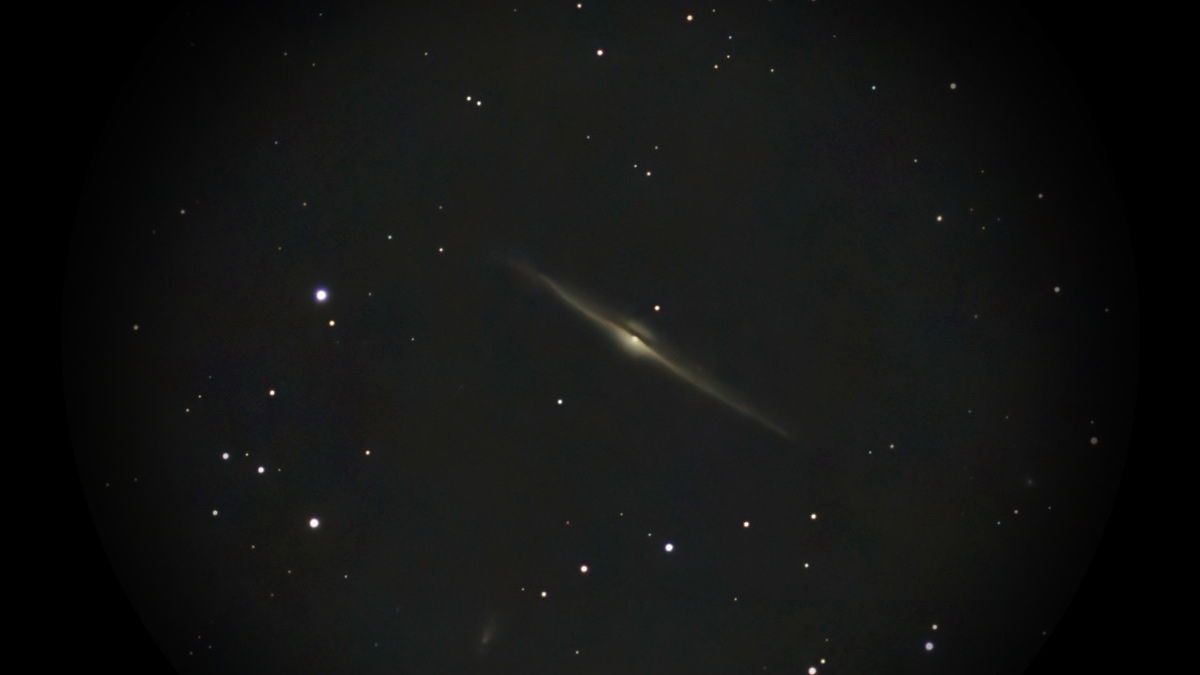
In the constellation of Coma Berenices lies a rich collection of deep sky objects. See M53, M85, and M64 to name a few. One of the most breathtaking targets is the edge-on spiral galaxy NGC 4565, also called the Needle Galaxy or Caldwell 38. It’s best viewed between March and May in the northern hemisphere.
In fact, it was in springtime when astronomer William Herschel discovered the slender sliver object during his visual sweeps of the night sky on April 6, 1785. At the time, he had no idea this glowing streak was a separate galaxy as astronomers still believed most nebulae were part of our Milky Way. It wasn’t until the 20th century, thanks to Edwin Hubble and others, that we came to understand galaxies like NGC 4565 as “island universes” far beyond our own galaxy.
NGC 4565 lies about 30 to 40 million light-years away. Instead of seeing the familiar spiral arms face-on, we’re treated to the vertical cross-section of a galaxy, showing us just how thin and flat these star systems really are. The galaxy spans over 100,000 light-years across, roughly the size of our own.
Even in a small telescope (4–6 inches), under dark skies, the Needle Galaxy reveals its long, elegant shape. Larger scopes (8 inches and up) can show more detail, including the soft glow of the central bulge and hints of the dark dust lane that cuts across the disk. In my 8-inch SCT, I was only able to see the streak of light with a slighter brighter buldge in the middle due to suburban light pollution, but it still was a great target—my sketch is below. Using a large telescope or imaging equipment like the Seestar S50, one can also view the galaxy, NGC 4562. More on that at the bottom of this article.
When you gaze at NGC 4565, you’re not just looking at a distant galaxy — you’re catching a side-profile glimpse of what our own galaxy might look like from far away. It’s a humbling reminder of our place in the cosmos, and a visual treat for anyone with a telescope and a sense of wonder.
My Observations
| Date | June 16, 2025 |
| Time | 9:59 p.m. |
| Location | Tampa, FL |
| Magnification | 82x |
| Scope | Meade 8″ SCT |
| Eyepiece | 25mm |
| Seeing | Average |
| Transparency | Average |
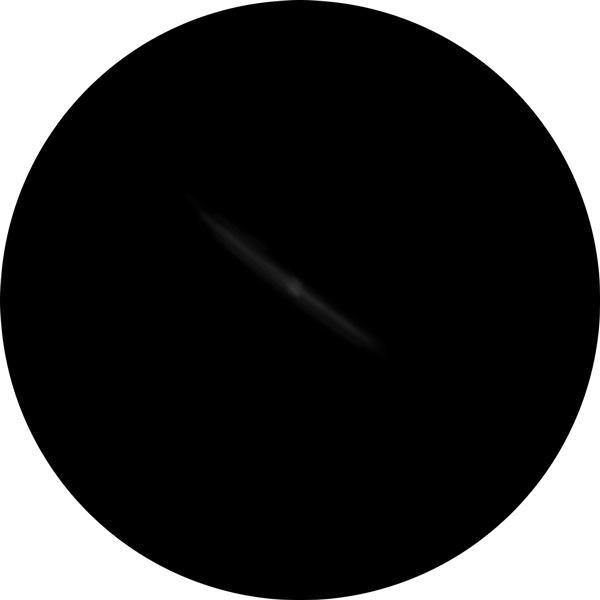
On this night, I started my search, knowing that even a relatively large galaxy like this could be elusive under less-than-ideal conditions. My Meade’s computer didn’t position the scope exactly in the area, so I slowly scanned back and forth until the faint, elongated smudge finally drifted into view. It wasn’t the breathtaking, dusty spiral I’d seen in astrophotographs, but there it was: an undeniably slender line of light, with a subtle but definite brighter bulge in the middle.
Even through the haze of light pollution, the distinctive shape of NGC 4565 was apparent, a testament to its true grandeur. Observing such a distant and magnificent galaxy, even as a ghostly outline, was a satisfying experience.
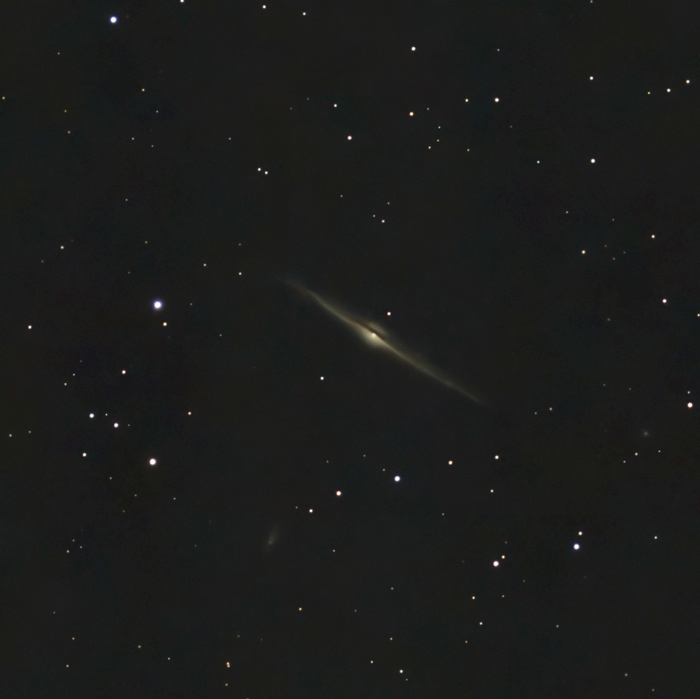
Note about NGC 4562 shown as a faint smudge below and left of the Needle Galaxy:
While the Needle Galaxy often steals the spotlight due to its dramatic edge-on presentation, its neighbor NGC 4562 is also an interesting celestial object. Located in the constellation Coma Berenices, NGC 4562 is classified as a barred spiral galaxy. It’s considerably fainter than NGC 4565, with an apparent visual magnitude of around 13-14, making it a more challenging target for amateur astronomers. It’s a member of the Coma I Group of galaxies, a collection that also includes the more prominent Needle Galaxy. Its presence near the famous NGC 4565 offers a nice opportunity to observe a contrasting galaxy type within the same field of view.
Key Stats
| Constellation | Coma Berenices |
| Best Viewing | Spring |
| Visual Magnitude | +9.08 |
| Absolute Magnitude | -21.33 |
| Distance from Earth | ~ 39 million ly |
| Diameter | ~ 191,000 ly |
| Apparent Size | 16.8 x 2.9 arcmin |
| My Viewing Grade | A- |
| Designations | Caldwell 38 (C38), UGC 7772, PGC 42038 |
Sources
Sketch and Seestar photo by Wayne McGraw
 The Garden Astronomer