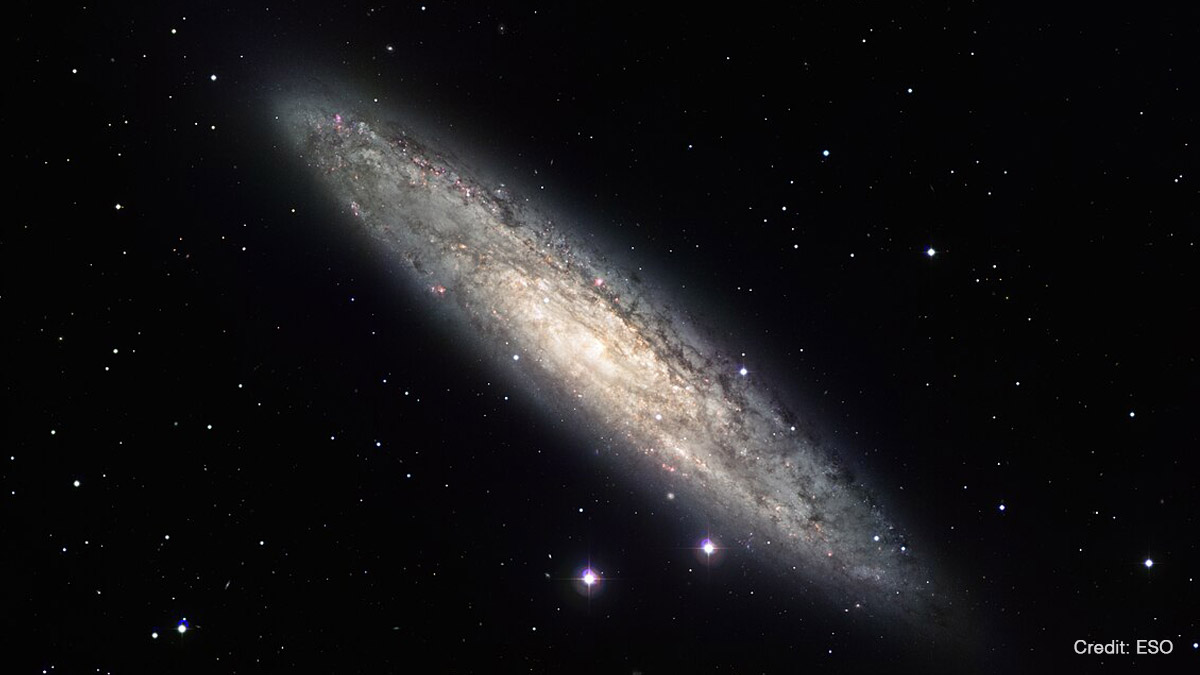
Nestled in the southern constellation Sculptor, the Silver Coin Galaxy, also known as the Silver Dollar Galaxy, shines as one of the closest and brightest spiral galaxies beyond the Milky Way. It is located approximately 11.4 million light-years from Earth and has an apparent magnitude of +8.0, allowing those with binoculars or small telescopes to peer at the galaxy under fall and winter skies.
A Star-Making Powerhouse
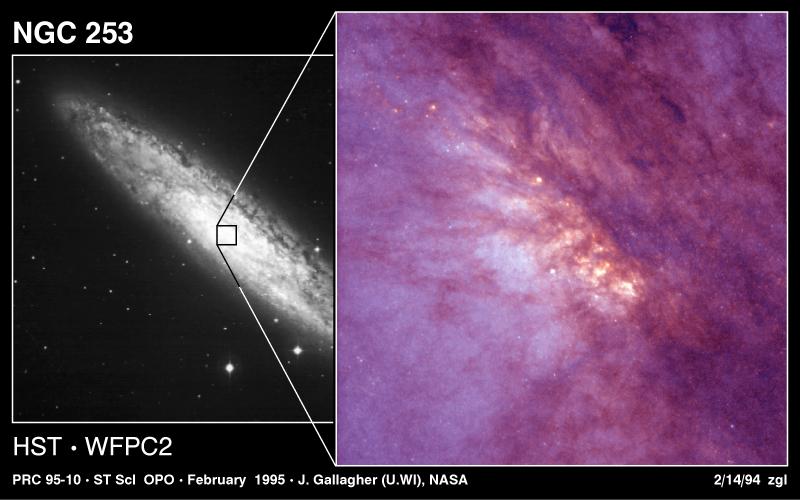
NGC 253 isn’t just a regular spiral galaxy; it’s a starburst galaxy. This means it’s creating new stars at an incredible rate. This intense star birth gives astronomers a perfect laboratory to study how gas is converted into stars and how powerful stellar winds shape the galaxy around them. The color image below, captured by NASA’s Hubble Space Telescope, shows intense star formation erupting across a central region roughly 1,000 light-years wide.
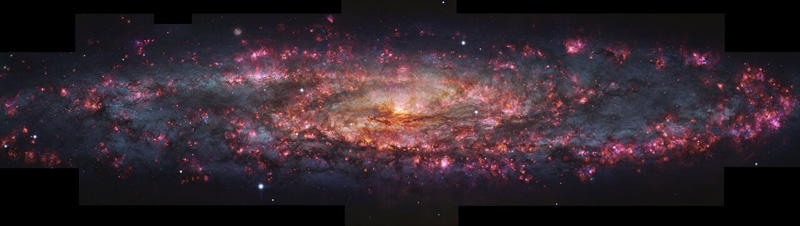
In 2025, astronomers produced the striking image below, which presents an intricate thousand-color view of the Sculptor Galaxy. The widespread patches of pink light represent glowing ionized hydrogen gas, highlighting active star-forming regions across the galaxy. These vibrant zones are layered over a detailed map of mature stars, producing the rich blend of pink and blue hues visible throughout the galaxy.
History of Its Discovery
Caroline Herschel discovered this remarkable galaxy on September 23, 1783. A year later, on October 30th, her brother William recorded his own observation as a bright, elongated “nebula.” This entry eventually became part of the famous New General Catalogue (NGC) in 1888.
NGC 253 is a reminder that galaxies are not static pinwheels in space. Instead, they are alive, dynamic, and sometimes, bursting at the seams with stars.
My Observations
Observation on November 23, 2024: On this Tampa night beneath suburban skies, I have my Seestar S50 sitting beside me. My trusted visual companion, the Meade 8-inch SCT, is out of commission tonight—its absence felt like a friend missing from a long-anticipated gathering. But the Seestar is ready, and I’m eager to embrace what the night has to offer. This time, it’s not the cloudy gray of Seattle in November. Those skies I know all too well, but this time I’m looking up at Florida’s southern sky vault, which to me, opens a rare and generous window to observe at this time year.
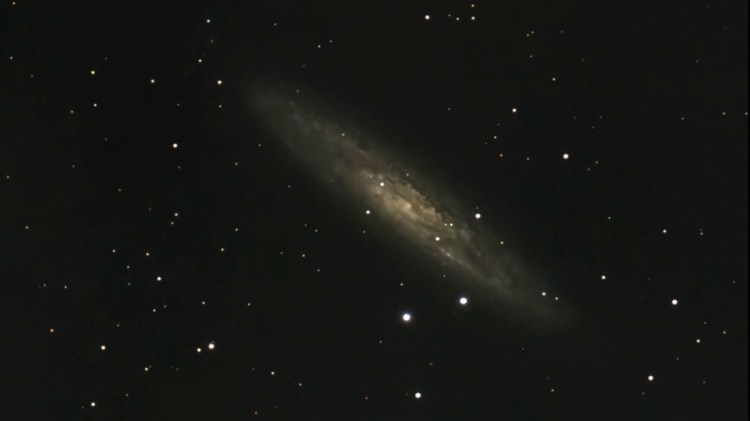
The Seestar captures NGC 253’s dusty and elongated figure, its heart faintly glowing with the light of furious starbirth. And yet, as gratetful as I am for this photo, I miss the intimate connection of eyepiece to eye, the thrill of light that has traveled millions of years finally touching the back of my own eye. Still, I feel joy. This is a night to remember. I will return to NGC 253, perhaps with my Meade again, to see it not only with my eyes but with wonder renewed.
Key Stats
| Constellation | Sculpter |
| Best Viewing | Autumn |
| Visual Magnitude | +8 |
| Absolute Magnitude | -21.2 |
| Distance from Earth | 25 million ly |
| Diameter | 70,000 ly |
| Apparent Size | 27.5′ × 6.8′ arcmin |
| Designations | Caldwell 65, UGCA 13, ESO 540-30, PGC 2789, LEDA 2789 |
Sources
Banner photo credit: ESO. Source.
Seestar photo by Wayne McGraw
 The Garden Astronomer
3 thoughts on “NGC 253: A Starburst Galaxy in Sculptor”