
Tucked within the winter constellation Taurus, NGC 1758 is an open star cluster that doesn’t make headlines like the Pleiades or Hyades. Lying about 2,500 light-years away, this cluster offers a window into the midlife of stars and the dynamic evolution of our galaxy’s spiral arms.
According to the Deep Sky Corner website, William Herschel discovered the open clusters NGC 1758 (VII 21) and NGC 1750 (VIII 43) on December 26, 1785, using his “18.7-inch speculum reflector at Slough, UK.” He described NGC 1758 as a “cluster of pretty compressed stars with many extremely small stars mixed with them.”
What sets NGC 1758 apart is its age and density. Estimated to be around 700 million years old, it’s a mature open cluster, with stars that have moved past their early chaotic youth but haven’t yet drifted apart. These stars were born from the same molecular cloud and still hang together in a loose gravitational bond, offering astronomers a clean sample of similar-age stars for studying stellar evolution, while some may already be transitioning into red giants.
While it’s not visible to the naked eye, NGC 1758 can be spotted with a decent amateur telescope under dark skies. You’ll find it near the star cluster M45 (the Pleiades), forming part of the complex stellar backdrop that makes Taurus a go-to constellation for winter skywatchers.
NGC 1758 might not have the flash of its famous neighbors, but for those who seek out lesser-known cosmic wonders, it’s a rewarding target. In astronomy, sometimes the best discoveries are the ones hidden in plain sight—quiet, ancient, and still glowing.
My Observations
| Date | December 28, 2000 |
| Time | 7:42 p.m. |
| Location | Seattle, WA |
| Magnification | 145x |
| Scope | Meade 8″ SCT |
| Eyepiece | 14mm |
| Seeing | Average |
| Transparency | Average |
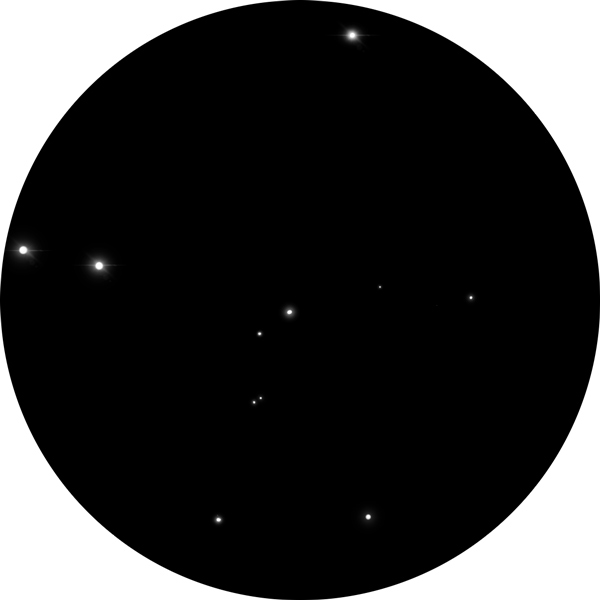
A full moon dominates the sky, casting a silver wash that drowns out the fainter stars. Only the brighter members of the cluster break through the glare, and I find myself questioning whether I’m truly seeing the full extent of NGC 1758—or just a portion of it. Its proximity to NGC 1750, nearly overlapping in the field, makes it difficult to distinguish where one cluster ends and the other begins.
The moonlight blurs the boundary between the two, and the dimmer stars that would normally sketch out the full shape are invisible tonight. Still, the brighter points shine through steadily, giving me at least a glimpse into this intriguing region.
It’s not lost on me that I’m looking at the same cluster William Herschel observed on December 26, 1785—exactly 215 years and 2 days ago. The thought adds depth to the moment. Herschel saw this very patch of sky with a far different telescope, under far darker skies, yet the stars we share are the same. Across two centuries, under different moons, we meet in this light.
Key Stats
| Constellation | Taurus |
| Best Viewing | Winter |
| Distance from Earth | ~2,477 ly |
| Diameter | ~6 ly |
| Apparent Size | ~ 9 arcmin |
| Milky Way Location | Orion Spur |
| My Viewing Grade | B |
| Other Designations | OCL 469, nearby NGC 1750 |
Sources and Notes
Banner photo from Egres73. Image licensed under the Creative Commons Attribution-Share Alike 3.0 Unported license.
Sketch by Wayne McGraw
 The Garden Astronomer