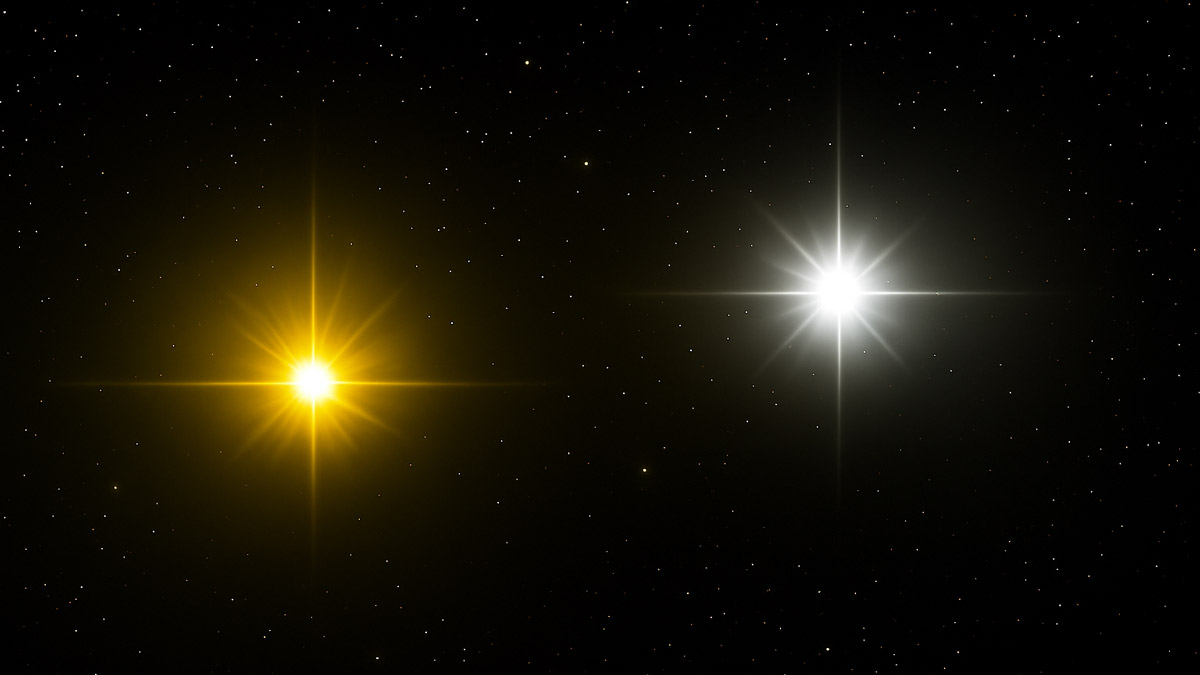
Tucked within the constellation Serpens is the binary star Struve 1931 (also cataloged as Σ 1931 or STF 1931). First recorded in 1799, this system makes a rewarding target for mid‑northern observers—especially on spring and early‑summer evenings—thanks to its brightness and the generous separation between its two components.
The primary shines at roughly magnitude 7.2, while the secondary registers around magnitude 8.0, making both stars accessible in small, backyard telescopes. The brighter star is classified F7V, indicating a mature, hydrogen‑fusing dwarf that is somewhat hotter, more luminous, and slightly more massive than the Sun. Its companion is a G3V star—a yellow, main‑sequence object very much like our Sun, albeit a touch hotter and brighter. According to my research, the two stars are physically related and a true binary.
Separated by approximately 13.3 arcseconds, the pair presents just enough challenge to delight smaller scopes: under steady skies and moderate magnification, the two stars cleanly split and reveal their individual colors.
My Observations
| Date | June 18, 2024 |
| Time | 11:26 p.m. |
| Location | Seattle, WA |
| Magnification | 169x |
| Scope | Meade 8″ SCT |
| Eyepiece | 12mm |
| Seeing | Above Average |
| Transparency | Above Average |
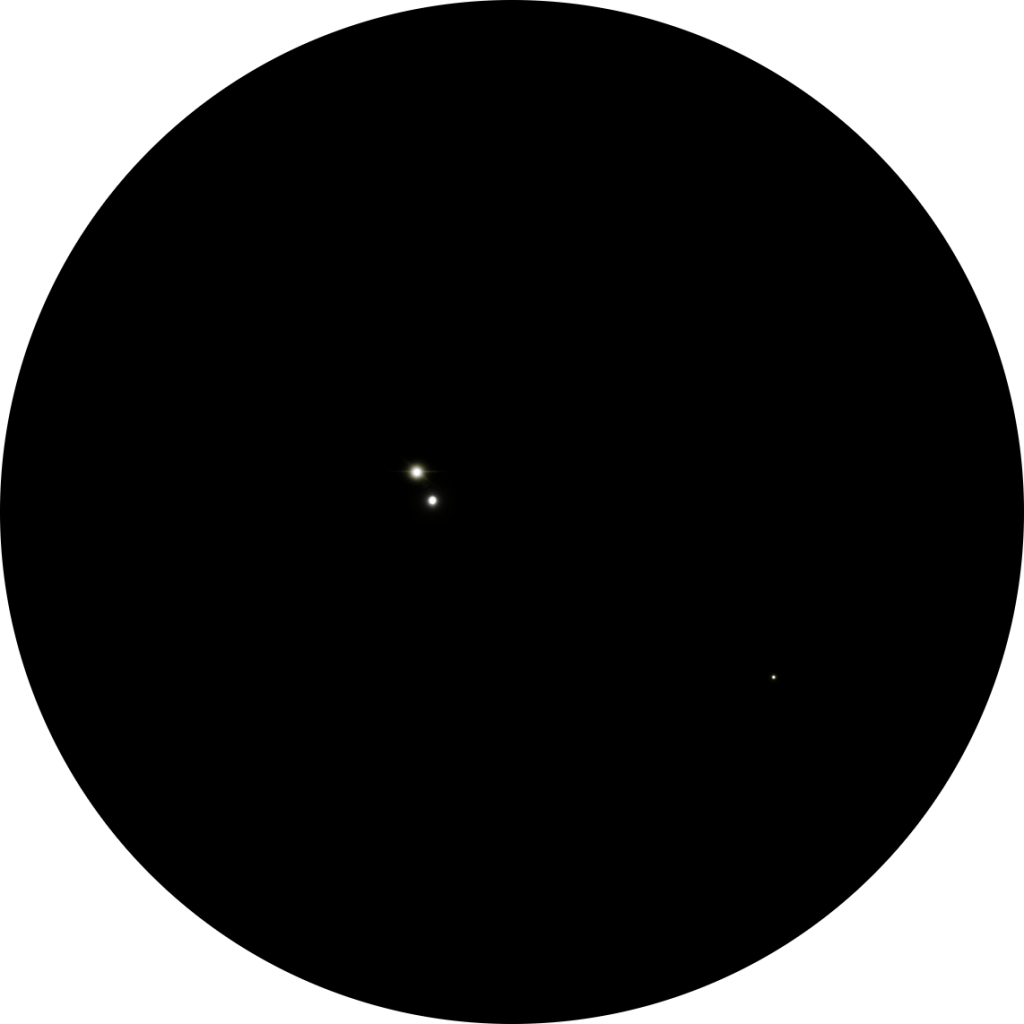
Through the eyepiece, observers are greeted with two stars of similar brightness. The slightly larger primary star appears to have a yellow tinge to it, while the smaller secondary appears a duller white. According to the Stelle Doppie website, STF 1931 is a triple system with a magnitude +12.7 star 172 arcseconds away. There is a very faint star in the lower right side of my eyepiece (shown in the sketch above), and I’m debating if this is the third star in the system.
Key Stats
| Constellation | Serpens |
| Best Viewing | Late Spring, Summer |
| Visual Magnitude | +7.2 | +8.0 |
| Distance from Earth | 163 ly |
| Separation | 13.3″ |
| Position Angle | 165.5° |
| Milky Way Location | Orion Spur |
| My Viewing Grade | B |
| Designations | SAO 101480, HD 136160, HIP 74930, STF 1931 |
Sources and Notes
Sketch by Wayne McGraw
 The Garden Astronomer